 0
0
 0
0
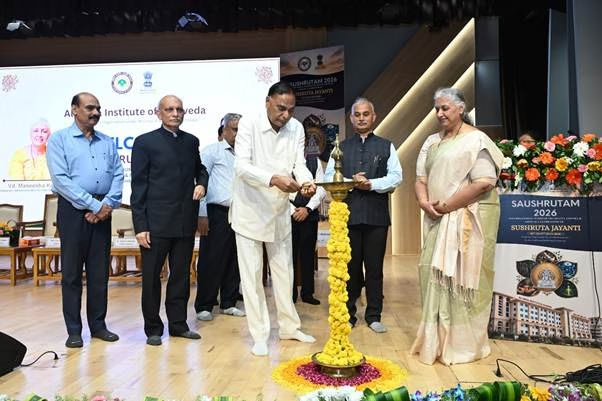
NEW DELHI — In a major step toward building a multidisciplinary, evidence-based healthcare ecosystem, the All India Institute of Ayurveda (AIIA) successfully concluded its high-profile three-day international seminar, “Saushrutam 2026.” Held from July 15 to July 17, 2026, under the aegis of the Ministry of Ayush, the global summit brought together top surgical minds, medical researchers, and policymakers to advance the surgical legacy of Acharya Sushruta, widely recognized as the “Father of Surgery.”
The conference highlighted a rapidly growing trend in global healthcare: the integration of time-tested traditional medical systems with contemporary, cutting-edge surgical technology. Occurring on the auspicious occasion of Sushruta Jayanti, the seminar served as a scientific forum where traditional Shalya Tantra (Ayurvedic surgery) met modern surgical specializations.
Restoring the Identity of the Ayurvedic Surgeon
For decades, modern public perception has largely categorized Ayurvedic practitioners strictly as physicians who utilize herbal remedies and lifestyle interventions. However, historical and clinical realities paint a far more complex picture. Acharya Sushruta’s foundational text, the Sushruta Samhita (dated to the 1st millennium BCE), meticulously outlines over 120 surgical instruments, complex plastic surgery techniques (such as rhinoplasty), and procedures for cataract removal, fractures, and bladder stones.
Speaking at the valedictory session on July 17, Vd. Maneesha Kothekar, Chairperson of the National Commission for Indian System of Medicine (NCISM), emphasized that high-caliber academic gatherings are shifting modern public perception.
“Seminars such as Saushrutam should be organised regularly as they provide valuable exposure to students and strengthen academic and professional engagement in the field of Ayurveda,” Kothekar stated. “Such initiatives are helping society recognise Ayurvedacharyas not only as physicians but also as skilled surgeons.”
To broaden the impact of this academic integration, the conference witnessed the release of several critical publications. Among them was Neetra Rogya: Samanya Jankari aur Niwaran, an public-facing text written in accessible language designed to disseminate scientific information regarding eye diseases, improve public health literacy, and dispel common misconceptions about traditional ocular treatments.
A Cross-Disciplinary Meeting of Medical Minds
The three-day seminar, preceded by a hands-on pre-conference workshop on July 14, stood out for its strictly collaborative framework. Rather than operating in an isolated silo, the event featured an extensive academic exchange between traditional experts and leading modern surgeons from India’s premier medical institutions, including:
-
The All India Institute of Medical Sciences (AIIMS)
-
Sir Ganga Ram Hospital, New Delhi
-
Sanjay Gandhi Postgraduate Institute of Medical Sciences (SGPGI), Lucknow
-
Government Medical College, Agartala
International delegates and resource persons from nine countries—including the United Kingdom, Greece, Austria, Israel, Thailand, Indonesia, Sri Lanka, Nepal, and India—participated in the deliberations.
Prof. (Vd.) P.K. Prajapati, Director of AIIA, explained that the vision behind Saushrutam 2026 extends beyond mere historical celebration. The core objective is to create a rigorous, global platform to foster scientific dialogue, facilitate the exchange of evidence-based surgical practices, and showcase emerging technological innovations while strengthening academic collaboration between Ayurveda and modern surgical sciences.
High-Tech Collaboration: AIIA and IIT Delhi Renew Alliance
Demonstrating that the future of traditional surgery relies heavily on objective technological validation, the AIIA officially renewed its Memorandum of Understanding (MoU) with the Indian Institute of Technology (IIT) Delhi for another five years.
This sustained partnership will focus on collaborative engineering and biomedical research, including the modernization of surgical tool design, the objective evaluation of wound-healing formulations, and the technological standardization of classical procedures like Kshara Sutra therapy—a specialized medicated seton therapy widely utilized for the management of complex fistulae-in-ano.
Independent public health experts view this cross-pollination of disciplines as crucial for patient safety and clinical progress.
“The integration of engineering with traditional medical systems is where true innovation occurs,” says Dr. Arvinder Singh, a Delhi-based independent health systems consultant and former public health policy researcher, who was not involved in organizing the seminar. “When an institution like IIT applies its rigorous material science and engineering benchmarks to traditional surgical frameworks, it elevates patient safety, refines instrument ergonomics, and provides the objective data required for global medical acceptance.”
Public Health Implications and the Road to Integrated Care
For the general public, the professional convergence showcased at Saushrutam 2026 carries distinct practical health implications. A holistic, integrated healthcare system allows patients to potentially benefit from a dual approach: leveraging the precise diagnostic capabilities and acute interventions of modern medicine alongside the tissue-protective, minimally invasive, and rehabilitative strengths of Ayurveda.
For instance, peer-reviewed clinical data published over the years by institutions like the Indian Council of Medical Research (ICMR) has shown that for specific conditions like Bhagandara (fistula-in-ano), the Ayurvedic Kshara Sutra technique exhibits recurrence rates that are comfortably comparable to, or in some cohorts lower than, conventional surgical procedures like fistulectomy, while preserving sphincter control and offering an ambulatory (walk-in, walk-out) care model.
Prof. (Dr.) Yogesh Badwe, Organising Chairman of Saushrutam 2026, reiterated that the ultimate goal remains “improving the quality of surgical practices in Ayurveda and strengthening the Ayurvedic surgical fraternity” to ensure optimal, safe delivery of care to the public.
Clinical Limitations and Counterarguments
Despite the enthusiastic optimism surrounding the event, the integration of traditional surgical methods faces considerable debate within the broader medical community.
Critics from contemporary medical bodies frequently point out that while ancient frameworks laid the groundwork for modern surgery, the mainstream execution of major surgeries—such as cardiothoracic, neurosurgery, or advanced oncology—requires mastery over modern anesthesiology, intensive critical care, sterile techniques, and complex pharmacology that are native to modern allopathic medicine.
Furthermore, global medical experts caution that training pathways must remain strictly defined to prevent “mixopathy”—a term used by critics to describe the blurred lines between different medical systems. Public health authorities emphasize that any expansion of surgical privileges or modern cross-training must be backed by transparent, standardized clinical trials, uniform curriculum controls under bodies like the NCISM, and an uncompromised focus on patient safety outcomes above all else.
By actively addressing these limitations through rigorous, collaborative research protocols with institutions like IIT Delhi and AIIMS, the organizers of Saushrutam 2026 hope to establish a transparent, evidence-based pathway forward, ensuring traditional surgical wisdom safely enriches modern medical practice.
References and Sources
Institutional & Statistical Sources
-
Press Information Bureau (PIB) Delhi, Ministry of Ayush: Event Record: “All India Institute of Ayurveda Successfully Concludes Three-Day International Seminar ‘Saushrutam 2026’” (Posted July 17, 2026).
Medical Disclaimer: This article is for informational purposes only and should not be considered medical advice. Always consult with qualified healthcare professionals before making any health-related decisions or changes to your treatment plan. The information presented here is based on current research and expert opinions, which may evolve as new evidence emerges.