 0
0
 0
0
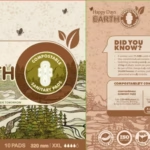
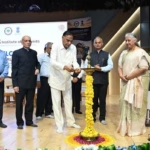
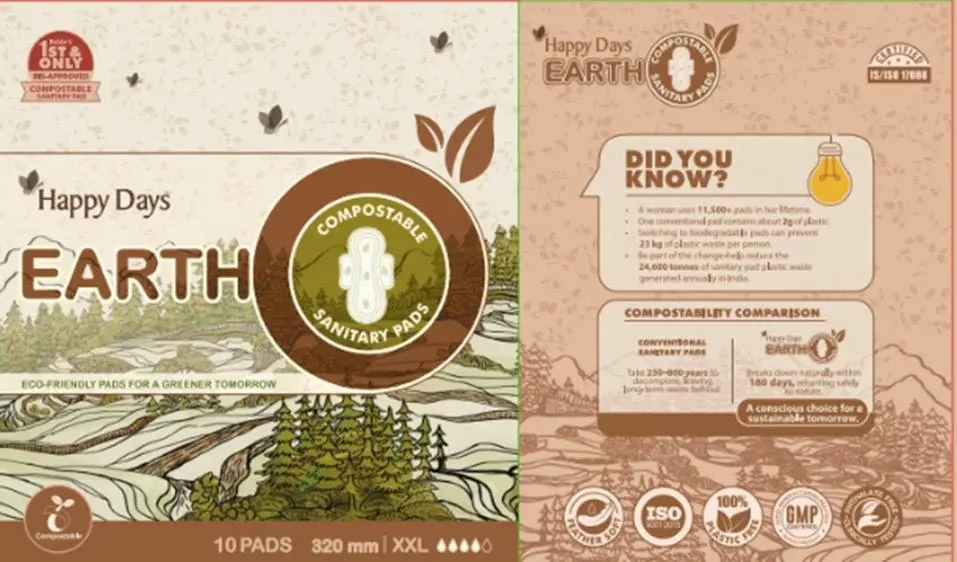
NEW DELHI — In a major development for public health and environmental sustainability, HLL Lifecare Ltd., a central public sector enterprise under India’s Ministry of Health and Family Welfare, announced the launch of “Happy Days Earth” on July 17, 2026. The new product is a fully compostable sanitary napkin engineered to meet strict quality guidelines while directly tackling the mounting crisis of plastic menstrual waste. By achieving compliance with the Bureau of Indian Standards (BIS), this public-sector initiative marks a pivotal shift: moving menstrual hygiene policy beyond basic affordability and access toward long-term material sustainability and expanded consumer choice.
The launch aligns closely with updated global frameworks. The World Health Organization (WHO) recently reiterated in its June 2026 updated fact sheet that menstrual health is not merely a matter of hygiene, but a fundamental element of health, dignity, and overall well-being. By integrating ecological responsibility with physical health, this new manufacturing direction addresses both consumer demand and critical infrastructure gaps in one of the world’s largest menstrual care markets.
Engineering a Greener Period: What the Technology Claims
Conventional disposable sanitary pads rely heavily on petroleum-based plastics and synthetic Super Absorbent Polymers (SAPs) to manage fluid. These materials can take up to 500 years to decompose in landfills. In contrast, HLL’s Happy Days Earth introduces an entirely plant-derived material architecture designed to break down rapidly without sacrificing performance.
According to company specifications, the pad is constructed from three primary layers:
-
-
Top Sheet: Crafted from plant-derived fibers that sit comfortably against the skin.
-
Absorbent Core: A cellulose-based center that replaces traditional synthetic gel polymers.
-
Back Sheet & Packaging: Utilizing compostable leak-proof layers designed to integrate safely into organic waste streams.
-
During standardized testing, the product achieved more than 91% biodegradation within 156 days, benchmarking effectively against rigorous compostability standards like ISO 17088. Furthermore, HLL reported an fluid absorbency of 35 milliliters (ml). This exceeds the minimum requirement of 30 ml mandated under the newly updated Indian regulatory framework, IS 5405:2025, which standardizes specifications for disposable pads, panty liners, maternity pads, and period panties.
Balancing the Alternatives: What the Medical Evidence Shows
For consumers looking to minimize their environmental footprint, compostable pads represent just one avenue. Reusable menstrual options, particularly menstrual cups, have accumulated a substantial body of independent clinical validation over the last decade.
For individuals weighing their choices, the medical literature highlights high efficacy and safety across diverse groups:
-
The Lancet Public Health Meta-Analysis: A comprehensive systematic review spanning 43 distinct studies and 3,319 participants demonstrated that menstrual cups are highly safe and present leakage rates that are similar to, or even lower than, conventional disposable pads or tampons. Notably, 73% of participants expressed a desire to continue using the cup after the conclusion of the trials. However, researchers noted a clear learning curve, with many users requiring several menstrual cycles to achieve complete comfort.
-
Revista Colombiana de Obstetricia y Ginecología Review: A separate evaluation found that while the initial acceptability of menstrual cups ranged widely (35% to 90%), long-term continued use stabilized between 48% and 94%.
The Public Health Consensus: Sustainable menstrual care is clinically sound and highly effective, but its success relies heavily on comprehensive education, physical comfort, and reliable access to private sanitation facilities.
Expert Perspectives and Real-World Caveats
While health professionals welcome the expansion of eco-friendly alternatives, they urge a balanced approach. “A compostable pad offers an excellent middle ground for individuals who prefer the familiarity of a disposable product but want to reduce plastic waste,” notes Dr. Ananya Sen, an independent public health specialist not involved in the HLL launch. “However, product choice is highly individual. A person’s age, anatomical comfort, daily flow volume, and access to clean water must dictate what they use.”
Furthermore, epidemiologists emphasize that laboratory success does not automatically guarantee ecological success. Laboratory-controlled biodegradation requires specific temperature, moisture, and microbial conditions. In the real world, if a compostable pad is wrapped in standard plastic or thrown into a typical tightly packed landfill devoid of oxygen, its decomposition will be significantly delayed. The true public health and environmental value of this product will heavily depend on developing localized collection, sorting, and municipal composting systems.
Medical experts also point out a notable scientific limitation: HLL’s performance results are currently corporate-reported. The public data lacks independent replication, peer-reviewed trial publications, or long-term tracking of user skin health and irritation profiles. Healthcare providers emphasize that people experiencing specific clinical conditions—such as menorrhagia (abnormally heavy menstrual bleeding), recurrent vulvovaginal irritation, or pelvic pain—should consult their physician before modifying their menstrual routines.
Moving Forward: What This Means for Your Daily Health
For the everyday consumer, the expansion of the sustainable hygiene market offers empowering options, but individual needs should always come first.
| Product Type | Primary Environmental Benefit | Key Practical Considerations | Best Suited For |
| Compostable Pads (e.g., Happy Days Earth) | Breaks down in months; avoids synthetic plastics and SAP gels. | Requires proper organic disposal pathways; higher single-use unit cost. | Users preferring disposables; settings with limited washing privacy. |
| Menstrual Cups | Reusable for up to 10 years; drastically reduces cumulative waste. | Requires a multi-cycle learning curve and access to clean water for sterilization. | Users seeking low long-term costs; comfortable with internal insertion. |
Ultimately, HLL’s public sector push—coupled with its expanded manufacturing capacity to produce 5 million menstrual cups annually—proves that modern menstrual care is no longer a simple choice between basic hygiene and environmental degradation. For policymakers, medical professionals, and consumers alike, the future of menstrual health rests at the intersection of clinical safety, accessibility, and environmental responsibility.
Reference Section
-
Corporate & News Sources: HLL Lifecare Ltd. Product Announcement and Launch Data, July 16–17, 2026 (Reported via PTI / ThePrint / The Hawk).
Medical Disclaimer: This article is for informational purposes only and should not be considered medical advice. Always consult with qualified healthcare professionals before making any health-related decisions or changes to your treatment plan. The information presented here is based on current research and expert opinions, which may evolve as new evidence emerges.