 0
0
 0
0
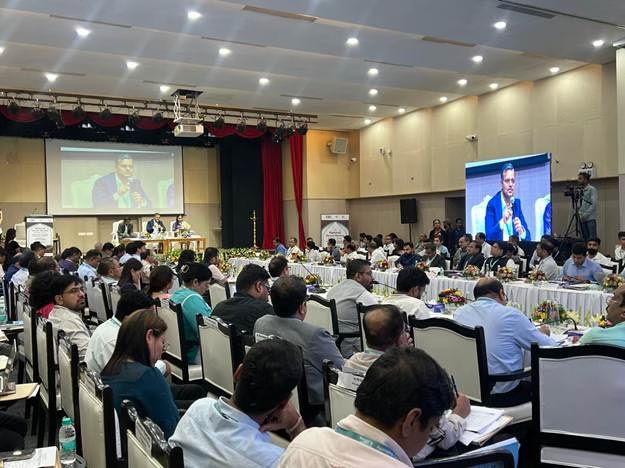
NEW DELHI — In a major policy push to reshape the landscape of public health delivery in India, the National Health Authority (NHA) has launched a comprehensive, technology-driven roadmap for the next phase of its flagship healthcare initiatives. The strategic blueprint was finalized during the inaugural day of a high-level, two-day National Review Meeting—termed Chintan Shivir—which commenced here yesterday at Madhya Pradesh Bhawan.
The convention brought together top health leadership from the Ministry of Health and Family Welfare (MoHFW), the NHA, and various States and Union Territories. Spearheaded by Shri Prataprao Jadhav, Union Minister of State (Independent Charge) for the Ministry of Ayush and Minister of State for Health and Family Welfare, the assembly marked a decisive shift toward an integrated ecosystem combining modern medicine, traditional AYUSH frameworks, and cutting-edge artificial intelligence (AI).
Unprecedented Scale: Financial Protection and Digital Footprints
The review underscored the monumental scale achieved by India’s dual health programs: the Ayushman Bharat Pradhan Mantri Jan Arogya Yojana (AB PM-JAY) and the Ayushman Bharat Digital Mission (ABDM).
According to official data released at the conclave, AB PM-JAY has officially cemented its status as the world’s largest health assurance scheme, facilitating cashless treatment worth over ₹1.91 lakh crore. The program operates through a vast network of more than 37,000 empanelled hospitals nationwide, providing a critical safety net against catastrophic health expenditures for India’s most vulnerable populations.
Concurrently, the digital framework has scaled dramatically under the Digital India umbrella. The ABDM has crossed a milestone of creating more than 94 crore Ayushman Bharat Health Account (ABHA) numbers, effectively linking over 100 crore digital health records.
+-------------------------------------------------------------+
|               KEY MILESTONES ACHIEVED (2026)                |
+------------------------------+------------------------------+
| AB PM-JAY Cashless Value     | > ₹1.91 Lakh Crore           |
+------------------------------+------------------------------+
| Empanelled Hospitals         | > 37,000 Nationwide          |
+------------------------------+------------------------------+
| ABHA Numbers Created         | > 94 Crore Registered        |
+------------------------------+------------------------------+
| Linked Health Records        | > 100 Crore Digitized        |
+------------------------------+------------------------------+
Tech-Driven Governance and Clinical Oversight
A significant highlight of the Chintan Shivir was the rollout of systemic, technology-driven reforms aimed at minimizing leakage, improving claims processing, and embedding rigorous clinical governance. The NHA announced major upgrades to its underlying IT architecture, deploying an advanced Auto-Adjudication Engine designed to process medical claims with greater speed, consistency, and transparency.
To safeguard public funds, the National Anti-Fraud Unit (NAFU) presented updated risk-based monitoring frameworks that leverage data analytics to detect anomalous billing patterns and prevent systemic fraud. Furthermore, the NHA introduced a revamped framework for planned pre-authorization across selected complex surgical procedures to ensure that clinical protocols are strictly adhered to before treatments commence.
Dr. Sunil Kumar Barnwal, Chief Executive Officer of the NHA, emphasized that the massive repository of data generated by PM-JAY serves as a vital national health indicator. By analyzing these data streams, public health officials can map real-time disease patterns across specific geographies and demographic cohorts, transitioning India toward highly targeted, evidence-based policymaking.
The Next Iteration: Aarogya Setu 2.0 and NHCX
The review highlighted the implementation roadmap for a suite of citizen-centric digital health applications officially rolled out on June 29, 2026. This digital suite marks the transition into “ABDM 2.0,” focusing on tangible utility over mere record creation.
Key components of this updated digital infrastructure include:
-
Aarogya Setu 2.0 & Ayushman App: Re-engineered platforms designed to help citizens easily discover nearby medical facilities, manage their health history, and download Ayushman benefit cards.
-
National Health Claims Exchange (NHCX): An open, interoperable gateway currently undergoing Health Management Information System (HMIS) pilots. The NHCX acts as a standardized digital clearinghouse, allowing seamless communication and claim settlements between hospitals and insurance payers, drastically reducing administrative overhead.
-
Unified Health Interface (UHI) & Specialized Registries: Including the National Drug Registry and the Bharat Health Terminology Service (BHTS) to standardize medical vocabularies across diverse Indian states.
The day concluded with a technical presentation by the All India Institute of Medical Sciences (AIIMS), New Delhi, showcasing the integration of a Clinical Decision Support System (CDSS). This AI-driven tool assists frontline medical professionals by offering evidence-based diagnostic and treatment recommendations at the point of care.
Expert Perspectives: The Public Health Outlook
Independent health policy experts view the integration of public health data and digital infrastructure as a necessary evolution, though they note that implementation details will dictate its long-term success.
“Connecting nearly a billion individual health records is a staggering administrative achievement,” says Dr. K. Srinath Reddy, a distinguished public health expert and former President of the Public Health Foundation of India (PHFI), who was not involved in the NHA review. “However, the true metric of ABDM 2.0 will be its interoperability across the deeply fragmented private and public sectors. If the National Health Claims Exchange can successfully cut down discharge times and administrative bottlenecks for the average patient, it will be a true game-changer.”
Public health analysts also point out that utilizing PM-JAY data for disease surveillance could drastically improve how India handles localized outbreaks and non-communicable disease (NCD) burdens. By observing spikes in specific pre-authorization requests, the government can allocate resources to hard-hit districts before a full-scale crisis emerges.
Limitations, Challenges, and the Road Ahead
Despite the celebratory data, independent analysts and the NHA itself acknowledge substantial hurdles in achieving complete saturation.
A primary limitation remains the stark digital divide and varying levels of health literacy across rural India. While creating 94 crore ABHA numbers is a milestone on paper, a significant percentage of rural beneficiaries still struggle to navigate smartphone apps or understand how their digital records are utilized.
Furthermore, independent evaluations from organizations like the World Health Organization (WHO) frequently emphasize that insurance-based models must be accompanied by a robust strengthening of primary healthcare infrastructure. Out-of-pocket spending on outpatient care—such as daily medicines and diagnostics, which are often not fully covered under tertiary hospital insurance schemes—remains a major financial burden for the poorest families.
The NHA has signaled its intent to address these gaps during the second day of the Chintan Shivir. Immediate priorities include accelerating the Ayushman Vay Vandana Yojana (focused on senior citizen care), expanding coverage to frontline community workers—specifically ASHA workers, Anganwadi workers, and Anganwadi helpers—and iron out regional disparities in hospital empanelment to ensure that the vision of a truly equitable healthcare system is realized by the target year of Viksit Bharat @2047.
Reference Section
Government and Official Sources
-
Press Information Bureau (PIB) Delhi: Official communique, Ministry of Health and Family Welfare, Government of India. Published July 17, 2026.
This article is for informational purposes only and should not be considered medical advice. Always consult with qualified healthcare professionals before making any health-related decisions or changes to your treatment plan. The information presented here is based on current research and expert opinions, which may evolve as new evidence emerges.