 0
0
 0
0
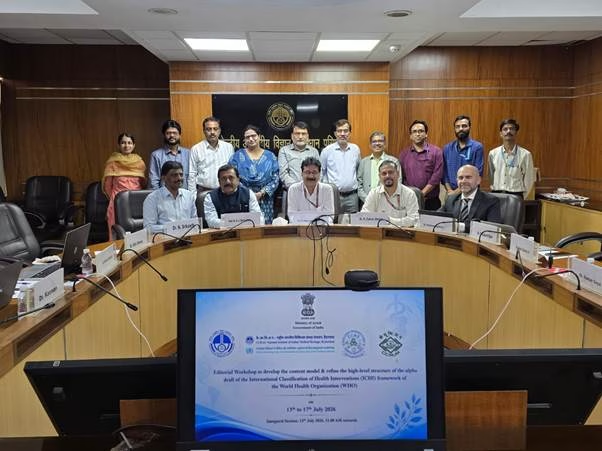
HYDERABAD, INDIA — In a landmark effort to bridge ancient healing traditions with modern digital medicine, the Ministry of Ayush, Government of India, launched a pivotal five-day editorial workshop on July 13, 2026. The initiative aims to standardize and integrate Ayurveda, Siddha, and Unani (ASU) traditional medicine systems into the World Health Organization’s (WHO) International Classification of Health Interventions (ICHI) framework.
Running through July 17, 2026, the workshop brings together international informatics professionals, scientific experts, and medical policy leaders at the National Institute of Indian Medical Heritage (NIIMH) in Hyderabad. The goal is to refine a high-level digital structure and build a robust hierarchy of National Health Intervention Codes (NHIC) for traditional practices. The event represents a critical milestone in India’s strategy to secure a permanent place for traditional systems in global electronic health records and universal health coverage frameworks.
Coding the Invisible: Why Standardized Data Matters
For decades, traditional medicine systems have faced a significant hurdle in global healthcare: a lack of standardized data terminology. While conventional medicine relies on precise international codes for every diagnosis and procedure—enabling seamless billing, insurance tracking, and clinical research—traditional interventions have largely operated outside this digital ecosystem.
This lack of standardized data creates a data vacuum. Without common codes, electronic health records (EHRs) cannot accurately capture a patient’s holistic treatment plan if it includes traditional therapies. Furthermore, public health agencies struggle to track the utilization, safety, and efficacy of these treatments on a global scale.
The workshop directly addresses this gap by building on preliminary drafts compiled during consultative meetings in May 2026. A massive, expert-validated repository is currently being scrutinized and categorized into a layered digital hierarchy:
-
Ayurveda: 13 specialties, 76 distinct therapies, and 714 specific procedures.
-
Siddha: 25 specialties, 130 therapies, and 996 procedures.
-
Unani: 15 specialties, 179 therapies, and 551 procedures.
By translating these hundreds of complex, historically rooted therapies into a scientifically structured alphanumeric code, the initiative prepares traditional medicine for integration into international health informatics.
Global Recognition and Digital Interoperability
During the inaugural session, Vaidya Rajesh Kotecha, Secretary of the Ministry of Ayush, emphasized that this project is far more than a routine bureaucratic exercise.
“This initiative represents a transformational step towards positioning India’s traditional medical systems within the global scientific, digital, and policy ecosystem,” Kotecha stated. “Incorporating standardized health terminologies will ensure Ayush interventions become an integral part of broader digital health ecosystems, matching modern health informatics standards.”
For consumers and patients, this transition holds profound practical implications. As traditional practices achieve “global interoperability”—meaning health information data can be shared accurately across different digital systems and international borders—patients may find it easier to communicate their complete health histories to conventional doctors. It also lays the necessary structural groundwork for insurance providers to eventually evaluate and cover traditional therapies under standard health insurance plans, moving closer to true universal health coverage.
Dr. Kavita Jain, Joint Secretary of the Ministry of Ayush, outlined the long-term policy impacts, noting that clear digital documentation is crucial for gathering large-scale public health data. This perspective was echoed by international digital health leaders, including Dr. Robert Jakob, Data Standards and Informatics Team Leader at the WHO, and Dr. Stephane Espinosa, a WHO consultant. Both experts focused on ensuring that India’s new traditional health codes align perfectly with the technical architecture of the broader WHO-ICHI framework.
Balancing Innovation with Evaluation: Limitations and Challenges
While the initiative is being praised as a forward-thinking step for digital integration, independent public health experts urge cautious optimism, pointing out substantial operational challenges.
Integrating traditional terminology into a rigid, Western-designed informatics framework is structurally complex. Traditional systems like Ayurveda view health dynamically, often tailoring multi-component lifestyle, dietary, and herbal interventions to an individual’s unique constitution (Prakriti). Reducing these fluid, highly individualized practices into strict, standardized procedural codes risks oversimplifying the treatment philosophy.
Furthermore, standardizing the names and codes of procedures is not the same as verifying their clinical efficacy. Independent medical researchers emphasize that inclusion in the WHO-ICHI framework provides a structural framework for data collection, but it does not replace the ongoing need for rigorous, double-blind, peer-reviewed clinical trials to confirm the safety and effectiveness of specific traditional therapies. Public health advocates note that for true global integration to succeed, this digital upgrade must be matched by strict quality control, standardized practitioner training, and transparent reporting of adverse events.
The Road Ahead for Public Health
The rigorous vetting process for the primary coding drafts has been steered by the leadership of India’s apex research councils, including Prof. Vaidya Rabinarayan Acharya (CCRAS), Prof. Dr. N.J. Muthukumar (CCRS), and Dr. N. Zaheer Ahmed (CCRUM). Dr. N. Srikanth, Deputy Director General of CCRAS, noted that establishing this standardized terminology is a critical foundational step toward elevating the global scientific credibility of traditional practices.
As the workshop concludes at the NIIMH in Hyderabad, the finalized alpha draft will represent the first comprehensive bridge between ancient clinical logic and modern digital health infrastructure. For the global healthcare consumer, this digital transformation promises a future where traditional and conventional medicine can be recorded, studied, and managed side-by-side on the exact same screen.
Reference Section
Government & Institutional Frameworks
-
Ministry of Ayush, Government of India: Press Information Bureau (PIB) Delhi. Headline: Ministry of Ayush Launches Five-Day Editorial Workshop on WHO-ICHI Framework for Ayurveda, Siddha and Unani Systems. Published July 13, 2026.
Medical Disclaimer: This article is for informational purposes only and should not be considered medical advice. Always consult with qualified healthcare professionals before making any health-related decisions or changes to your treatment plan. The information presented here is based on current research and expert opinions, which may evolve as new evidence emerges.