 0
0
 0
0
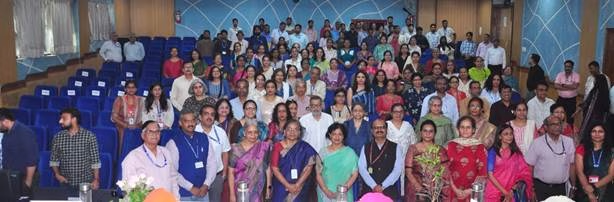
NEW DELHI – In a significant move to reshape the landscape of Indian scientific innovation, the Council of Scientific & Industrial Research (CSIR) has announced a strategic evolution for its flagship research program, the CSIR-ASPIRE scheme. During the “ASPIRE-SHAKTI” event held this week at the CSIR Headquarters in New Delhi, leadership outlined a clear vision for the next phase of the program: moving beyond academic research to actively support the commercialization of technologies developed by women scientists.
The event, which celebrated the accomplishments of women researchers across India, highlighted the scheme’s progress since its inception on International Women’s Day in 2023. Dr. N. Kalaiselvi, Secretary of the Department of Scientific & Industrial Research (DSIR) and Director General of CSIR, presided over the release of the ASPIRE-SHAKTI Compendium—a detailed record of the research milestones achieved by participants to date.
A New Chapter: From Lab to Market
While the primary success of the ASPIRE scheme has been fostering independent research, the upcoming phase aims to address a common challenge in the scientific community: the “valley of death” between a successful laboratory experiment and a market-ready product.
Dr. Kalaiselvi announced that CSIR plans to identify approximately 20 to 30 outstanding ASPIRE projects for intensive support. This assistance will go beyond traditional grant funding; the council aims to bridge the gap between researchers and the start-up ecosystem. By connecting these scientists with industry partners and innovation hubs, CSIR intends to facilitate the translation of high-potential research into tangible technologies that could serve the public.
For the general public, this means that laboratory breakthroughs—ranging from new diagnostic tools in life sciences to sustainable engineering solutions—may move more quickly into real-world settings where they can have a direct impact on healthcare and quality of life.
The Impact of ASPIRE: By the Numbers
The CSIR-ASPIRE scheme has established a significant national footprint, acting as a crucial pipeline for women scholars pursuing advanced scientific careers. Since the scheme’s launch, it has received 2,878 project proposals from 969 institutions across the country.
Of these, 301 women researchers were competitively selected to serve as independent Principal Investigators (PIs)—the lead scientists responsible for the research project and its funding. This represents a rigorous selection process, with an acceptance rate of approximately 10 percent.
The diversity of the research output is notable:
-
Life Sciences: 152 projects
-
Engineering Sciences: 54 projects
-
Inter/Transdisciplinary Sciences: 37 projects
-
Chemical Sciences: 34 projects
-
Physical Sciences: 25 projects
The scientific output from these projects is robust. To date, participants have produced over 253 publications in SCI-indexed journals. SCI-indexed journals are highly regarded in the scientific community because they require stringent peer review, ensuring that the published research meets high standards of quality and validity. Additionally, the scheme has led to over 15 patent filings and more than 20 presentations at international conferences. Beyond the research itself, the program has successfully trained over 300 research fellows, including Junior Research Fellows (JRFs), Senior Research Fellows (SRFs), and Research Associates.
Addressing the Inclusion Gap
Despite the program’s success, CSIR leadership remains focused on addressing regional disparities in scientific participation. Dr. Kalaiselvi expressed concern regarding the lower participation rates from India’s North-East region and Ladakh.
“We need targeted outreach and awareness initiatives,” Dr. Kalaiselvi stated, emphasizing the importance of bringing universities and colleges in Tier-2 and Tier-3 cities into the fold. The goal is to make future calls for proposals more inclusive and representative of India’s broad demographic and geographic diversity. By expanding the reach of the ASPIRE scheme, the council hopes to tap into a wider pool of talent that may previously have lacked the resources or visibility to apply for such national-level grants.
Rigorous Standards and Peer Evaluation
The ASPIRE-SHAKTI event also served as the initiation for Project Review Sessions. These sessions allow Subject Area Committees to assess the mid-term progress of funded projects.
Experts from various fields have lauded the transparency of the process. Dr. Annapurni Subramaniam, Director of the Indian Institute of Astrophysics, Bengaluru, and Chairperson of the ASPIRE Physical Sciences Committee, alongside Prof. Sharmila A. Bapat of Savitribai Phule Pune University, Chairperson of the ASPIRE Life Sciences Committee, both emphasized the rigorous nature of the peer-evaluation system used to select the researchers.
This level of scrutiny is vital for maintaining the credibility of scientific research, particularly in fields like life sciences, where findings often influence medical treatments, public health guidelines, or diagnostic protocols.
Implications for Future Health Research
For health-conscious consumers and healthcare professionals, the emphasis on Life Sciences within the ASPIRE scheme is particularly promising. With 152 projects currently focused on this domain, the potential for future breakthroughs in health technology is significant. As these projects move toward the commercialization phase announced by the CSIR, they may contribute to a more robust pipeline of locally developed, evidence-based health innovations.
The integration of research mentorship, rigorous peer review, and a clear path toward market translation suggests that the CSIR-ASPIRE scheme is doing more than just providing funding; it is building a sustainable infrastructure for scientific progress in India.
References
-
Press Information Bureau (PIB). (2026, July 13). CSIR-ASPIRE Compendium Released, Next Phase of the Scheme to Focus on Inclusion, Innovation and Technology translation. Ministry of Science & Technology, Government of India.
Medical Disclaimer: This article is for informational purposes only and should not be considered medical advice. Always consult with qualified healthcare professionals before making any health-related decisions or changes to your treatment plan. The information presented here is based on current research and expert opinions, which may evolve as new evidence emerges.