 0
0
 0
0
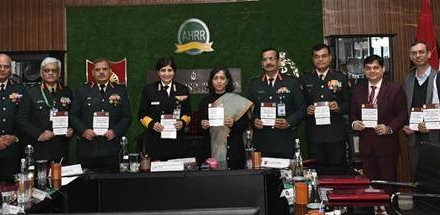
NEW DELHI — In a major milestone for integrative healthcare, the President of India, Smt. Droupadi Murmu, will inaugurate “Saushrutam 2026” on July 15, 2026. The three-day international seminar, hosted by the All India Institute of Ayurveda (AIIA) in New Delhi, aims to forge a collaborative path between classical Ayurvedic surgical techniques and modern medical science. Coinciding with Sushruta Jayanti—the annual celebration honoring Acharya Sushruta, widely acknowledged as the “Father of Surgery”—the event marks a high-profile push by the Ministry of Ayush to establish a standardized, evidence-based framework for Ayurvedic surgical practice, known historically as Shalya Tantra.
The seminar arrives at a critical juncture for public health, as modern medicine increasingly explores complementary protocols to tackle chronic conditions and post-surgical rehabilitation. With delegates spanning nine countries—including the United Kingdom, Austria, Israel, Greece, and Indonesia—the summit will gather top-tier biomedical authorities from institutions like the All India Institute of Medical Sciences (AIIMS) alongside traditional scholars to evaluate how ancient methodologies withstand modern scientific scrutiny.
High-Tech Diagnostics Meets Ancient Therapeutics
A primary highlight of the seminar’s launch is the formal inauguration of a state-of-the-art 3 Tesla (3T) High-Field Magnetic Resonance Imaging (MRI) system at AIIA. Procured at a cost of ₹14.5 crore, this advanced diagnostic machine features artificial intelligence-driven workflows and specialized anatomical baseline scanning.
For healthcare consumers, this integration provides a practical benefit: it allows clinicians to utilize world-class diagnostic imagery to map anatomical anomalies before deploying traditional treatments. The clinical sessions will focus heavily on refining and validating core Ayurvedic interventions:
-
Kshara Sutra: A medicated, alkaline thread technique used to treat complex fistulas and hemorrhoids, which peer-reviewed trials indicate may offer lower recurrence rates than conventional surgery.
-
Agnikarma: Thermal micro-cauterization applied under specific guidelines for chronic musculoskeletal pain management.
-
Wound Management (Vrana Ropana): The application of botanical formulations designed to accelerate tissue healing.
-
Marma Chikitsa: The manipulation of vital anatomical zones to manage neuromuscular disorders.
“Saushrutam 2026 will serve as a landmark international platform for advancing evidence-based Ayurvedic surgery,” stated Prof. (Vd.) P. K. Prajapati, Director of AIIA. “By bringing together the timeless principles of Acharya Sushruta with contemporary surgical innovations, the seminar will strengthen academic collaboration, encourage high-quality research, and promote excellence in surgical education.”
Evaluating Clinical Safety and Legal Realities
While the concept of integrative surgery holds substantial promise, it remains a subject of intense professional debate within the broader medical community. A key objective of the conference is addressing these frictions openly, particularly regarding patient safety, standardization, and medico-legal liability.
Independent medical experts urge a measured, highly regulated approach to integration. Modern surgical protocols rely on standardized sterilization, localized or general anesthesia, and rapid emergency intervention systems—areas where classical texts require careful translation into contemporary settings.
“Cross-disciplinary dialogue is essential, but patient outcomes must remain the absolute metric,” says Dr. A. K. Sharma, a retired consultant gastroenterologist not involved with the event organization. “Techniques like Kshara Sutra have demonstrated measurable clinical success in proctology. However, clear boundaries must be maintained. High-risk, invasive visceral surgeries require modern specialized life-support systems and surgical infrastructure that cannot be replaced by traditional techniques alone. The focus should be on complementary care rather than complete substitution.”
Organizers have structured dedicated panels to confront these operational limits. According to Prof. (Dr.) Yogesh Badwe, Organising Chairman and Medical Superintendent at AIIA, the agenda features specific technical tracks examining integrative oncology, proctology, intellectual property rights, and complex medico-legal issues to establish definitive protocols regarding where Ayurveda can safely support or extend surgical care.
Mapping the Human Infrastructure: The NCISM Female Graduate Study
Beyond clinical procedures, the seminar will highlight the socio-economic infrastructure supporting traditional medicine. The National Commission for Indian System of Medicine (NCISM) will release a landmark national study titled “Evaluation of Professional Career of Ayurveda Female Graduates – An Observational Exploratory Study.”
The study addresses a crucial public health dynamic: while women constitute a significant percentage of enrolled Ayurveda students across India, their long-term retention, career progression, and transition into specialized surgical fields face structural challenges. The findings are expected to shape future workforce policies, ensuring that trained female clinicians are effectively utilized within rural and urban healthcare pipelines.
Practical Takeaways for Patients
For health-conscious consumers, the shift toward evidence-based Ayurveda means greater safety and transparency. As institutions like AIIA adopt advanced tools like the 3T MRI, patients seeking alternative therapies can expect a rigorous diagnostic baseline before undergoing treatment.
Experts advise patients considering integrative options to verify that their practitioners are properly credentialed, operating out of recognized medical institutions, and using therapies backed by verified clinical trials.
The event will close with a multi-disciplinary panel featuring modern surgical experts from premier centers like Sir Ganga Ram Hospital and SGPGI Lucknow. Dr. Vyasadeva Mahanta, Organising Secretary, noted that the final sessions will focus on formulating collaborative research frameworks, ensuring that traditional practices survive not on historical reputation, but on verifiable contemporary safety data.
Document Sources and References
- https://www.pib.gov.in/PressReleasePage.aspx?PRID=2284340®=48&lang=1
Medical Disclaimer: This article is for informational purposes only and should not be considered medical advice. Always consult with qualified healthcare professionals before making any health-related decisions or changes to your treatment plan. The information presented here is based on current research and expert opinions, which may evolve as new evidence emerges.