 0
0
 0
0
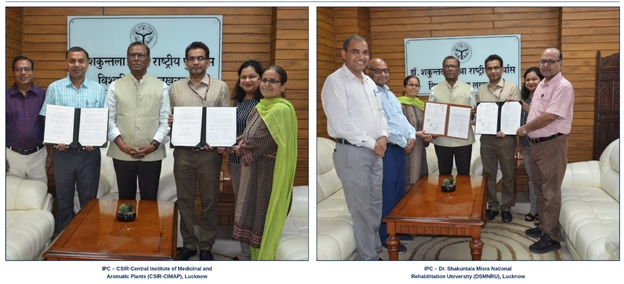
LUCKNOW, INDIA — In a major effort to elevate healthcare standards, expand drug safety monitoring, and foster inclusion for persons with disabilities, the Indian Pharmacopoeia Commission (IPC) signed and renewed two milestone strategic Memoranda of Understanding (MoUs) in Lucknow on Thursday.
The agreements—partnering the nation’s pharmacopoeial authority with the CSIR-Central Institute of Medicinal and Aromatic Plants (CSIR-CIMAP) and Dr. Shakuntala Misra National Rehabilitation University (DSMNRU)—mark a comprehensive push toward standardising traditional botanical medicines and pioneering accessible safety reporting for vulnerable patient populations.
The official ceremony brought together key leaders in national health and scientific research, including Dr. V. Kalaiselvan, Secretary-cum-Scientific Director at the IPC, Prof. Sanjay Singh, Vice-Chancellor of DSMNRU, and senior scientific officials from CSIR-CIMAP.
Standardising Botanical Medicine: Science Meets Traditional Knowledge
Traditional and herbal therapies are widely used in India, where an estimated 70% to 80% of the population relies on traditional systems of medicine like Ayurveda for primary healthcare. However, varying cultivation environments, extraction methods, and lack of uniform testing standards have historically posed challenges for consistent potency, purity, and batch-to-batch reliability.
       [ Herbal/Medicinal Plants ]
                    │
                    ▼ (CSIR-CIMAP Expertise)
       [ Chemical Profiling & Active Markers ]
                    │
                    ▼ (IPC Standardisation)
       [ Monograph Creation & Quality Standards ]
                    │
                    ▼
       [ Consistently Safe & Effective Medicines ]
The renewed alliance between the IPC and CSIR-CIMAP directly targets these challenges. CSIR-CIMAP, a premier public research institute under the Council of Scientific and Industrial Research, brings decades of expertise in phytochemistry (the study of plant chemicals) and agricultural research.
Through this renewed partnership, researchers will focus on three main areas:
-
Medicinal Plant Research: Cataloging bioactive compounds across key therapeutic flora.
-
Chemical Standardisation: Establishing reference standards to ensure herbal products contain precise active ingredient amounts.
-
Quality Evaluation: Creating modern, reliable testing methods to detect contaminants, heavy metals, or adulterants in botanical formulations.
“Establishing standardized botanical monographs is equivalent to creating a precise biological blueprint for plant-based therapies,” says Dr. Ananya Mukherjee, an independent pharmaceutical policy consultant not involved in the MoUs. “Without strict chemical profiling, two herbal preparations with the exact same label can vary widely in strength or purity. This collaboration gives clinicians and consumers greater confidence in the safety and efficacy of traditional products.”
Inclusion in Healthcare: Quality Protocols for Assistive Devices
In a groundbreaking move toward inclusive health, the IPC’s newly signed agreement with DSMNRU—a specialized university dedicated to accessible education and rehabilitation—targets two under-regulated areas of public health: assistive device quality and accessible drug safety monitoring.
The collaboration institutes rigorous protocols for evaluating the safety, ergonomic fit, and long-term performance of assistive technologies. Assistive devices—ranging from prosthetic limbs and orthopedic mobility aids to hearing equipment—are vital health interventions for the world’s estimated 1.3 billion persons with disabilities.
Under the new initiative, scientific testing protocols will ensure these devices meet defined durability, biocompatibility, and structural safety benchmarks before reaching patients.
Sign Language Pharmacovigilance: Bridging the Safety Gap
Beyond device quality, the IPC-DSMNRU partnership introduces a pioneering public health tool: sign language-based pharmacovigilance (the practice of monitoring the safety of drugs and detecting adverse reactions after they are released to the public).
Historically, adverse drug reaction (ADR) reporting systems have relied heavily on written forms, phone hotlines, or digital text portals—formats that can present communication barriers for individuals who are deaf or hard of hearing.
To address this inequality, the partnership will launch a specialized pharmacovigilance training module delivered entirely in sign language. This initiative aims to:
-
Educate deaf and hard-of-hearing patients on identifying potential adverse drug reactions.
-
Train community healthcare workers and educators in accessible safety reporting.
-
Integrate direct, accessible reporting pathways into national database systems, such as the Pharmacovigilance Programme of India (PvPI).
   [ Traditional Reporting Pathways ]          [ Inclusive Pathway (New) ]
    Text Forms / Hotlines / Portals             Sign Language Training Modules
                  │                                         │
                  ▼                                         ▼
   (Barriers for Deaf/Hard of Hearing)      (Empowered Reporting & Direct Communication)
                  │                                         │
                  └────────────────────┬────────────────────┘
                                       │
                                       ▼
                       [ National PvPI Safety Database ]
“Ensuring medicine safety requires capturing experiences from every segment of the population,” Dr. Kalaiselvan explained during the ceremony. “These strategic collaborations strengthen scientific research, quality standards, and institutional partnerships. By improving access to safe, effective, and high-quality healthcare products, we contribute directly to Uttar Pradesh’s emergence as a center of excellence and advance our shared national health vision.”
Expert Perspectives, Public Health Impact, and Future Outlook
Public health experts have welcomed the dual initiative, emphasizing its alignment with global health strategies that advocate for integrative medicine and health equity.
“A common gap in national drug safety monitoring globally is the systemic underreporting of adverse events from marginalized or vulnerable groups,” notes Dr. Rajesh Verma, a public health specialist and epidemiologist. “By deploying tailored sign-language tools, India is establishing an inclusive template for pharmacovigilance that other nations could emulate.”
Key Strategic Outcomes at a Glance
| Initiative | Lead Partners | Target Objective | Core Benefit |
| Herbal Standardisation | IPC & CSIR-CIMAP | Chemical profiling & standard reference monographs | Consistent batch quality & reduced contamination risks |
| Assistive Tech Evaluation | IPC & DSMNRU | Standardized testing protocols for physical devices | High-durability, safe, and ergonomically fitted aids |
| Inclusive Pharmacovigilance | IPC & DSMNRU | Sign language educational modules & ADR reporting | Equal access to medicine safety networks |
Potential Challenges and Counterarguments
While the strategic vision has drawn praise, independent analysts note that implementation will present technical and logistical challenges:
-
Variability in Raw Materials: Standardising botanical medicines requires control over soil quality, climate variations, and post-harvest handling, which can vary widely across regional agricultural supply chains.
-
Standardising Sign Language Terminology: Technical medical terms, specific drug interactions, and complex physiological symptoms do not always have direct, standardized equivalents in sign language dialects, requiring careful collaboration with linguistic experts.
-
Adoption and Enforcement: Designing quality testing protocols for assistive technology is only the first step; widespread clinical adoption will require regulatory integration and enforcement across manufacturing sectors.
Practical Takeaways for Patients and Healthcare Providers
-
For Health Consumers: The standardization of herbal medicine will help consumers choose plant-based products validated by verified scientific testing, reducing exposure to adulterated remedies.
-
For Persons with Disabilities: Standardized evaluation protocols aim to improve the durability and safety of mobility and assistive tools, while accessible reporting platforms make it easier to voice medication safety concerns.
-
For Healthcare Clinicians: Standardized pharmacopoeial monographs provide doctors and pharmacists with reliable data on plant-drug interactions, aiding safer integrative care decisions.
These strategic MoUs mark a significant step forward in combining traditional knowledge with modern scientific standards, ensuring that progress in healthcare reaches every community.
References
-
Press Information Bureau (PIB) Delhi. (2026, July 23). IPC Strengthens Viksit UP–Viksit Bharat Vision Through Strategic MoUs to Advance Healthcare Quality and Scientific Innovation. Ministry of Health & Family Welfare, Government of India.
Medical Disclaimer: This article is for informational purposes only and should not be considered medical advice. Always consult with qualified healthcare professionals before making any health-related decisions or changes to your treatment plan. The information presented here is based on current research and expert opinions, which may evolve as new evidence emerges.