 0
0
 0
0
GENEVA — Global health authorities are calling on nations to urgently accelerate their national meningitis defense plans, warning that a persistent global burden continues to take hundreds of thousands of lives every year despite the availability of effective vaccines and treatments.
In a health update published on July 22, 2026, the World Health Organization (WHO) signaled a pivot from policy commitments to operational deployment. Following high-level regional summits in Copenhagen and Cairo, the health agency urged member states to scale up immunizations, diagnostic lab capacity, and long-term survivor support to stay on track for the global target of defeating bacterial meningitis by 2030.
The Persistent Burden: Why Urgent Action Is Needed
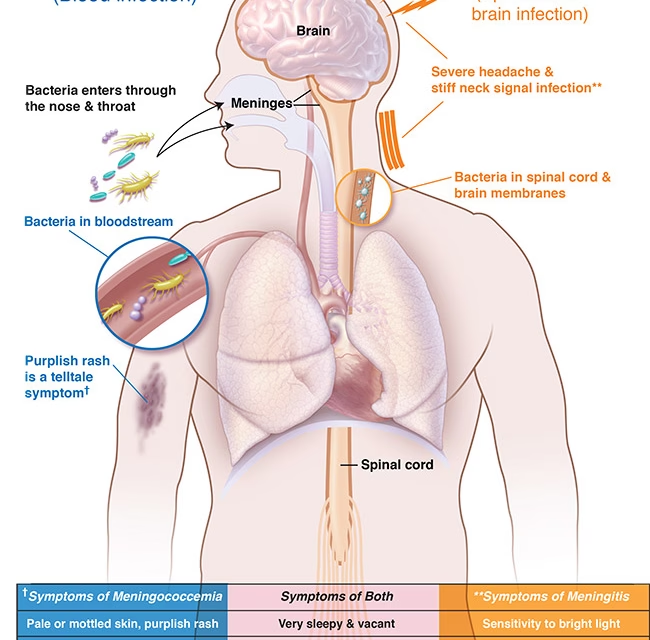
Meningitis—a severe inflammation of the membranes (meninges) surrounding the brain and spinal cord—remains one of the most swift and devastating infectious threats known to medicine. It can kill an otherwise healthy individual within 24 hours of symptom onset or leave survivors with life-altering neurological impairments.
Recent epidemiological data highlight the stark scale of the crisis:
-
Annual Mortality: Estimates from a Lancet Neurology global burden analysis reported approximately 259,000 deaths and 2.5 million clinical cases worldwide in 2023.
-
Vulnerable Populations: Children under five years old account for more than a third of all fatal outcomes.
-
Geographic Hotspots: Low-income regions, particularly the “African meningitis belt” stretching from Senegal to Ethiopia—including countries like Nigeria, Niger, and Chad—continue to experience the highest incidence and outbreak risk.
“Bacterial meningitis is a clinical emergency where hours directly dictate survival and long-term quality of life,” notes Dr. Elizabeth Howard, an independent global infectious disease researcher based in London. “The problem isn’t just treating an acute infection; it is building a rapid-response system that catches cases before irreversible central nervous system damage occurs.”
From Roadmap to Execution: The 2030 Targets
In 2020, the World Health Assembly endorsed the Defeating Meningitis by 2030 Global Road Map. The initiative established ambitious benchmarks to transform global control:
-
Eliminate bacterial meningitis epidemics entirely.
-
Reduce vaccine-preventable bacterial meningitis cases by 50%.
-
Slash total deaths by 70%.
-
Mitigate disability and improve post-recovery quality of life for all survivors.
The recent WHO regional workshops brought together national policy leaders to align domestic healthcare strategies with these international goals. Priority areas include expanding laboratory confirmation capabilities, establishing standardized clinical care guidelines, and creating structured rehabilitation networks for individuals living with hearing loss, vision loss, or cognitive impairments.
However, execution gaps remain significant. According to data from the WHO and the Meningitis Research Foundation’s Progress Tracker, only 12 out of 194 countries had fully operationalized national meningitis plans as of May 2026.
    [Global Ambition: 194 Nations Committed]
                       │
                       ▼
    [Operational Reality: 12 National Plans Approved]
                       │
                       ▼
   [Core Priority: High-Risk Immunization & Lab Scaling]
Prevention and Treatment Challenges
While bacterial meningitis is primarily caused by four major pathogens—Neisseria meningitidis, Streptococcus pneumoniae, Haemophilus influenzae, and Group B Streptococcus—no single universal vaccine exists to protect against all strains.
Vaccination coverage remains uneven globally. To bridge this protection gap across high-risk regions, public health initiatives are rolling out advanced multivalent vaccines. Among these is Men5CV, a pentavalent meningococcal conjugate vaccine designed to protect against five major serogroups (A, C, W, Y, and X) in a single dose.
       ┌─────────────────────────────────────────────────────────┐
       │              Major Pathogens to Target                  │
       └────────────────────────────┬────────────────────────────┘
                                    │
         ┌──────────────────────────┼──────────────────────────┐
         ▼                          ▼                          ▼
Neisseria meningitidis   Streptococcus pneumoniae   Haemophilus influenzae
 (Serogroups A,C,W,Y,X)      (Pneumococcus)               (Hib)
Systemic Limitations
Despite advances in vaccine development, global health experts caution that technology alone cannot eliminate outbreaks without robust healthcare infrastructure:
-
Diagnostic Delays: Confirming bacterial strains requires specialized cerebrospinal fluid (CSF) testing, which many rural clinics lack.
-
Treatment Protocols: Suspicion of bacterial meningitis demands immediate empiric antibiotic therapy. Delaying treatment while awaiting laboratory confirmation dramatically increases mortality rates.
-
Financing & Logistics: Maintaining cold-chain delivery for vaccines in remote areas requires sustained funding and healthcare workforce capacity.
Public Health Guidance: Recognizing the Signs
For the general public and healthcare providers alike, early identification is the most critical line of defense. Because early symptoms frequently mimic common viral illnesses like influenza, recognizing specific warning signs can be lifesaving.
| Early Physical Symptoms | Neurological & Systemic Indicators |
| High fever & chills | Severe, sudden headache |
| Stiff neck (nuchal rigidity) | Photophobia (sensitivity to light) |
| Nausea or vomiting | Confusion, delirium, or altered consciousness |
| Cold hands and feet | Seizures or purplish skin rashes (meningococcemia) |
If you or someone in your care experiences a sudden combination of high fever, severe headache, photophobia, and a stiff neck, seek emergency medical care immediately.
Looking Ahead
The WHO’s latest push reinforces that defeating meningitis requires an integrated approach linking preventative immunization, swift diagnostic confirmation, emergency antibiotic administration, and long-term survivor support. While regional planning represents progress, turning global targets into reality will depend on whether nations convert these frameworks into fully funded domestic health programs.
Medical Disclaimer
This article is for informational purposes only and should not be considered medical advice. Always consult with qualified healthcare professionals before making any health-related decisions or changes to your treatment plan. The information presented here is based on current research and expert opinions, which may evolve as new evidence emerges.
Reference Section
-
World Health Organization. “Momentum builds as countries accelerate action to defeat meningitis.” Published July 22, 2026.