 0
0
 0
0
Read Time:5 Minute, 57 Second
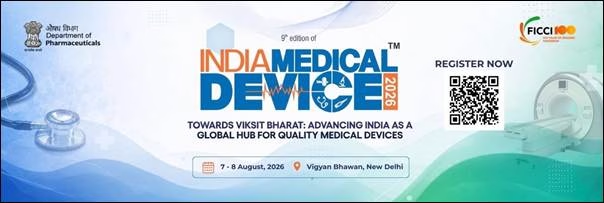
NEW DELHI — On August 7 and 8, 2026, policymakers, global healthcare executives, clinical researchers, and MedTech innovators will gather at Vigyan Bhawan in New Delhi for the 9th India Medical Device 2026 conference. Hosted by the Department of Pharmaceuticals under the Ministry of Chemicals & Fertilizers, in partnership with the Federation of Indian Chambers of Commerce & Industry (FICCI), the flagship summit aims to redefine India’s medical technology landscape. Under the banner “Towards Viksit Bharat: Advancing India as a Global Hub for Quality Medical Devices,” the two-day event addresses a crucial public health mandate: accelerating domestic manufacturing, ensuring high-quality standards, and leveraging artificial intelligence to expand affordable, lifesaving care across India.
Minister of State for Health & Family Welfare and Chemicals & Fertilizers, Smt. Anupriya Patel, will inaugurate the event on August 7. The summit will culminate on August 8 with a keynote address by Union Minister for Chemicals & Fertilizers, Shri Jagat Prakash Nadda, focusing on “Atmanirbhar MedTech: Accelerating India’s Journey towards Viksit Bharat”.
Accelerating Domestic Manufacturing and Quality Infrastructure
Currently valued at over $15 billion to $18 billion, India’s medical devices market is among the fastest-growing in the world, expanding at a compound annual growth rate (CAGR) of 8% to 12%. However, the nation has historically relied on imports for nearly 70% to 80% of its medical devices—particularly high-end diagnostic imaging equipment, advanced interventional cardiology tools, and complex surgical systems.
India Medical Device 2026 serves as the primary strategic platform to reverse this trend by emphasizing “localization” and component manufacturing. The event brings together key leaders, including:
-
Shri Manoj Joshi, Secretary, Department of Pharmaceuticals
-
Smt. Punya Salila Srivastava, Secretary, Ministry of Health & Family Welfare
-
Dr. Rajeev Singh Raghuvanshi, Drugs Controller General of India (DCGI)
-
Dr. M. Srinivas, Member (Health), NITI Aayog
“India Medical Device 2026 will provide a premier platform to showcase India’s growing MedTech capabilities, strengthen global partnerships, foster innovation and quality manufacturing, and chart the roadmap for positioning India as a trusted global hub for quality medical devices,” stated Shri Manoj Joshi, Secretary of the Department of Pharmaceuticals.
The agenda opens with sessions dedicated to component manufacturing and localizing supply chains, paired with practical workshops on optimizing existing national testing laboratories. Building robust testing infrastructure is critical to ensure locally manufactured devices meet rigorous global safety and efficacy benchmarks set by the Central Drugs Standard Control Organisation (CDSCO) and international standards organizations.
From Artificial Intelligence to Universal Health Coverage
The summit’s agenda reflects how technology and regulation intersect to shape clinical care:
High-Impact Devices & AI Innovations
Discussions will address building technology leadership in high-volume devices alongside the emergence of India as a Software as a Medical Device (SaMD) powerhouse. With AI algorithms increasingly used for early detection of conditions like diabetic retinopathy, cardiovascular disease, and oncological lesions, establishing clear regulatory pathways for AI integration is a top priority.
Clinical Evidence & Regulatory Pathways
A critical session on day one focuses on generating clinical evidence and streamlining regulatory pathways to transition local innovations into export-ready products. Concurrent roundtables will address maintenance and service ecosystems to keep advanced machinery functional in rural and regional hospitals.
Universal Coverage & Reimbursement
On the second day, an exclusive CEO Roundtable led by Union Minister J.P. Nadda will precede discussions on reimbursement mechanisms for innovative therapies. Aligning MedTech innovation with national health insurance frameworks, such as Ayushman Bharat (AB PM-JAY), remains essential for bringing cutting-edge treatments to underserved communities.
                 INDIA MEDTECH TRANSFORMATION ROADMAP

   +---------------------------------------------------------------+
   |                      POLICY & INCENTIVES                      |
   |   • Production-Linked Incentive (PLI) Scheme                  |
   |   • National Medical Devices Policy                           |
   +-------------------------------+-------------------------------+
                                   |
                                   v
   +---------------------------------------------------------------+
   |                   LOCALIZED MANUFACTURING                     |
   |   • Component Manufacturing  • Dedicated MedTech Parks        |
   |   • Diagnostic Equipment     • Advanced Implants & Devices   |
   +-------------------------------+-------------------------------+
                                   |
                                   v
   +---------------------------------------------------------------+
   |                 HEALTHCARE ACCESSIBILITY & AI                 |
   |   • SaMD & AI Diagnostics    • Expanded Rural Access          |
   |   • Lower Patient Costs      • Ayushman Bharat Integration    |
   +---------------------------------------------------------------+
What This Means for Everyday Healthcare
For patients and healthcare providers, the push toward an Atmanirbhar (self-reliant) MedTech ecosystem is not merely an economic initiative—it directly impacts patient care, costs, and clinical outcomes:
-
Greater Affordability: Local production lowers manufacturing and logistics overhead, reducing out-of-pocket costs for essential items like stent procedures, orthopedic implants, blood glucose monitors, and dialysis equipment.
-
Faster Access to Advanced Diagnostics: As domestic manufacturing of high-volume devices expands, tier-2 and tier-3 city hospitals can acquire modern MRI scanners, CT machines, and point-of-care testing kits faster.
-
Tailored Technological Solutions: Indigenous MedTech start-ups are creating devices specifically designed for local conditions—such as portable ECG monitors equipped for variable power conditions and rugged diagnostic kits built for remote health centers.
“Sustained collaboration between policymakers, industry, academia, and healthcare experts is essential,” said Shri Tushar Sharma, Chair of the FICCI Medical Devices Committee and Managing Director & GM for India & South Asia at Abbott Healthcare. “India Medical Device 2026 will provide an important platform for driving meaningful dialogue, fostering partnerships, and accelerating the growth of India’s medical devices ecosystem.”
Industry Perspectives, Challenges, and Roadblocks
While the expansion of India’s MedTech sector promises significant benefits, healthcare analysts and industry observers highlight several obstacles that must be navigated to achieve long-term success:
Import Dependence on Raw Components
Even as final assembly shifts to domestic facilities, advanced microprocessors, specialized sensors, and high-grade medical alloys are still largely imported. True self-reliance requires building an end-to-end component manufacturing supply chain within the country.
Regulatory Consistency and Turnaround Times
Industry representatives note that maintaining stringent safety standards while streamlining regulatory approvals is a delicate balance. Clear, predictable timelines from the DCGI are critical to prevent delays in bringing innovative technologies to market.
R&D Capital Investment
While government programs like the Production Linked Incentive (PLI) scheme have spurred manufacturing investments, early-stage biomedical research requires substantial capital. Expanding public-private venture funding is vital to turn domestic academic research into market-ready products.
Independent healthcare policy analysts emphasize that domestic manufacturing must always maintain clinical rigor. Bridging the gap between affordable engineering and high-quality clinical performance will determine whether Indian-made medical devices gain full trust in international markets.
Looking Ahead: The Horizon for Indian MedTech
Major global and domestic companies—including GE HealthCare, Abbott Healthcare, Philips India, Medtronic India, Johnson & Johnson MedTech, and Hindustan Syringes & Medical Devices Ltd.—will participate alongside local start-ups. The event highlights a clear trend: India is evolving from a consumer of global medical technologies into a key developer and manufacturer.
As deliberations begin at Vigyan Bhawan, the outcome of these policy discussions and strategic partnerships will help shape the accessibility, affordability, and quality of healthcare for millions of patients across the nation.
Reference Section
-
Government Press Information:
-
Press Information Bureau (PIB), Government of India. Department of Pharmaceuticals Announcement: 9th India Medical Device 2026 at Vigyan Bhawan, New Delhi. Posted August 5, 2026 (Release ID: PIB Delhi).
-
Medical Disclaimer: This article is for informational purposes only and should not be considered medical advice. Always consult with qualified healthcare professionals before making any health-related decisions or changes to your treatment plan. The information presented here is based on current research and expert opinions, which may evolve as new evidence emerges.


Happy
0 %

Sad
0 %

Excited
0 %

Sleepy
0 %

Angry
0 %

Surprise
0 %