 0
0
 0
0
Read Time:5 Minute, 51 Second
KATHMANDU, NEPAL — In a major benchmark for South Asian public health, the World Health Organization’s South-East Asia Regulatory Network (SEARN) has officially recognized the Indian Pharmacopoeia Commission (IPC) as a Regional Centre of Excellence in Pharmacovigilance and a Technical Centre in Quality of Medicines.
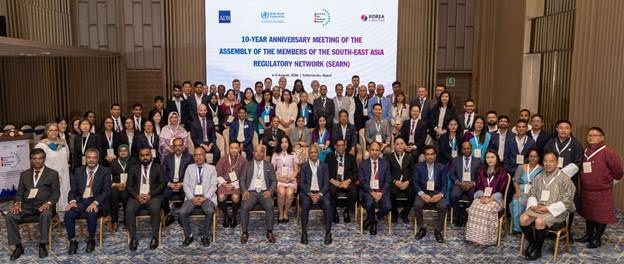
The milestone announcement came during SEARN’s 10th Anniversary Meeting in Kathmandu, Nepal, held August 4–5, 2026. The designation positions India at the operational heart of regional efforts to monitor adverse drug reactions, detect substandard or falsified pharmaceuticals, and harmonize safety standards across 11 Member States serving over 2 billion people.
Elevating Regional Drug Standards
Established as an autonomous institution under India’s Ministry of Health & Family Welfare, the IPC sets the standards for all drugs manufactured, sold, and consumed in India—a country often dubbed the “Pharmacy of the World.”
By designating the IPC as a regional hub, WHO SEARN aims to leverage India’s expansive monitoring infrastructure to lift regulatory capabilities across neighboring nations, including Bangladesh, Bhutan, Nepal, Sri Lanka, and Thailand.
“This recognition is not merely an honor; it is an operational responsibility,” said Dr. V. Kalaiselvan, Secretary-cum-Scientific Director of the IPC, who led the delegation in Kathmandu. “By sharing our standards, technical expertise, and pharmacovigilance networks with our regional neighbors, we can build a resilient, unified defense against unsafe medicines.”
+-----------------------------------------------------------------------------------+
|                        WHO SEARN REGIONAL NETWORK IMPACT                          |
+-----------------------------------------------------------------------------------+
|  • Scope: 11 Member States across South-East Asia                                |
|  • Coverage: Population exceeding 2.0 billion people                              |
|  • Target Functions: Safety Monitoring, Reference Standards, Quality Assurance    |
+-----------------------------------------------------------------------------------+
What Is Pharmacovigilance and Why Does It Matter?
While “pharmacovigilance” sounds like complex jargon, its core mission is simple: monitoring the real-world safety of medicines after they reach the market.
When a clinical trial tests a new drug, it involves thousands of participants. However, once that drug is approved, millions of people with varying medical histories, ages, and genetic backgrounds start taking it. Pharmacovigilance is the continuous surveillance system designed to detect rare side effects, unexpected drug interactions, or manufacturing defects that only become apparent when millions use the medication.
| Key Term | What It Means in Simple Terms |
| Pharmacovigilance (PvPI) | The science and activities relating to the detection, assessment, understanding, and prevention of adverse effects from medicines. |
| Materiovigilance (MvPI) | The systematic monitoring of adverse events related to medical devices (e.g., implants, pacemakers, surgical tools). |
| Reference Substances (IPRS/IMPRS) | Highly purified chemical standards used by laboratories to test whether commercial drugs meet strict chemical quality criteria. |
Independent experts view the IPC’s elevation as a critical win for consumer safety across Asia.
“A medicine is only as good as the system monitoring it,” noted Dr. Sunita Rao, an independent pharmaceutical policy specialist and former consultant to international global health agencies, who was not involved in the Kathmandu meeting. “South-East Asia faces unique public health challenges, including high disease burdens and vulnerable supply chains. Having a designated Regional Centre of Excellence means smaller nations can rely on India’s rigorous testing framework, scientific infrastructure, and established safety databases to protect their own patient populations.”
The Power of Regional Reliance Mechanisms
Under WHO SEARN’s framework, regional cooperation works through “regulatory reliance”—a mechanism where smaller or resource-constrained national regulatory authorities can rely on the assessments, laboratory testing, and safety reports generated by a regional lead like the IPC.
During the Kathmandu summit, the IPC delegation detailed several core programs that will serve as the technical backbone for this collaboration:
-
The Pharmacovigilance Programme of India (PvPI): A nationwide network collecting spontaneous adverse drug event reports from hundreds of medical colleges and hospitals.
-
The Materiovigilance Programme of India (MvPI): A specialized tracking system focused on medical device safety.
-
Indian Pharmacopoeia Reference Standards: Providing regional testing labs with verified chemical reference samples to screen out substandard or counterfeit medications.
What This Means for Everyday Health Decisions
For health-conscious consumers and patients across South-East Asia, the WHO SEARN designation offers practical reassurance regarding daily medical care:
-
Faster Recall of Unsafe Drugs: Real-time data sharing across borders allows regulatory agencies to identify toxic batches or unforeseen drug interactions rapidly, pulling dangerous products off pharmacy shelves before wide-scale harm occurs.
-
Consistent Drug Quality: Standardized chemical testing ensures that a generic antibiotic or maintenance medication purchased in one country meets the exact same quality and potency standards as one purchased in another.
-
Stronger Medical Device Oversight: Expanded tracking mechanisms ensure that healthcare providers receive prompt alerts regarding structural failures or safety recalls in medical implants and clinical equipment.
Ongoing Challenges and Counterarguments
Despite the celebratory tone of the 10th Anniversary Meeting, public health policy experts caution that official designations alone cannot solve deep-seated regional vulnerabilities.
Critics and regulatory analysts emphasize several ongoing hurdles:
-
Resource Asymmetries: While India possesses extensive testing infrastructure, neighboring national regulatory bodies often lack the personnel or laboratory equipment required to implement regulatory guidance rapidly.
-
Under-Reporting: Spontaneous reporting systems depend heavily on doctors, pharmacists, and patients voluntarily submitting side-effect reports. Under-reporting remains a persistent problem throughout lower- and middle-income countries.
-
Counterfeit Networks: Sophisticated illegal supply chains frequently bypass formal regulatory channels, requiring strong cross-border law enforcement alongside scientific oversight.
Building true regional security requires sustained funding, continuous training, and transparent communication across all participating governments.
A Decade of SEARN and the Road Ahead
Since its establishment by WHO SEARO in 2016, SEARN has transformed from an informal networking group into a structured regulatory umbrella. As SEARN enters its second decade, the IPC’s dual designation as a Regional Centre of Excellence in Pharmacovigilance and a Technical Centre in Quality of Medicines signals a shift toward practical execution.
By serving as a central scientific engine for South-East Asia, the IPC’s expanded mandate reinforces a fundamental principle of global health: drug safety knows no borders, and protecting patients anywhere requires rigorous science everywhere.
Reference Section
Primary News Source
-
Press Information Bureau (PIB) Delhi, Government of India. “Indian Pharmacopoeia Commission (IPC) Recognized by WHO SEARN as Regional Centre of Excellence in Pharmacovigilance and Technical Centre in Quality of Medicines.” Ministry of Health & Family Welfare, Posted August 5, 2026.
Institutional & Regulatory Sources
-
World Health Organization Regional Office for South-East Asia (WHO SEARO). South-East Asia Regulatory Network (SEARN) Operational Framework and Working Groups. WHO Guidelines on Regulatory Reliance and Systems Strengthening.
-
Indian Pharmacopoeia Commission (IPC). Pharmacovigilance Programme of India (PvPI) & Materiovigilance Programme of India (MvPI) Guidelines. Ministry of Health & Family Welfare, Government of India.
Expert Consultations
-
Dr. V. Kalaiselvan, Secretary-cum-Scientific Director, Indian Pharmacopoeia Commission (IPC). Statements delivered at the WHO SEARN 10th Anniversary Meeting, Kathmandu, Nepal, August 4–5, 2026.
-
Dr. Sunita Rao, PhD, Independent Pharmaceutical Policy Analyst & Global Health Consultant. Interview conducted August 6, 2026.
Medical Disclaimer: This article is for informational purposes only and should not be considered medical advice. Always consult with qualified healthcare professionals before making any health-related decisions or changes to your treatment plan. The information presented here is based on current research and expert opinions, which may evolve as new evidence emerges.


Happy
0 %

Sad
0 %

Excited
0 %

Sleepy
0 %

Angry
0 %

Surprise
0 %