 0
0
 0
0
Read Time:4 Minute, 0 Second
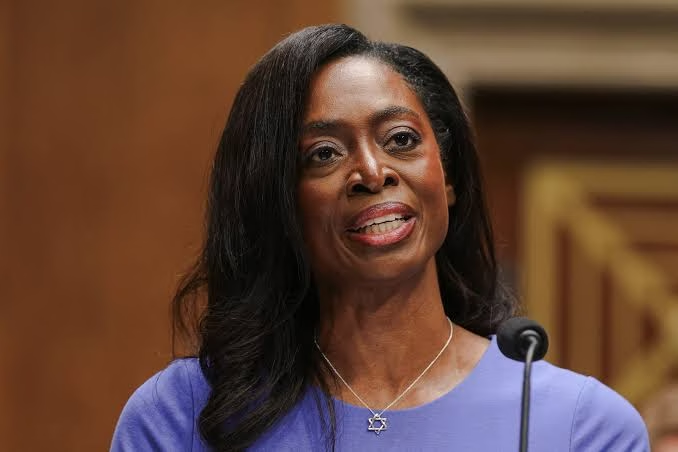
WASHINGTON — In a narrow 51-44 vote on Wednesday, August 5, 2026, the U.S. Senate confirmed Dr. Erica Schwartz to serve as the 22nd director of the Centers for Disease Control and Prevention (CDC). The decision fills a critical leadership void after nearly a year without a Senate-approved director at the nation’s premier public health agency. As a physician, attorney, and retired Rear Admiral in the U.S. Public Health Service Commissioned Corps, Dr. Schwartz steps into the role during a high-stakes moment marked by political friction, internal staff turnover, and evolving public health challenges.
A Polarized Vote Ends Nearly a Year of Uncertainty
The vote concluded months of ambiguity surrounding the leadership of the Atlanta-based agency. The confirmation represents a notable legislative success for the administration following earlier difficulties in securing leadership for pivotal federal health positions.
The vote largely split along party lines, reflecting ongoing congressional debates over public health governance. Senator Tim Kaine of Virginia stood out as the sole Democratic lawmaker to vote in favor of the confirmation.
Public health organizations and medical professionals closely watched the confirmation process. The CDC serves as the backbone of the nation’s health infrastructure—responsible for national disease surveillance, immunisation guidelines, outbreak response, and evidence-based guidance for healthcare workers and the public.
A Background Spanning Medicine, Law, and Military Service
Dr. Schwartz brings a multi-disciplinary background to the agency’s helm:
-
Military and Public Health Service: Served as Deputy Surgeon General and held key roles within the U.S. Coast Guard, overseeing health operations and emergency readiness.
-
Pandemic Response Expertise: Played a direct operational role in coordinating logistics for COVID-19 vaccine distribution across federal health systems.
-
Dual-Degree Training: Holds both a Doctor of Medicine (M.D.) and a Juris Doctor (J.D.), providing her with a specialized foundation in medical practice and regulatory law.
Her nomination was met with cautious optimism by mainstream public health advocates. Unlike some recent political appointments in health policy, Dr. Schwartz is viewed as a traditional institutional candidate. She has consistently supported routine childhood vaccination programs. During her Senate confirmation hearing, lawmakers questioned her extensively on whether she would preserve the agency’s scientific rigor and resist external political influence.
What Stable Leadership Means for Daily Public Health
For patients, families, and practicing clinicians, federal leadership transitions carry direct real-world consequences. The CDC establishes clinical standards that dictate how local doctors diagnose emerging infectious diseases, how hospitals handle infection control, and when schools or workplaces update safety protocols.
Vaccination policy remains a primary example of how federal recommendations touch daily life. Rigorous scientific data compiled by the CDC shows that remaining up to date on recommended vaccines—including annual influenza and COVID-19 immunizations—dramatically lowers the risk of severe illness, hospitalization, and emergency department visits, while offering protective benefits against post-viral complications such as Long COVID.
“When a major public health agency maintains stable, Senate-confirmed leadership, local health departments and practicing physicians can trust and act on official guidance with greater agility,” noted a public health physician not involved in the nomination process. “Clear, transparent communication grounded in rigorous data is essential to protecting community health.”
Key Priorities for the New Administration
| Focus Area | Core Objective | Impact on the Public |
| Disease Surveillance | Modernize real-time tracking of emerging pathogens. | Faster warning systems for local outbreaks. |
| Institutional Stability | Address staff attrition and boost internal morale. | Retains veteran scientists and research integrity. |
| Clinical Guidance | Streamline communication with healthcare providers. | Clearer, consistent advice from primary care doctors. |
| Vaccine Safety | Maintain transparent evaluation procedures. | Preserves trust in routine immunization schedules. |
Ongoing Challenges and Open Questions
Despite the confirmation, significant operational and political hurdles lie ahead. Observers note that leadership change alone cannot instantly resolve internal morale issues, retain departing scientific personnel, or bridge polarized public opinions on health mandates.
Furthermore, Dr. Schwartz will navigate her mandate under Health and Human Services (HHS) Secretary Robert F. Kennedy Jr., whose public stance on vaccine safety has frequently diverged from established scientific consensus. How Dr. Schwartz balances cabinet-level directives with the CDC’s historical commitment to independent, peer-reviewed science will serve as a primary benchmark of her tenure.
For healthcare consumers, medical experts stress that baseline health practices should remain steady: rely on peer-reviewed guidance, consult trusted primary care providers for personal medical decisions, and stay informed through verified public health channels.
Medical Disclaimer: This article is for informational purposes only and should not be considered medical advice. Always consult with qualified healthcare professionals before making any health-related decisions or changes to your treatment plan. The information presented here is based on current research and expert opinions, which may evolve as new evidence emerges.
References
-
Reuters. “US Senate confirms Schwartz as CDC director.” Published August 5, 2026. Reuters Coverag


Happy
0 %

Sad
0 %

Excited
0 %

Sleepy
0 %

Angry
0 %

Surprise
0 %