 0
0
 0
0
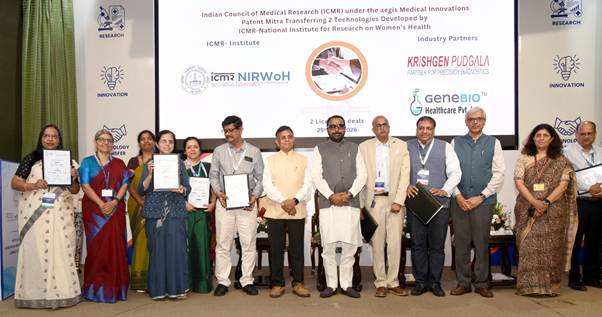
NEW DELHI — In a major move to transform how medical research reaches the public, the Indian Council of Medical Research (ICMR) hosted the country’s largest-ever biomedical innovation and technology transfer event here on Monday.
The initiative, named “Medical Innovations Patent Mitra: Innovators-to-Industry (I2I) Connect,” bridges the long-standing gap between laboratory discoveries and mass manufacturing. By commercializing 41 homegrown public health technologies—including critical diagnostic kits and vaccines—the event signals a shift in India’s role from a global consumer of medical technology to an international exporter of affordable healthcare solutions.
Bridging the “Valley of Death” in Medical Research
For decades, global medical research has suffered from what scientists call the “valley of death”—a phenomenon where promising laboratory discoveries fail to reach patients because researchers lack the resources, patent knowledge, or industry connections to mass-produce them.
The Patent Mitra initiative functions as a specialized facilitation cell. It actively helps scientists protect their intellectual property (IP), navigate regulatory pathways, and match with pharmaceutical manufacturers who can bring these products to market at scale.
[Laboratory Discovery] ➔ [Patent Mitra (IP & Regulatory Support)] ➔ [Industry Partner] ➔ [Affordable Patient Care]
During his keynote address at the Manekshaw Centre, Shri Prataprao Ganpatrao Jadhav, Union Minister of State for Health and Family Welfare, emphasized that the initiative is a decisive step toward national self-reliance.
“India is moving from being a consumer of health technologies to becoming a global source of affordable and innovative healthcare solutions, powered by institutions like ICMR and strong industry partnerships,” Jadhav stated.
Breakthroughs in Vaccine Manufacturing and Diagnostics
The centerpiece of the I2I Connect event was the immediate transfer of 41 public health technologies to commercial industry partners. The portfolio spans affordable medical devices, advanced therapeutics, and point-of-care diagnostics designed for resource-limited settings.
Key Technologies Transferred to Industry:
-
Next-Generation Vaccines: Advanced glycoconjugate and recombinant vaccines targeting Typhoid and Paratyphoid.
-
Rapid Diagnostics: Low-cost, highly accurate diagnostic kits for Japanese Encephalitis, Tuberculosis (TB), and Mpox.
-
Critical Biomaterials: For the first time, ICMR transferred well-characterized, inactivated biomaterials for Kyasanur Forest Disease (KFD) and Chandipura virus directly to private manufacturers to accelerate localized vaccine production.
The inclusion of Chandipura virus and KFD biomaterials is particularly significant for public health. Chandipura virus, primarily affecting children in rural areas, can cause rapid, fatal encephalitis (brain inflammation). Historically, a lack of standardized testing materials has slowed down the development of effective treatments.
What This Means for Everyday Healthcare
For the general public, the commercialization of these technologies is expected to drive down healthcare costs significantly. Locally manufactured diagnostic kits eliminate import duties and reliance on foreign supply chains, which frequently cause shortages during regional outbreaks.
Independent experts view the platform as a necessary evolutionary step for Indian healthcare.
“When a public institution like ICMR partners directly with private manufacturers, it changes the market dynamics,” says Dr. Anita Sharma, a public health policy analyst not involved with the event. “It means a diagnostic test that used to cost several thousand rupees because it was imported might now be available at a fraction of the cost at a local primary health center. This directly impacts patient compliance and early disease detection.”
The Landscape Ahead: Scale, Limitations, and Balancing Safety
Despite the optimism surrounding the launch, public health experts note that technology transfer is only the first step in a complex ecosystem. Bringing 41 technologies to market introduces distinct logistical hurdles.
| Phase | Critical Milestones & Challenges |
| 1. Technology Transfer | Successfully achieved at the I2I Connect event; blueprints and biomaterials handed over. |
| 2. Commercial Upscaling | Manufacturers must adapt delicate laboratory processes to high-volume assembly lines without compromising quality. |
| 3. Clinical Trials & Regulatory Review | New formulations and devices must clear strict Central Drugs Standard Control Organisation (CDSCO) safety trials. |
| 4. Cold Chain & Distribution | Vaccines and diagnostic reagents require robust temperature-controlled shipping infrastructure to reach rural India. |
“A successful technology transfer does not mean a product will be on pharmacy shelves next month,” cautions Dr. Sharma. “Private industry must still invest heavily in clinical validation, scale up manufacturing under strict Good Manufacturing Practices (GMP), and secure regulatory approvals. There is always a risk that some transferred technologies may stall during the scaling phase if production costs prove unviable.”
Furthermore, balancing rapid deployment with rigorous safety evaluation remains paramount. Dr. Rajiv Bahl, Director General of ICMR and Secretary of the Department of Health Research, assured attendees that the Patent Mitra framework is designed to accelerate, not bypass, regulatory checkpoints.
“Medical Innovations Patent Mitra accelerates the journey of indigenous biomedical research from laboratories to people,” Dr. Bahl said, noting that the release of the inaugural Indian Biomedical Patent Landscape Report alongside the event will give the industry a transparent roadmap of safety and compliance standards.
A Vision for Global Leadership
As India targets its “Viksit Bharat” (Developed India) goals, the focus on health infrastructure has shifted toward global leadership. Dr. Gobardhan Das, Member of NITI Aayog, re-emphasized that the domestic talent pool is fully capable of competing on the world stage.
“India has the scientific capability and innovation ecosystem to emerge as a global leader in health technologies,” Dr. Das stated during the proceedings. “Medical Innovation Patent Mitra will play a crucial role in protecting intellectual property, enabling technology transfer, and accelerating the journey of indigenous innovations from laboratories to society.”
By establishing a permanent pipeline where independent innovators, startups, and public scientists can seamlessly hand off validated research to industrial scale-manufacturing, India is constructing a resilient health ecosystem designed to withstand future pandemics while making daily healthcare highly accessible.
Reference Section
Institutional Sources
-
Indian Council of Medical Research (ICMR): Official proceedings and press releases from the “Medical Innovations Patent Mitra: Innovators-to-Industry (I2I) Connect” event, New Delhi (May 25, 2026).
-
Press Information Bureau (PIB), Government of India: Ministry of Health and Family Welfare directive on biomedical technology transfers (Posted May 25, 2026).
Medical Disclaimer: This article is for informational purposes only and should not be considered medical advice. Always consult with qualified healthcare professionals before making any health-related decisions or changes to your treatment plan. The information presented here is based on current research and expert opinions, which may evolve as new evidence emerges.