 0
0
 0
0
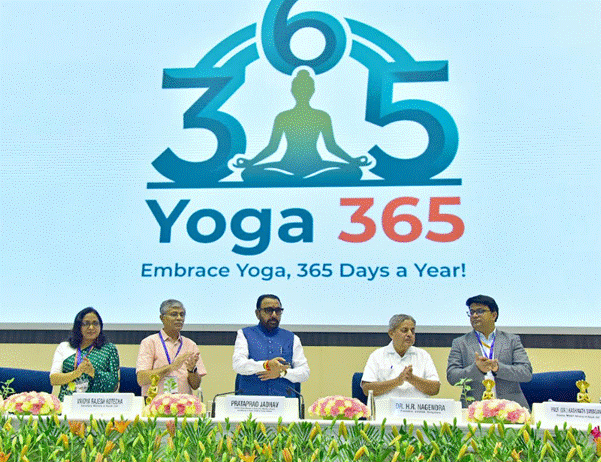
NEW DELHI — In a strategic shift from annual celebration to permanent lifestyle integration, the Union Ministry of Ayush has officially unveiled “Yoga 365,” a nationwide campaign designed to transform yoga from a once-a-year event into a daily health ritual. Launched during the Yoga Mahotsav–2026 at Vigyan Bhawan, the initiative seeks to bridge a significant “practice gap” in a country where nearly the entire population is aware of yoga’s benefits, yet only a fraction practices it consistently.
The campaign marks the 100-day countdown to the 2026 International Day of Yoga (IDY) and introduces a digital-first approach to wellness, highlighted by a new partnership with the platform Habuild to provide free, daily guided sessions to citizens across the globe.
The “Delta” of Wellness: Bridging the Gap
While the International Day of Yoga has seen participation swell to over 260 million people as of 2025, government data suggests that the transition to daily habit remains the final frontier for public health officials.
According to the National Sample Survey (NSS) 79th Round, awareness of traditional wellness systems is nearly universal in India, standing at 95% in rural areas and 96% in urban centers. However, the actual practice is far less common. Currently, regular yoga practice is reported in approximately 1.1 crore (11 million) rural households and 1.4 crore (14 million) urban households.
“This gap between awareness and practice is precisely what the Yoga 365 campaign seeks to bridge,” stated Shri Prataprao Jadhav, Hon’ble Union Minister of State for Ayush. “Yoga is a powerful discipline for mental clarity, physical health, and emotional balance. Our effort is to encourage people to integrate yoga into their daily routines so that wellness becomes a way of life rather than an occasional activity.”
Evidence-Based Benefits of Daily Practice
The push for daily integration is supported by a growing body of clinical research. Unlike sporadic exercise, consistent yoga practice—often referred to as “low-dose, high-frequency” intervention—has been shown to significantly impact non-communicable diseases (NCDs).
A 2023 meta-analysis published in the Journal of Clinical Medicine suggests that regular yoga practice can reduce markers of systemic inflammation and lower cortisol levels, the body’s primary stress hormone. Furthermore, the Ministry of Ayush has recently introduced specific yoga protocols aimed at managing NCDs such as hypertension and Type 2 diabetes.
“Yoga functions as a mind-body medicine,” says Dr. Ananya Sharma, a preventive medicine specialist not affiliated with the Ministry. “When practiced daily, it moves beyond mere stretching. It helps regulate the autonomic nervous system, which is crucial for cardiovascular health and immune function. The challenge for most patients isn’t the difficulty of the poses, but the consistency of the habit.”
Digital Accessibility and Institutional Integration
To lower the barrier to entry, the Morarji Desai National Institute of Yoga (MDNIY) has signed a Memorandum of Understanding (MoU) with the wellness platform Habuild. This collaboration aims to provide:
-
Free Daily Sessions: Online guided yoga accessible via smartphones.
-
Scalable Outreach: Moving beyond physical yoga centers to reach remote geographies.
-
Adaptive Protocols: Sessions tailored for various fitness levels and age groups.
The Yoga 365 framework also incorporates the “Y-Break” (Yoga Break) protocol, a five-minute routine designed specifically for corporate employees to de-stress and refocus during the workday. By embedding these “micro-habits” into schools, offices, and neighborhood groups, the Ministry hopes to make yoga a “natural part of the everyday routine,” according to Ms. Monalisa Dash, Joint Secretary, Ministry of Ayush.
Addressing Limitations and Challenges
While the initiative is ambitious, experts note that “one size does not fit all” in medical wellness. Critics of mass-marketed yoga programs often point to the risk of injury when practice is not supervised by trained professionals, particularly for individuals with pre-existing musculoskeletal conditions or chronic illnesses.
Furthermore, behavioral scientists argue that digital access alone may not be enough to sustain long-term change. “The transition from awareness to action requires more than a free app,” notes Dr. Sharma. “It requires community support and environmental cues. The ‘Yoga 365’ plan to involve community groups and institutions is a step in the right direction, as social accountability is often the key to habit formation.”
Public Health Implications
The broader vision of Yoga 365 is to alleviate the burden on India’s healthcare infrastructure by emphasizing preventive care. As NCDs continue to rise globally, low-cost, high-impact lifestyle interventions like yoga offer a sustainable path toward “Universal Health Coverage.”
Vaidya Rajesh Kotecha, Secretary, Ministry of Ayush, emphasized that the campaign’s strategy is rooted in making yoga “practical and relevant for everyday health.” By moving the conversation from “why” we should do yoga to “how” we can do it every day, the initiative aims to create a culture where mental and physical maintenance is as routine as brushing one’s teeth.
As the 100-day countdown to June 21 begins, the success of Yoga 365 will ultimately be measured not by the number of people who gather in parks for one day, but by the number of mats that remain unrolled on June 22 and beyond.
Medical Disclaimer:
This article is for informational purposes only and should not be considered medical advice. Always consult with qualified healthcare professionals before making any health-related decisions or changes to your treatment plan. The information presented here is based on current research and expert opinions, which may evolve as new evidence emerges.
References
Institutional Sources:
-
Ministry of Ayush, Government of India. (2026). Launch of Yoga Mahotsav–2026 and Yoga 365 Initiative. Press Information Bureau (PIB) Delhi.