 0
0
 0
0
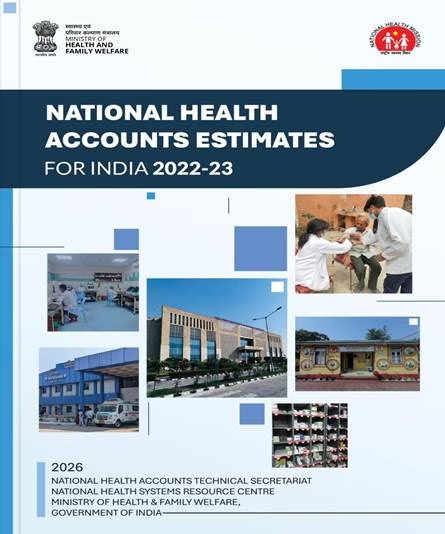
NEW DELHI — In a landmark shift for India’s healthcare landscape, the Union Health Ministry released its tenth annual National Health Accounts (NHA) estimates for the fiscal year 2022–23 on May 27, 2026. The comprehensive report reveals that government healthcare expenditure has nearly tripled over the last decade, expanding from ₹1.30 lakh crore in 2013–14 to ₹3.85 lakh crore in 2022–23. This unprecedented surge in public funding has significantly eased the financial strain on individual families, driving the citizen’s out-of-pocket healthcare burden down to a historic low.
The data, compiled by the National Health Accounts Technical Secretariat (NHATS) at the National Health Systems Resource Centre (NHSRC), shows a fundamental realignment in how healthcare is financed in India. For the first time in the nation’s modern economic history, public funding has effectively overtaken direct household medical costs as the primary driver of total health spending. Public health authorities view this structural inversion as a major milestone toward achieving Universal Health Coverage (UHC) across the country’s population of over 1.4 billion people.
The Decadal Shift: Rising Budgets and Falling Costs
The latest NHA figures illustrate a decade of steady, targeted increases in public health infrastructure. Government Health Expenditure (GHE) as a percentage of the nation’s Gross Domestic Product (GDP) climbed from 1.15% in 2013–14 to 1.43% in 2022–23. When evaluated under the newly instituted GDP tracking series with a 2022–23 baseline, that share reaches 1.48%.
This fiscal expansion is even more apparent when viewing individual and overall budget metrics:
-
Share of Total Spending: Public funding accounted for 43.7% of India’s Total Health Expenditure (THE) in 2022–23, skyrocketing from a meager 28.6% ten years prior.
-
Per Capita Funding: In individual terms, government health spending per citizen grew 2.7 times, rising from ₹1,042 to ₹2,786.
-
Budget Prioritization: Healthcare took a larger piece of the overall fiscal pie, with its share of General Government Expenditure (GGE) rising from 3.78% to 4.89%.
This consistent public investment directly correlates with a steep decline in Out-of-Pocket Expenditure (OOPE)—the money individuals must pay directly at pharmacies and clinics. In 2013–14, direct household costs made up a staggering 64.2% of all health spending in India. By 2022–23, that number plummeted by nearly 21 percentage points down to 43.4%.
Primary Healthcare Takes Center Stage
A major catalyst behind the falling costs for families is the government’s heavy pivot toward localized, preventive care. Public spending on primary healthcare more than doubled, jumping from ₹0.5 lakh crore in 2013–14 to ₹1.4 lakh crore in 2022–23. According to the report, primary care now commands 46% of India’s combined public and private health expenditures, overshadowing secondary care at 34% and specialized tertiary hospital care.
Senior health ministry officials attribute this protective shift to the widespread rollout of more than 180,000 Ayushman Arogya Mandir wellness centers across rural and semi-urban districts. These local hubs provide 12 expanded packages of medical services, ranging from maternal and child healthcare to free essential drugs, diagnostic testing, and non-communicable disease screenings. By managing conditions like hypertension and diabetes early at a neighborhood level, these centers drastically reduce downstream hospitalizations that historically forced families into medical debt.
The Pandemic “Boost” and a Growing Safety Net
The report highlights a clear decadal trend line showing a massive spending spike during the height of the COVID-19 crisis. Faced with a global emergency, the government elevated its healthcare spending to a temporary peak of 1.84% of GDP during the 2021–22 fiscal year.
This funding funded the Emergency COVID Response Packages (ECRP-I & II) and financed the world’s largest mass vaccination initiative. While this was a one-time emergency intervention, it left behind an expanded baseline of physical medical infrastructure and drove household out-of-pocket expenses down to a temporary low of 39.4% during that period.
Simultaneously, India’s broader financial safety net has matured. Social Security Expenditure (SSE) on health—which covers public financial risk programs like the Ayushman Bharat Pradhan Mantri Jan Arogya Yojana (AB PM-JAY), social health insurance schemes, and medical reimbursements for government workers—nearly doubled from 6% to 9.9% of total spending. Concurrently, private health insurance expanded from 3.4% to 9.2%, demonstrating a substantial rise in consumer awareness and financial literacy regarding medical risk planning.
Expert Perspectives and the “Missing Middle”
Independent public health analysts have welcomed the report’s findings but note that a deeper dive reveals areas requiring urgent attention. Independent experts point out that while percentages are falling, absolute household spending remains a heavy burden because of broader market conditions.
“While the drop in out-of-pocket expenditure as a share of total spending is highly positive, absolute household costs remain considerable because overall healthcare expenses and inflation have surged over the decade,” observed Dr. Rajeev Jayadevan, a prominent public health expert, in an interview with Livemint.
Dr. Jayadevan also warned of an unfolding demographic gap in India’s current universal care architecture:
“More critically, nearly 300 to 400 million working-class Indians—like drivers, gig workers, and shopkeepers—form a ‘Missing Middle.’ They do not qualify for low-income government schemes like Ayushman Bharat, yet they lack corporate health benefits or the personal wealth to afford high-quality private coverage.”
Furthermore, detailed spending breakdowns show that commercial pharmacies still drive the bulk of household expenses. The retail purchase of pharmaceuticals, including everyday prescriptions, health supplements, vitamins, and protein formulations, remains the single largest component of remaining out-of-pocket expenditures.
What This Means for Your Health Decisions
For health-conscious consumers and everyday citizens, India’s shifting health economics offer direct practical benefits:
-
Utilize Free Grassroots Networks: Before visiting commercial hospitals for routine diagnostics, basic treatments, or chronic care management, check your nearest Ayushman Arogya Mandir. Utilizing these government-vetted wellness centers for free drug packages and diagnostics can save thousands of rupees annually.
-
Re-evaluate Your Insurance Portfolio: With private and social insurance pools widening, citizens who fall into the “Missing Middle” should proactively explore low-cost, retail private health insurance. Do not wait for a medical emergency to evaluate healthcare purchasing power.
-
Focus on Preventive Medicine: Take advantage of community-based health screenings. Catching systemic metabolic conditions early prevents high-cost tertiary hospital stays down the line.
References & Methodology
1https://www.pib.gov.in/PressReleasePage.aspx?PRID=2265816®=3&lang=1
Medical Disclaimer: This article is for informational purposes only and should not be considered medical advice. Always consult with qualified healthcare professionals before making any health-related decisions or changes to your treatment plan. The information presented here is based on current research and expert opinions, which may evolve as new evidence emerges.