 0
0
 0
0
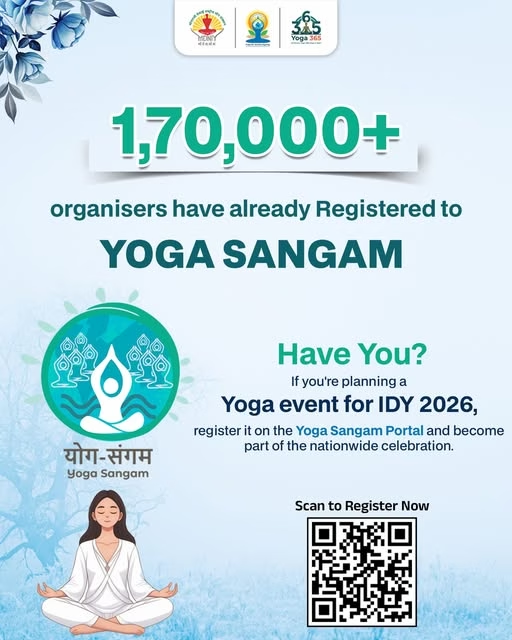
NEW DELHI — As India prepares to celebrate the 12th International Day of Yoga (IDY) on June 21, 2026, the Ministry of Ayush has deployed a scaled-up version of its digital ecosystem to coordinate an unprecedented nationwide wellness campaign. At the forefront of this technological shift is the relaunched Yoga Sangam Portal, an online platform that has already registered more than 1.7 lakh event organisers. By shifting public health delivery from localized mega-events to a decentralized, citizen-led model, the initiative represents a significant evolution in how public health campaigns leverage technology to tackle global lifestyle diseases.
Scaling a Distributed Wellness Movement
The platform’s relaunch was officiated in Khajuraho, Madhya Pradesh, by Shri Prataprao Jadhav, Union Minister of State (Independent Charge) for Ayush and Minister of State for Health and Family Welfare, marking the 25-day countdown to IDY 2026. The digital architecture acts as a centralized administrative hub for a decentralized execution strategy. Rather than inviting citizens to a singular mass venue, the platform enables schools, residential welfare associations, corporate entities, and civil society groups to establish independent regional hubs.
This hybrid approach addresses a common limitation of national health initiatives: sustainability. By encouraging local communities to own and organize their events, the initiative attempts to transition an annual observance into a sustained routine. Partner organizations are tasked with managing localized logistics and reporting participation metrics, for which they receive institutional certification from the Ministry of Ayush.
The present momentum builds directly upon infrastructure validated during IDY 2025. In its inaugural deployment, the platform synchronized mass yoga demonstrations across more than 10 lakh unique locations and logged 13.04 lakh registered events nationwide. The 2026 version features enhanced server capacity to facilitate simultaneous photo uploads, automated reporting, and real-time geographic mapping of active wellness centers.
Standardizing Public Health Interventions: The Common Yoga Protocol
A key operational challenge of decentralized exercise campaigns is maintaining quality control and safety. To ensure uniformity across thousands of autonomous locations, the Ministry utilizes the Common Yoga Protocol (CYP)—a standardized, expert-vetted sequence of asanas (postures), pranayama (regulated breathing techniques), and meditation.
[Yoga Sangam Digital Portal]
          │
          ├──> Schools & Universities ───> Local CYP Execution
          ├──> Residential Association ──> Local CYP Execution
          └──> Private Corporations ─────> Local CYP Execution
From a clinical epidemiology standpoint, this standardization allows researchers to treat mass participation as a structured, measurable lifestyle intervention.
“Yoga Sangam represents a crucial shift toward community-driven preventative health,” says Dr. Anita Roy, an independent public health consultant based in New Delhi who was not involved in the portal’s design. “By using a uniform framework like the Common Yoga Protocol, the initiative removes guesswork, making structural physical activity accessible to populations with varying fitness baselines.”
The Clinical Substrate: Mitigating Chronic Metabolic Risk
The focus on broad public participation comes at a time when non-communicable diseases (NCDs)—such as type 2 diabetes, hypertension, and cardiovascular diseases—comprise a rising share of the global healthcare burden. Medical literature supports utilizing standardized yoga protocols as low-cost, primary preventative measures.
A peer-reviewed, open-label prospective trial published in Frontiers in Public Health tracked 374 yoga-naïve participants who practiced the Common Yoga Protocol for 30 days under trained supervision. The clinical data revealed significant metabolic improvements from baseline to day 30:
-
Lipid Optimization: Serum levels of low-density lipoprotein (LDL, often termed “bad” cholesterol) and total cholesterol (TC) decreased significantly.
-
Cardiovascular Biomarkers: High-density lipoprotein (HDL, or “good” cholesterol) levels showed marked improvement.
-
Autonomic Regulation: Regular practitioners demonstrated improvements in resting blood pressure, fasting blood glucose, and neurocognitive performance metrics.
Additionally, a separate clinical trial published in the Journal of Non-Communicable Diseases analyzed 90 individuals with mild-to-moderate dyslipidemia over three months. The study confirmed that regular adherence to the CYP protocol, especially when integrated with dynamic sequences like Surya Namaskar (Sun Salutations), restored baroreceptor sensitivity and down-regulated the hypothalamic-pituitary-adrenal (HPA) axis, reducing circulating stress hormones such as cortisol.
Logistical Bottlenecks and Methodological Boundaries
While the scale of 1.7 lakh registered organizers indicates high digital adoption, independent medical analysts urge caution regarding public health conclusions drawn from self-reported data.
One primary systemic limitation is attrition and execution fidelity. In structured clinical trials of the Common Yoga Protocol, drop-out rates frequently range between 15% and 25% over a multi-month period. Translating a single-day mass mobilization on June 21 into long-term behavioral change requires community support systems that extend past the conclusion of the event.
Furthermore, there is a risk of technical exclusion. Although the digital portal streamlines institutional registration, populations in rural areas with limited internet access may face barriers to participation, potentially widening health literacy gaps between urban centers and rural areas.
From a patient-safety perspective, medical professionals emphasize that standardized protocols are not universally applicable. While the CYP is designed to be gentle, specific populations—including pregnant individuals, older adults with balance issues, and those with advanced osteoarthritis or uncontrolled severe hypertension—must modify or avoid specific inversions and rapid breathing cycles (Kapalabhati) to avoid injury.
Implications for Future Health Campaigns
The Yoga Sangam model provides a blueprint for managing large-scale public health interventions through digital organization. By relying on local facilitators rather than an expanded government workforce, the system lowers the administrative cost per participant.
If the platform maintains its current growth trajectory through June 21, the data collected could offer insights into population-wide engagement with preventative health measures. For health-conscious consumers, the portal provides an accessible entry point to a standardized health practice, underscoring the role of digital infrastructure in supporting personal health decisions.
References
-
Press Information Bureau (PIB) Delhi, Ministry of Ayush. Government Statement issued on June 17, 2026.
Medical Disclaimer: This article is for informational purposes only and should not be considered medical advice. Always consult with qualified healthcare professionals before making any health-related decisions or changes to your treatment plan. The information presented here is based on current research and expert opinions, which may evolve as new evidence emerges.