 0
0
 0
0
NEW DELHI — A landmark shift is occurring in how 1.4 billion people interact with the Indian healthcare system. According to the newly released National Statistical Office (NSO) 80th Round Survey on Household Social Consumption: Health, India has witnessed a dramatic expansion in healthcare coverage, a surge in proactive health-seeking behavior, and a significant reduction in the financial burden on the nation’s most vulnerable populations.
The survey, which canvassed 139,732 households across both rural and urban sectors, provides a definitive look at the country’s medical landscape as of 2026. The data suggests that sustained public investment and the scaling of the Ayushman Bharat ecosystem are fundamentally altering the “out-of-pocket” crisis that has historically plagued Indian households.
The End of the “Silence of Sickness”?
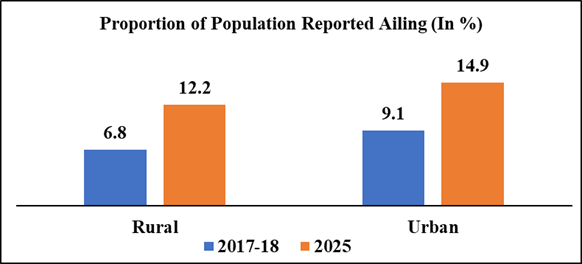
Perhaps the most striking finding is the doubling of the Proportion of Population Reporting Ailments (PPRA). In rural areas, this figure rose from 6.8% in 2017-18 to 12.2% in 2025; urban areas saw a jump from 9.1% to 14.9%.
While a rise in reported illness might initially seem concerning, public health experts view it as a triumph of awareness. “Historically, many Indians—particularly in rural belts—ignored symptoms until they became catastrophic,” says Dr. Aruna Sharma, a public health policy consultant not involved in the NSO study. “This ‘nearly doubling’ indicates a decisive shift toward proactive health-seeking behavior. People are no longer suffering in silence; they are seeking care because they believe it is accessible and affordable.”
This transition is also epidemiological. The survey notes a decline in infectious diseases alongside a rising prevalence of non-communicable diseases (NCDs) like diabetes and cardiovascular conditions. This reflects an aging population and a more robust screening apparatus at the primary care level.
The “Zero-Rupee” Reality in Public Care
For decades, Out-of-Pocket Expenditure (OOPE) was the leading cause of “medical impoverishment” in India. The 80th Round survey suggests the tide is turning:
-
Outpatient Care: The median OOPE for non-hospitalization care in public facilities has hit zero. This is attributed to the Free Drugs Service Initiative (FDSI) and Free Diagnostics Initiative (FDI).
-
Hospitalization: In more than half of all hospitalization cases at public facilities, the expenditure was recorded at just ₹1,100.
-
National Median: The median medical expenditure per hospitalization case nationwide stands at ₹11,285, suggesting that high-cost cases are becoming the exception rather than the rule.
“The fact that the median expenditure in public facilities is zero for outpatients is a game-changer,” notes Dr. Rajesh Kumar, a healthcare economist. “It validates the ‘hub-and-spoke’ diagnostic models and the expansion of over 1.84 lakh Ayushman Arogya Mandirs (AAMs), which act as the first point of contact for the community.”
Insurance Coverage: A Threefold Leap
The survey highlights a massive scaling of financial risk protection. Government-financed health insurance schemes, including Pradhan Mantri Jan Arogya Yojana (PM-JAY), have seen coverage skyrocket:
| Region | 2017-18 Coverage | 2025 Coverage |
| Rural | 12.9% | 45.5% |
| Urban | 8.9% | 31.8% |
This expansion is most visible among the bottom two consumption quintiles (the poorest 40% of the population), where out-of-pocket costs have shown a consistent downward trajectory. By removing the fear of “catastrophic health expenditure,” the government has incentivized families to seek institutional care rather than relying on informal or unqualified providers.
Maternal Health and Institutional Births
The report marks another milestone in maternal health. Institutional deliveries—births taking place in medical facilities rather than at home—have climbed to 95.6% in rural areas and 97.8% in urban areas.
This success is rooted in a suite of targeted interventions such as Janani Suraksha Yojana (JSY) and the Pradhan Mantri Surakshit Matritva Abhiyan (PMSMA). Notably, 66.8% of rural deliveries now occur in government health facilities, reflecting a restored trust in the public sector’s ability to handle high-stakes medical events.
Challenges and Limitations
Despite the optimistic data, some gaps remain. While public facility utilization is rising—increasing from 28% in 2014 to 35% in 2025 for rural outpatient care—a significant portion of the population still opts for private healthcare, where costs remain substantially higher.
Additionally, while the “median” expenditure is low, the “mean” (average) is often skewed by high-cost specialized treatments. This indicates that while primary and secondary care are becoming affordable, tertiary care for complex conditions still poses a financial risk for those not covered by insurance.
Practical Implications for Citizens
For the average reader, the NSO 80th Round findings offer three practical takeaways:
-
Utilize Primary Centers: Ayushman Arogya Mandirs are now equipped to handle free screenings and essential medicines, reducing the need to visit expensive city hospitals for minor ailments.
-
Verify Insurance Status: With nearly 50% of rural India now covered, families should check their eligibility for PM-JAY or state-specific schemes to avoid unnecessary spending.
-
Affordable Medication: The AMRIT pharmacies and Jan Aushadhi outlets offer discounts of up to 50–90% on market rates for chronic disease medications (like those for blood pressure and diabetes).
A New Era of Equity
The NSO 80th Round survey paints a picture of a healthcare system in transition—moving away from a “pay-to-survive” model toward a “right-to-health” framework. While the journey toward universal health coverage continues, the data suggests that for millions of Indians, the cost of getting better is no longer the price of staying out of poverty.
Medical Disclaimer: This article is for informational purposes only and should not be considered medical advice. Always consult with qualified healthcare professionals before making any health-related decisions or changes to your treatment plan. The information presented here is based on current research and expert opinions, which may evolve as new evidence emerges.
References
-
NSO Survey: National Statistical Office (NSO) 80th Round, “Household Social Consumption on Health in India” (Released April 2026).
-
Government Source: Press Information Bureau (PIB), Delhi. “NSO Survey Highlights Improved Healthcare Access Across India.” Posted 29 APR 2026.