 0
0
 0
0
Read Time:5 Minute, 23 Second
TRICHY, India — For millions living in rural and semi-urban India, a cancer diagnosis brings not only a fight for survival, but a formidable financial and logistical burden. High-end radiation therapy, a cornerstone of modern oncology, has historically been concentrated in tier-one metropolitan hubs. However, an innovative public-private financial partnership in Tamil Nadu is proving that advanced, affordable oncology services can thrive in regional centers, transforming the landscape of rural cancer care.
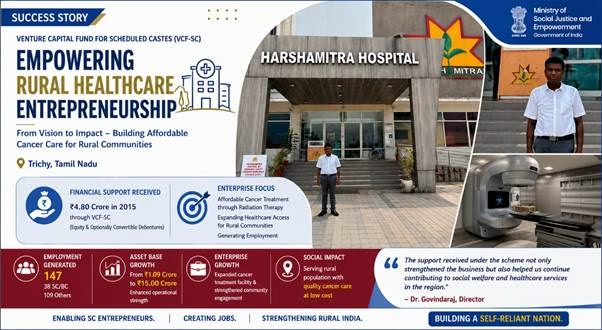
Through financial assistance from the Venture Capital Fund for Scheduled Castes (VCF-SC)—managed under the Ministry of Social Justice and Empowerment—Harshamitra Oncology Pvt. Ltd., located in Trichy, successfully expanded its specialised radiation therapy infrastructure. By securing ₹4.80 crore in combined equity and optionally convertible debentures, the facility, founded by renowned oncologist Dr. P. Govindaraj, expanded its capacity to serve thousands of economically disadvantaged patients who previously had to travel hundreds of kilometers for life-saving treatment.
This intervention highlights a growing push in global health policy: utilizing targeted social venture capital to build sustainable, high-tech healthcare infrastructure in medically underserved regions.
The Rural-Urban Divide in Global Cancer Care
Cancer remains one of the leading causes of morbidity and mortality worldwide. According to data from the World Health Organization (WHO) and the International Agency for Research on Cancer (IARC), approximately 70% of global cancer deaths occur in low- and middle-income countries. A major contributor to this disparity is the lack of equitable access to radiotherapy.
+-------------------------------------------------------------------------+
|                    THE ONCOLOGY ACCESSIBILITY GAP                       |
|                                                                         |
|  METROPOLITAN HUBS                   RURAL & SEMI-URBAN REGIONS         |
|  * High concentration of linacs     * Severe equipment shortages        |
|  * Advanced treatment techniques    * Travel burden (100-300+ km)       |
|  * Higher out-of-pocket costs        * Delayed diagnosis & treatment    |
|                                                                         |
+-------------------------------------------------------------------------+
Radiotherapy is required in over 50% of all cancer cases, either as a primary curative treatment, an adjuvant therapy alongside surgery and chemotherapy, or a palliative measure to relieve pain. Yet, linear accelerators (linacs)—the advanced machines used to deliver precise radiation doses while sparing surrounding healthy tissue—require substantial capital investment, complex shielding infrastructure (bunkers), and specialized personnel.
“When specialized medical equipment costs millions of dollars, private healthcare investment naturally clusters around affluent urban centers where patient purchasing power is higher,” explains Dr. Ananya Mukherjee, an independent healthcare economist and public health policy analyst not affiliated with the study. “This creates ‘care deserts’ in rural areas. Patients face impossible choices: incur catastrophic health expenditures traveling to distant cities, or forego treatment entirely.”
Scalable Infrastructure: The Harshamitra Model
Established with the explicit mission of delivering equitable oncology care, Harshamitra Super Speciality Cancer Hospital and Research Centre sought to disrupt this dynamic in Central Tamil Nadu. While the institution possessed clinical expertise, scaling radiation therapy operations required capital that traditional commercial lenders are often reluctant to extend to regional enterprises targeting low-margin, high-volume populations.
The intervention of the VCF-SC in 2015 provided the necessary capital injection. The ₹4.80 crore financial structure enabled the center to:
-
Upgrade Infrastructure: Expand specialized radiation bunkers designed to house modern radiotherapy equipment.
-
Enhance Clinical Capacity: Deliver precise radiation doses using modern treatment planning systems, reducing side effects and improving localized tumor control.
-
Generate Local Employment: Create direct clinical jobs (radiation therapists, medical physicists, oncology nurses) and indirect support positions within the local economy.
“The financial support received under the scheme not only strengthened our business operations, but crucially helped us continue contributing to social welfare and healthcare access across the region,” stated Dr. Govindaraj, founder and managing director of Harshamitra Oncology.
By offering high-end radiation protocols locally at subsidized or affordable rates, the enterprise reduced secondary costs for families, such as prolonged urban lodging, transport expenses, and lost daily wages for family caregivers.
Evaluating Public Health Impact and Policy Counterarguments
From a public health standpoint, decentralized cancer care improves early intervention rates and treatment compliance. When therapy is accessible near a patient’s home, the likelihood of treatment abandonment—a major cause of poor outcomes in rural oncology—drops significantly.
However, health policy experts emphasize that financial capital alone cannot guarantee sustainable healthcare delivery in rural sectors. Several operational challenges must be managed concurrently:
-
Workforce Retention: Recruiting and retaining skilled medical physicists, radiation oncologists, and specialized technicians in non-metropolitan areas remains a systemic bottleneck.
-
Equipment Maintenance: Advanced linear accelerators require strict quality assurance, calibration, and routine maintenance. Technical downtime in remote facilities can disrupt daily fractionated radiation protocols, potentially impacting clinical efficacy.
-
Comprehensive Support Systems: Radiotherapy is rarely a standalone solution. Optimal patient outcomes require multidisciplinary tumor boards, surgical oncology, palliative care, and nutritional support.
“Social venture capital funds like the VCF-SC are vital catalysts,” notes Dr. Rajesh Sundaram, a senior consultant in community medicine. “However, long-term success requires integration with broader public health schemes—such as state and national health insurance frameworks—to ensure that operational costs remain covered while patient out-of-pocket expenses stay near zero.”
Practical Takeaways for Patients and Families
For individuals living in rural or semi-urban communities navigating a cancer diagnosis, local access to certified radiation therapy offers distinct clinical and practical advantages:
-
Consistency of Care: Radiation therapy typically requires daily doses (fractions) delivered five days a week over 2 to 7 weeks. Receiving care locally minimizes physical fatigue and financial strain.
-
Early Consultation: Accessing local specialized diagnostic tools speeds up the time from initial symptom detection to treatment initiation.
-
Financial Navigation: Patients should inquire whether regional facilities participate in government welfare schemes, insurance programs, or subsidized care models designed for low-income households.
Looking Ahead: A Blueprint for Inclusive Healthcare
The expansion of Harshamitra Oncology underscores how institutional financial mechanisms can bridge critical healthcare gaps. By combining social entrepreneurship with targeted venture funding, regional facilities can provide medical care that matches the quality of urban centers.
As non-communicable diseases like cancer continue to rise in developing nations, scaling models that marry clinical excellence with financial accessibility will be essential to achieving universal health coverage.
References
-
Press Information Bureau (PIB), Delhi. (2026, August 5). Delivering Affordable Cancer Care to Rural Communities: How VCF-SC Enabled Harshamitra Oncology Pvt. Ltd. to Expand Quality Healthcare Services. Ministry of Social Justice and Empowerment, Government of India.
Medical Disclaimer: This article is for informational purposes only and should not be considered medical advice. Always consult with qualified healthcare professionals before making any health-related decisions or changes to your treatment plan. The information presented here is based on current research and expert opinions, which may evolve as new evidence emerges.


Happy
0 %

Sad
0 %

Excited
0 %

Sleepy
0 %

Angry
0 %

Surprise
0 %