 0
0
 0
0
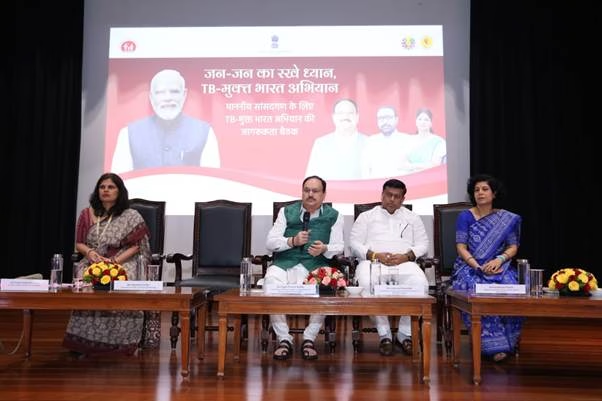
NEW DELHI — In a major push to eliminate tuberculosis (TB) by 2030, Union Minister of Health & Family Welfare Shri Jagat Prakash Nadda convened a strategic meeting on July 29, 2026, with Members of Parliament from West Bengal. Held on the sidelines of the Parliamentary session, the high-level meeting titled “Parliamentarians Championing a TB Mukt Bharat” sought to unite lawmakers across party lines to transform the national health mandate into a grass-roots public movement, or Jan Andolan.
The meeting highlighted significant milestone metrics for India’s public health system. According to data cited from the World Health Organization (WHO) Global TB Report 2025, India achieved a 21% decline in TB incidence between 2015 and 2024. This rate of reduction is nearly double the global average decline of 12%. Furthermore, India’s TB treatment coverage rate has reached 92%, outperforming the global benchmark of 78%.
“TB Mukt Bharat is not merely a health programme but a nationwide people’s movement requiring active public participation,” stated Union Health Minister Shri J.P. Nadda during his address. “The campaign can achieve its full potential only through collective ownership involving elected representatives, governments, civil society, and local communities.”
High-Tech Diagnostics and Asymptomatic Screening Reframe the Battle
Tuberculosis, an infectious disease caused by Mycobacterium tuberculosis, primarily attacks the lungs and spreads through the air when infected individuals cough or sneeze. Historically, combating TB in densely populated areas has been hampered by delayed diagnoses, high treatment abandonment rates, and the silent spread of asymptomatic cases.
To counter these hurdles, India’s TB elimination strategy has undergone a technological transformation. During the briefing, Smt. Aradhana Patnaik, Additional Secretary and Mission Director for the National Health Mission, noted that India’s molecular testing capacity expanded from a few hundred machines a decade ago to over 9,000 operational units today.
Key technological innovations driving the current phase of the campaign include:
-
Indigenous TruNat Molecular Diagnostics: Portable, battery-operated micro-PCR systems that allow point-of-care testing for rapid identification of both TB infection and resistance to Rifampicin (a primary front-line antibiotic).
-
AI-Enabled Handheld Radiography: Compact X-ray units integrated with artificial intelligence algorithms capable of flagging suspected lung lesions in seconds, enabling immediate follow-up testing in remote or underserved rural communities.
-
Asymptomatic Screening: Active case-finding strategies targeting vulnerable populations who carry or transmit the bacteria without displaying classic symptoms (such as chronic cough, night sweats, or unexplained weight loss).
   TRADITIONAL DIAGNOSIS                     MODERNIZED DIAGNOSIS
┌───────────────────────────┐             ┌───────────────────────────┐
│ • Sputum smear microscopy │             │ • Micro-PCR (TruNat)      │
│ • Delayed drug-resistance │  ────────►  │ • AI-driven handheld X-ray│
│   testing                 │             │ • Rapid drug-resistance   │
│ • Symptom-only screening  │             │   profiling (<2 hours)    │
└───────────────────────────┘             └───────────────────────────┘
“Deploying rapid molecular diagnostic tools at the primary healthcare level is a game-changer for infectious disease control,” says Dr. Rajesh Sharma, a senior public health clinician not involved in the government briefing. “Detecting multi-drug resistant TB (MDR-TB) within hours rather than weeks prevents transmission chains and ensures patients are started on the correct, drug-specific antibiotic regimen immediately.”
Expanding Social Safety Nets and Nutrition Support
Recognizing that clinical intervention alone cannot eradicate a disease deeply linked to socio-economic factors, the Indian government has increased financial and nutritional support for active patients under the Ni-kshay Poshan Yojana.
The monthly financial assistance provided directly to TB patients to meet their nutritional needs has been enhanced to ₹1,000 per month for the duration of their treatment. Proper nutrition is critical for TB recovery, as malnutrition weakens the immune system, increasing susceptibility to treatment failure and adverse drug events.
Complementing direct government support is the Ni-kshay Mitra initiative, which enables individuals, corporate entities, elected officials, and civil society organizations to “adopt” TB patients. These community sponsors provide supplemental nutritional baskets, psychosocial counseling, and vocational support. To date, over 500,000 Ni-kshay Mitras have been mobilized nationwide.
Grassroots Implementation: Focus on High-Risk Zones
The parliamentary consultation reviewed the outcomes of the multi-phase 100-Day TB Mukt Bharat Abhiyaan. The initiative began its first phase in December 2024 across 347 high-priority districts before expanding nationwide. The second phase, launched in March 2026, intensified screening across nearly 158,000 high-risk villages and urban wards.
In West Bengal, local implementation focused on specific vulnerable demographics:
-
Urban informal settlements and high-density slums.
-
Tea garden workers in northern districts facing geographically isolated healthcare infrastructure.
-
Industrial, mining, and migrant worker pockets where airborne transmission risks remain high.
Through targeted health camps (Ayushman Arogya Shivirs), field teams have brought screening devices directly to these populations, shifting public health strategy from passive hospital presentation to proactive community surveillance.
Challenges, Limitations, and Counterarguments
While the national metrics demonstrate measurable progress, independent public health experts urge cautious optimism. Eradicating a pathogen with deep socio-demographic roots presents systemic ongoing challenges:
-
Private Sector Integration: A significant portion of symptomatic patients in India initially seek care from private, unorganized medical providers. While mandatory notification laws exist, full compliance and standardized treatment delivery across all private clinics remain difficult to audit uniformly.
-
Treatment Adherence and Side Effects: Standard TB treatment requires taking daily medication for a minimum of six months, while multi-drug resistant strains demand complex regimens that can extend up to 9-24 months. Managing drug toxicities and preventing patient loss-to-follow-up remain severe hurdles.
-
Stigma Reduction: Despite public awareness campaigns, social stigma surrounding tuberculosis frequently leads patients to conceal symptoms, delaying early diagnosis and inadvertently spreading infection among household contacts.
Epidemiologists emphasize that sustaining a 21% incidence drop requires continuous district-level monitoring. “Broad national statistics can sometimes mask localized outbreaks,” warns Dr. Sharma. “The real test of sustained elimination will depend on whether district-level health officials maintain aggressive surveillance once short-term public campaigns conclude.”
What This Means for Readers
For individuals, families, and communities, India’s accelerated push against tuberculosis highlights several actionable health priorities:
-
Recognize the Symptoms: A persistent cough lasting more than two weeks, recurring low-grade fever, unexplained weight loss, night sweats, or coughing up blood warrant immediate medical evaluation.
-
Access Free Diagnostic and Treatment Resources: Public health facilities offer free molecular testing and standardized anti-TB medications nationwide. Private diagnoses can also be registered to access state nutritional subsidies.
-
Support Community Initiatives: Individuals and community leaders can register as Ni-kshay Mitras to provide nutritional or psychological support to neighbors undergoing treatment, directly reducing stigma and improving recovery rates.
Key Metrics at a Glance
| Public Health Metric | India Progress (2015–2024) | Global Average |
| TB Incidence Decline | 21% | 12% |
| Treatment Coverage Rate | 92% | 78% |
| Targeted High-Risk Wards/Villages | ~158,000 | N/A |
| Molecular Testing Infrastructure | 9,000+ units | N/A |
| Active Ni-kshay Mitras Mobilized | > 500,000 | N/A |
Reference Section
Government & Official Announcements
-
Press Information Bureau (PIB), Government of India. “Union Health Minister Shri Jagat Prakash Nadda calls upon MPs from West Bengal to lead Jan Andolan for TB Elimination.” Released July 29, 2026, New Delhi.
Medical Disclaimer: This article is for informational purposes only and should not be considered medical advice. Always consult with qualified healthcare professionals before making any health-related decisions or changes to your treatment plan. The information presented here is based on current research and expert opinions, which may evolve as new evidence emerges.