 0
0
 0
0
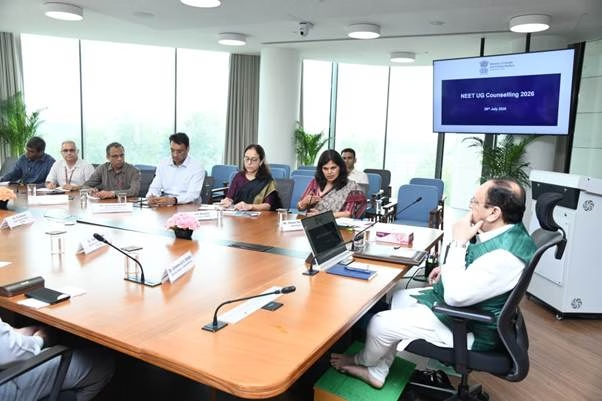
NEW DELHI — In a significant move aimed at streamlining undergraduate medical admissions and reducing administrative stress for thousands of aspiring doctors, Union Minister for Health and Family Welfare, Shri Jagat Prakash Nadda, officially reviewed the final preparedness for the National Eligibility cum Entrance Test Undergraduate (NEET UG) Counselling 2026 on July 29, 2026.
The high-level review, conducted with senior officials from the Directorate General of Health Services (DGHS), the Medical Counselling Committee (MCC), and the National Informatics Centre (NIC), marks the rollout of sweeping digital and structural reforms. Designed to make the admission process more transparent, accessible, and merit-based, the updated framework introduces single-point physical verification, expanded disability evaluation infrastructure, and complete end-to-end digitization for Non-Resident Indian (NRI) quota applicants.
With the NEET UG 2026 results declared by the National Testing Agency (NTA) on July 16, 2026, counselling for All India Quota (AIQ) seats across Bachelor of Medicine, Bachelor of Surgery (MBBS), Bachelor of Dental Surgery (BDS), and B.Sc. (Nursing) programs is set to commence imminently.
Core Counselling Reforms: Streamlining the Student Experience
For years, candidates navigating multi-round medical counselling faced substantial logistical hurdles, often traveling across states multiple times to verify documents or pay seat retention fees. The 2026 framework directly addresses these friction points through three central operational shifts:
1. One-Time Physical Reporting Framework
Under the new guidelines, candidates allotted a seat will exercise their choice online by selecting either a “Freeze” or “Float” status:
-
Freeze Option: Candidates satisfied with their allotted institution report physically to the college within the designated window to complete original document verification and fee payment.
-
Float Option: Candidates seeking seat upgradation in subsequent rounds can complete their document verification entirely online. They are no longer required to travel to the institution, deposit original physical certificates, or pay admission fees during interim rounds.
Upgradation privileges remain active through Round 3. Physical reporting, document submission, and fee deposition are required only once a final seat is retained at the conclusion of the third round.
2. Portal-Based Seat Resignation
To prevent seat locking and reduce physical travel, candidates permitted to resign from an allotted seat under counselling rules can now process their withdrawal directly through the official MCC portal, eliminating mandatory visits to participating medical colleges.
3. End-to-End Digitization of NRI Admissions
Transitioning away from email-based documentation, the NRI category admission pipeline is now fully integrated into the MCC online portal. Candidates must upload legal proofs demonstrating sponsorship compliance under the Guardians and Wards Act, 1890, in alignment with directions from the Supreme Court of India. Designated Document Verification Officers will inspect submissions through a time-bound digital workflow.
Expanding Access for Candidates with Benchmark Disabilities
A major highlight of the 2026 reforms is a dramatic expansion in infrastructure for Persons with Benchmark Disabilities (PwBD).
To ensure fair, uniform, and localized functional evaluations, the Health Ministry has increased the number of designated assessment centers nationwide from 16 to 61.
+-------------------------------------------------------------------+
|               PwBD ASSESSMENT REFORMS AT A GLANCE                 |
+-------------------------------------------------------------------+
| • Assessment Centers: Expanded from 16 to 61 centers nationwide.  |
| • Document Standard: Transitioned to "Eligibility Certificate".    |
| • Legal Recourse: Established new Appellate Disability Board.     |
+-------------------------------------------------------------------+
Following updated National Medical Commission (NMC) guidelines issued on July 27, 2026, disability evaluation boards will now issue an “Eligibility Certificate.” This document assesses functional capacity relative to medical curriculum competencies, balancing equal educational access with patient safety and clinical training standards. Additionally, the Ministry introduced an Appellate Disability Assessment Board, giving candidates a formal legal channel to appeal initial evaluation decisions.
System Integrity, Public Health Impact, and Expert Commentary
Ensuring the integrity of a national selection system that places over 100,000 medical students annually requires rigorous technological backing. Minister Nadda instructed officials to maintain active cybersecurity protocols, managed in tandem with the NIC, alongside pre-populated candidate data feeds from the NTA to eliminate data mismatch errors.
Medical education experts and healthcare administrators have broadly welcomed the systemic updates, while noting critical areas for ongoing monitoring.
“The transition to a single physical reporting protocol addresses a long-standing grievance among students and parents,” says Dr. Arisudan Sharma, a senior medical educator and healthcare consultant not involved in the Ministry’s committee. “Previously, candidates spent tens of thousands of rupees and countless hours traveling between cities just to hold a temporary seat during upgradation rounds. Eliminating redundant physical visits democraticizes the admission journey, especially for candidates from rural or economically weaker backgrounds.”
From a public health workforce perspective, streamlining admissions directly impacts the operational timeline of teaching hospitals. Delays in completing medical admissions cascade into clinical training schedules, delaying the entry of house surgeons and junior residents into tertiary healthcare facilities.
However, public health policy analysts emphasize the necessity of flawless software performance and clear communication.
“Digital verification systems are only as effective as the servers supporting them,” notes Dr. Meenakshi Sundaram, a public health researcher. “High portal traffic during peak choice-filling days can cause technical glitches. Maintaining a 24/7 toll-free helpline and a responsive grievance redressal mechanism will be vital to prevent candidate panic and ensure equal access across diverse digital literacy levels.”
Support Infrastructure and Next Steps for Candidates
To assist candidates, the MCC has established dedicated facilitation channels:
-
Toll-Free Helpline: 1800-102-7637 (Available 24/7)
-
Official Grievance Email:
[email protected] -
Multilingual Resources: Bilingual user guides, video walkthroughs, and step-by-step FAQs published on the official MCC portal.
Health authorities strongly advise all qualified candidates to thoroughly examine the official NEET UG Counselling Information Bulletin and verify seat matrix details before submitting their choices.
References
-
Press Information Bureau (PIB) Delhi. (2026, July 29). Union Health Minister Shri Jagat Prakash Nadda Reviews Preparedness for NEET UG Counselling 2026. Ministry of Health and Family Welfare, Government of India.
Medical Disclaimer: This article is for informational purposes only and should not be considered medical advice. Always consult with qualified healthcare professionals before making any health-related decisions or changes to your treatment plan. The information presented here is based on current research and expert opinions, which may evolve as new evidence emerges.