 0
0
 0
0
SHILLONG, INDIA — In a major push to correct decades of regional disparity, India’s North Eastern Region is undergoing a massive scientific transformation. The expansion of advanced weather monitoring, seismic tracking, and agricultural technology is rapidly reshaping public health outcomes and disaster preparedness for millions of citizens.
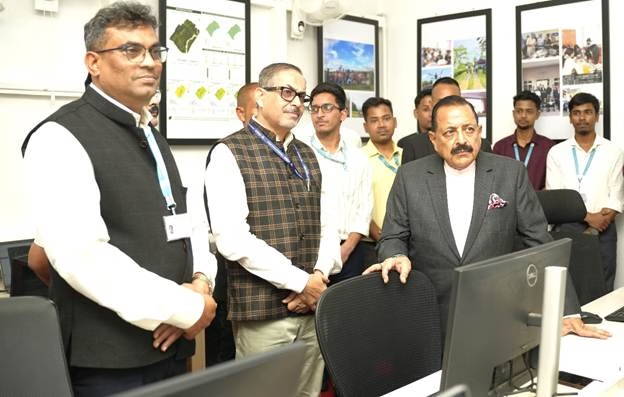
Speaking at a comprehensive review meeting on July 14, 2026, at the North East Centre for Technology Application and Reach (NECTAR) in Shillong, Union Minister Dr. Jitendra Singh revealed that the region’s scientific infrastructure has expanded exponentially over the last decade. Most notably, the number of weather radars in the North East has jumped from just two before 2014 to 13 today. Similarly, seismological observatories have more than doubled, increasing from 84 to 171, alongside the introduction of specialized lightning detection stations in Meghalaya and Tripura.
For a region historically vulnerable to extreme weather, flash floods, landslides, and earthquakes, this infrastructure surge represents more than just technological progress. It is a vital public health intervention.
Predicting the Unpredictable: Weather Radars and Public Safety
The North Eastern Region of India features some of the most complex geographical terrain in the world. Meghalaya’s Cherrapunji famously records the world’s highest average rainfall, yet until 2014, the entire state relied on a single weather radar.
According to meteorologists, early warning systems are the first line of defense against climate-induced health crises. When heavy rainfall hits mountainous terrain, it triggers rapid-onset events like flash floods and landslides. Beyond immediate physical trauma, these disasters severely impact public health by destroying water sanitation facilities, leading to outbreaks of waterborne diseases such as cholera, typhoid, and leptospirosis.
The deployment of 13 Doppler Weather Radars allows the India Meteorological Department (IMD) to track severe weather systems in real time. This capability gives local authorities a crucial window of several hours to evacuate high-risk communities, secure clean drinking water supplies, and pre-position emergency medical teams.
Combating the Silent Threat of Extreme Weather
The introduction of specialized lightning detection stations in Meghalaya and Tripura addresses a deadly but frequently overlooked public health hazard.
Data from the National Crime Records Bureau (NCRB) indicates that lightning is one of India’s leading causes of accidental death due to natural forces, accounting for thousands of fatalities annually. Rural farmers, outdoor laborers, and indigenous communities living in temporary structures are disproportionately vulnerable.
By providing localized, real-time alerts on lightning susceptibility, these new stations allow emergency services to broadcast warnings to rural communities before storms strike. Experts note that even a 30-minute advance warning can reduce lightning-related casualties by more than 80%, keeping farmers safe in areas with high storm activity.
Agriculture as a Health Standard: Soil and Nutrition
Public health extends beyond emergency disaster management; it is fundamentally rooted in food security and nutrition. During his visit, Dr. Jitendra Singh reviewed NECTAR’s work under the Prime Minister’s Development Initiative for North Eastern Region (PM-DevINE) program, highlighting the establishment of the Vasundhara Soil Organic Carbon Detection Laboratory-cum-Manufacturing Unit.
Utilizing technology transferred from the Bhabha Atomic Research Centre (BARC), this initiative has distributed over 2,500 in-situ soil testing kits to local farmers. The technology enables agricultural communities to evaluate soil health accurately, reducing over-reliance on chemical fertilizers and encouraging sustainable organic farming.
Medical professionals emphasize that soil quality directly dictates the nutritional profile of crops. Micronutrient deficiencies—such as iron, zinc, and vitamin A shortages—remain prevalent in rural populations. By scientifically managing soil health, farmers can cultivate nutrient-dense crops, directly combating malnutrition at the grassroots level.
Furthermore, the Minister witnessed a demonstration of a Mobile Food Processing Unit (MPU). Developed alongside the CSIR-Central Food Technological Research Institute (CFTRI), this “processing on wheels” model helps small-scale farmers process their produce immediately after harvest. This cuts down on post-harvest spoilage, protects agricultural livelihoods, and preserves the nutritional value of food before it reaches consumers.
Balancing Tech and Local Realities: Limitations to Consider
While the expansion of hardware—such as drones, radars, and laboratories—is a massive leap forward, public health policy experts urge caution regarding implementation challenges.
“Advanced scientific infrastructure is only as effective as the communication network behind it,” says Dr. Aranya Sen, an independent public health consultant specializing in disaster mitigation. “If a Doppler radar detects a flash flood threat, but the warning fails to reach a remote, off-grid village due to connectivity issues, the technology cannot save lives.”
Public health experts identify several structural hurdles that must be addressed to maximize these scientific upgrades:
-
The “Last-Mile” Communication Gap: Early warning data must be translated into simple, actionable alerts in local dialects and broadcasted via SMS, community radio, or local emergency networks.
-
Technical Literacy: Training regional youth is essential. While NECTAR has successfully trained 569 drone technicians and 107 certified drone pilots, scaling these programs across all eight North Eastern states will require a sustained, multi-year funding commitment.
-
Infrastructure Maintenance: Maintaining sensitive electronic equipment, like seismometers and radars, in high-humidity, high-rainfall environments requires highly specialized technical staff permanently stationed in remote areas.
Looking Forward: STEM and the Next Generation
To ensure these advancements are sustainable, NECTAR launched its STEM Education Laboratory, which introduces school students to robotics, coding, artificial intelligence, and 3D printing. Operating in collaboration with IIT Kanpur, the initiative plans to set up 50 STEM laboratories across five North Eastern states, aiming to reach roughly 25,000 students in historically underserved areas.
By introducing scientific concepts early, local institutions hope to cultivate a new generation of regional scientists, doctors, and engineers capable of solving the unique geographical and healthcare challenges of the North East.
The ongoing construction of NECTAR’s permanent campus in New Shillong is poised to serve as a centralized hub for this research, providing the regional infrastructure needed to turn laboratory innovations into practical, life-saving public health solutions.
Reference Section
-
Institutional Reports & Press Releases:
-
Press Information Bureau (PIB) Delhi. (2026, July 14). North East Witnesses Unprecedented Expansion of Science & Technology Infrastructure under Prime Minister Narendra Modi: Dr. Jitendra Singh. Ministry of Science & Technology.
- Medical Disclaimer: This article is for informational purposes only and should not be considered medical advice. Always consult with qualified healthcare professionals before making any health-related decisions or changes to your treatment plan. The information presented here is based on current research and expert opinions, which may evolve as new evidence emerges.
-