 0
0
 0
0
BENGALURU, INDIA — In a major breakthrough for industrial safety and public health, scientists at the Centre for Nano and Soft Matter Sciences (CeNS) in Bengaluru have developed a pioneering, ultra-sensitive ammonia gas sensor. Published in the prestigious journal ACS Sensors, this room-temperature technology can be integrated directly into clothing, smart bands, and self-powered wearable devices. The innovation marks a massive leap forward in preventing accidental exposure to ammonia—a highly corrosive gas that poses severe respiratory, skin, and ocular hazards to millions of industrial and agricultural workers globally.
The Hidden Danger in Essential Industries
Ammonia is a cornerstone of modern industry. It drives global agriculture as a primary component in fertilizer production, maintains cold-chain logistics through industrial refrigeration, and acts as a baseline chemical in manufacturing.
Yet, its widespread utility comes at a significant biological cost. When an accidental leak occurs, the consequences are immediate and devastating. Because ammonia reacts instantly with moisture in human tissue, inhalation can result in severe airway burns, pulmonary edema (fluid accumulation in the lungs), and lifelong respiratory dysfunction.
According to guidelines from the U.S. Occupational Safety and Health Administration (OSHA), the permissible exposure limit for ammonia is 50 parts per million (ppm) over an 8-hour shift. However, even brief spikes above this threshold can trigger permanent tissue damage or asphyxiation.
Nano-Engineering the Perfect Trap
Traditional gas sensors suffer from a major engineering bottleneck: they require elevated temperatures (often exceeding 200°C) or bulky external light sources to activate the chemical reactions needed to detect gas molecules. This high power consumption makes them entirely impractical for portable or wearable personal protective equipment (PPE).
To shatter this barrier, the CeNS research team—led by Prof. Angappane Subramanian, Dr. Vishnu G. Nath, Ankur Verma, Abhijit Paul, and Dr. Subash Cherumannil Karumuthil—turned to advanced nanotechnology. They engineered a hybrid heterostructure combining vanadium oxide and vanadium sulfide
Through a meticulously controlled surface transformation process, the team modified the material to create abundant “active sites.” These sites act like a customized chemical hook, trapping ammonia molecules out of the air at ambient room temperatures. Concurrently, the unique atomic architecture accelerates charge transport within the sensing layer, leading to lightning-fast electrical response times without requiring external heating elements.
The result is a sensor with exceptional capabilities:
-
Sub-PPM Detection: The platform can sense ammonia concentrations as low as 319 parts per billion (ppb)—a microscopic fraction of the standard 50 ppm safety limit.
-
Sharp Selectivity: It filters out ambient interference, ignoring other common environmental gases to ensure zero false alarms.
-
Long-Term Stability: The prototype demonstrated flawless operational reliability over repeated cycles exceeding ten weeks.
From the Lab Bench to Wearable Reality
What elevates this research from a materials science victory to a public health milestone is its immediate practical translation into real-world safety devices. The CeNS team did not just stop at the atomic level; they created fully functional, flexible prototypes across multiple consumer-friendly mediums:
-
-
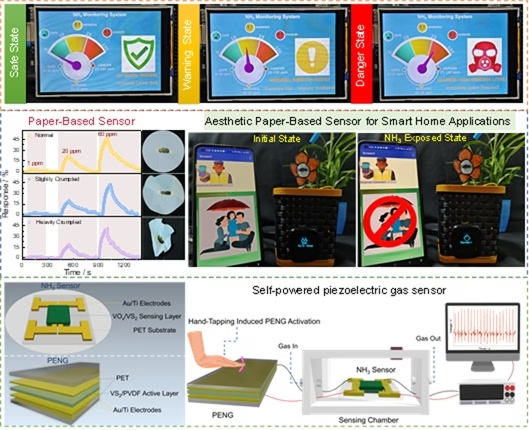
The Threshold Alert System: A portable monitor that automatically segments environmental air quality into three simple, intuitive categories: Safe, Warning, and Danger. This eliminates the need for complex digital readouts, giving frontline workers immediate, actionable visibility into their environment.
-
Self-Powered Autonomy: By marrying the nanomaterial sensor with a flexible piezoelectric nanogenerator, the researchers built a device that harvests mechanical energy from basic human movements (like walking or arm swinging). It converts this kinetic energy into electrical power, enabling continuous toxic gas detection with no battery changes or charging grids required.
-
E-Textiles and Smart Bands: The lightweight sensors were successfully fabricated onto polymer, paper, and ordinary textile substrates. Remarkably, these electronic fabrics maintained their precision even when subjected to intense bending, twisting, and folding.
-
Independent Experts Weigh In: Hype vs. Reality
While the engineering achievements are undeniable, occupational health experts emphasize that bringing this technology to commercial markets requires passing rigorous field tests.
“Operating at room temperature while hitting parts-per-billion sensitivity is a stellar achievement,” says Dr. Elena Rostov, an independent industrial hygienist and wearable sensor specialist not involved in the research. “In industries like chemical manufacturing or large-scale farming, early detection before the human nose can even register the scent is life-saving.”
However, Dr. Rostov points out essential limitations that must be answered during clinical and industrial scaling:
“Laboratory settings are highly controlled. In a real-world agricultural facility, these sensors will face punishing moisture, dust, and cross-contamination from livestock waste or organic volatile compounds. We need to see long-term field data proving that the vanadium oxide-vanadium sulfide (VOx/VS2) heterostructure won’t experience degraded sensitivity when coated in real-world industrial grit.”
Furthermore, public health analysts note that regulatory approvals from bodies like the National Institute for Occupational Safety and Health (NIOSH) require extensive testing under extreme temperatures and varying relative humidity levels.
A Vision for Personalized Public Health
If these barriers are overcome, the implications for public health are vast. Beyond protecting industrial laborers, portable, autonomous sensors could become standard safety gear for first responders entering disaster zones, hazardous material squads, and communities living near fertilizer hubs or agricultural corridors.
By turning everyday clothing and accessories into highly intelligent diagnostic shields, this nanotechnology shifts the paradigm of environmental safety from passive containment to proactive, individualized protection.
Reference Section
Study Citation
-
Journal: ACS Sensors (American Chemical Society)
-
Authors: Prof. Angappane Subramanian, Dr. Vishnu G. Nath, Ankur Verma, Abhijit Paul, and Dr. Subash Cherumannil Karumuthil.
-
Publication Date: July 14, 2026
-
Digital Object Identifier (DOI): https://doi.org/10.1021/acssensors.5c02600
Medical Disclaimer: This article is for informational purposes only and should not be considered medical advice. Always consult with qualified healthcare professionals before making any health-related decisions or changes to your treatment plan. The information presented here is based on current research and expert opinions, which may evolve as new evidence emerges.