 0
0
 0
0
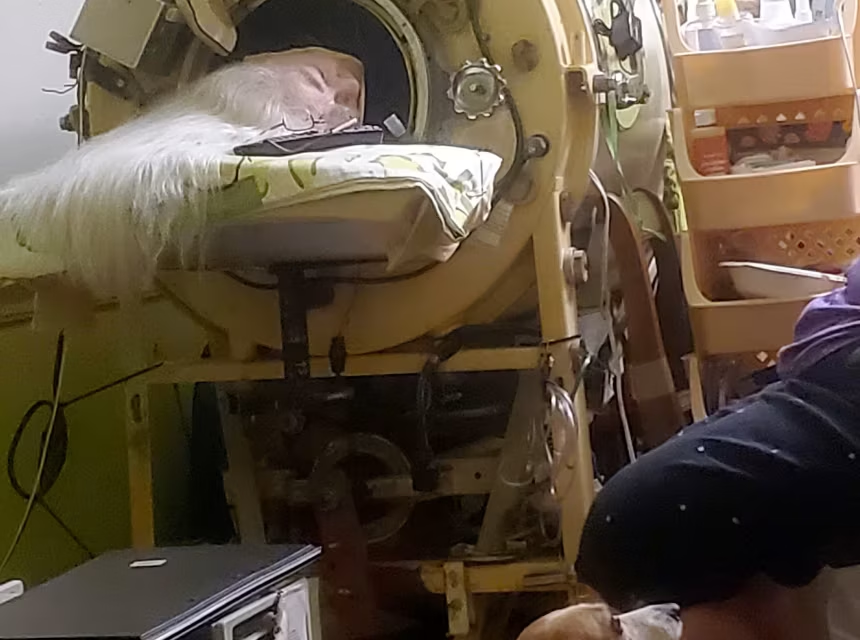
OKLAHOMA CITY — Martha Ann Lillard, the last known person in the United States to rely continuously on an iron lung for survival, passed away on June 26 at the age of 78. Her death, confirmed by family members and local obituary records, marks the closing of a poignant chapter in American medical history. Lillard was part of a disappearing generation that bore the most severe, permanent physical consequences of poliomyelitis (polio) before the advent of life-saving vaccines.
Contracting the highly infectious virus at just five years old in 1953, Lillard spent over seven decades relying on a heavy, negative-pressure ventilator to breathe. While her sister noted that physicians initially doubted she would survive past the age of 20, Lillard defied expectations for decades. Her family indicated that her final days were complicated by chronic pulmonary failure alongside challenges linked to long COVID, signaling how modern viral threats can overlap dangerously with long-term, pre-existing respiratory damage.
Lillard’s passing comes two years after the death of Paul Alexander, another high-profile American polio survivor who lived inside an iron lung until his death at age 78 in 2024. Together, their lives serve as extraordinary testaments to human resilience and visual monuments to a public health crisis that modern society has largely forgotten.
The Mechanical Lifeline: Why Iron Lungs Mattered
Before modern, positive-pressure intubation and non-invasive ventilation existed, the iron lung was the premier breakthrough in critical care medicine. Developed in the late 1920s, these massive yellow and white metal cylinders were designed to keep patients alive when poliovirus attacked the central nervous system, paralyzing the diaphragm and intercostal muscles needed to inhale.
The machine functions through a straightforward mechanical process:
-
Negative Pressure Generation: The patient’s body is sealed airtight inside the cylinder with only their head exposed. A motorized bellows pumps air out of the chamber, creating a vacuum.
-
Inhalation: This drop in pressure forces the patient’s chest cavity to expand, drawing air naturally into their lungs through the nose and mouth.
-
Exhalation: The bellows then pushes air back into the cylinder, increasing the internal pressure and allowing the chest wall to compress, pushing the air out.
While incredibly restrictive, the technology saved thousands of lives during the mid-20th-century epidemics. Today, iron lungs are entirely obsolete. This shift occurred not because respiratory paralysis is a thing of the past, but because global immunization campaigns effectively eradicated the need for mass-production of the machines. According to data from the World Health Organization (WHO), wild poliovirus cases worldwide have plummeted by more than 99% since 1988, dropping from roughly 350,000 cases annually across 125 endemic nations to just two endemic countries: Afghanistan and Pakistan.
The Persistent Reality of Poliovirus
Poliomyelitis is a viciously fast-moving viral pathogen that primarily targets children under five, though any unvaccinated individual remains highly vulnerable. The virus enters the body via the mouth, usually through contact with infected fecal matter or, less commonly, respiratory droplets. Alarmingly, standard over-the-counter alcohol-based hand sanitizers do not kill poliovirus; rigorous handwashing with soap and water remains the primary physical barrier against spread.
The Neurological Toll: Data from the World Health Organization reveals that roughly 1 in 200 polio infections results in irreversible, permanent flaccid paralysis. Among those paralyzed, between 5% and 10% die when their critical breathing muscles become completely immobilized by the virus.
For those who survive the initial acute phase, the medical battle is rarely over. “Lillard’s life and passing highlight a vital clinical reality: the damage caused by polio is a lifelong burden,” says Dr. Elena Rostova, an infectious disease specialist who tracks legacy vaccine-preventable illnesses (independent of the Lillard case). “Decades after the initial viral infection clears, patients frequently develop post-polio syndrome (PPS), characterized by new muscle weakness, profound fatigue, and joint degeneration. When you overlay that with age-related respiratory decline or a modern respiratory illness like COVID-19, the margins for survival become razor-thin.”
Public Health Context and Vaccine Essentiality
The Centers for Disease Control and Prevention (CDC) stresses a foundational truth: polio has no cure. Once the nerve cells governing motor function are destroyed by the virus, they cannot be repaired. The only protection is preventative immunization.
Public health agencies leverage two highly effective vaccines to keep the virus at bay: the Inactivated Poliovirus Vaccine (IPV), given via injection, and the Oral Polio Vaccine (OPV), which uses a weakened live virus. When communities maintain high immunization coverage, it creates a shield of herd immunity that protects the most vulnerable. However, when vaccination rates dip, the risk of a resurgence amplifies.
In recent years, public health officials have detected vaccine-derived poliovirus variants in wastewater systems within under-immunized urban pockets in developed nations. These variants occur when the weakened live virus from the oral vaccine circulates in communities with low immunization rates, mutating back into a form that can cause paralysis. The WHO repeatedly warns that as long as a single child remains infected anywhere in the world, failure to completely eradicate polio could lead to a global resurgence, potentially disabling up to 200,000 children annually within a decade.
Epidemiological Limitations and Analytical Nuance
From a journalistic and scientific perspective, certain limitations exist in assessing the exact medical timeline of Lillard’s passing. Much of the immediate information relies heavily on family statements, public obituaries, and regional reporting rather than formal, peer-reviewed clinical autopsies. Consequently, the exact interplay between her chronic, lifelong respiratory deficits, age-related frailty, and the specific impact of long COVID remains a localized clinical assessment rather than an absolute epidemiological statistic. Responsible medical reporting requires acknowledging that partial evidence should not be used to draw rigid, definitive causal links.
Furthermore, medical historians and clinicians emphasize that Lillard’s unique arrangement should not be generalized to modern respiratory care. While the iron lung is a legendary piece of history, contemporary patients facing severe respiratory failure or diaphragmatic paralysis are treated using positive-pressure mechanical ventilators, bilevel positive airway pressure (BiPAP) machines, or portable diaphragmatic pacemakers. These modern innovations allow for mobility, targeted air delivery, and significantly higher qualities of life than the airtight metal tubes of the 1950s.
Actionable Takeaways for Readers
The passing of Martha Lillard is far more than a historical milestone; it is an active alarm for contemporary preventative medicine.
For the General Public
-
Verify Immunization History: Ensure that your children receive the full, multi-dose routine childhood polio vaccine series according to the standard CDC schedule. If you are an adult traveling to regions with active viral transmission, consult a travel clinic to determine if a one-time lifetime IPV booster is required.
-
Practice Rigorous Hygiene: Remember that alcohol gels are ineffective against non-enveloped viruses like polio. Thorough handwashing with soap and water remains the benchmark for preventing fecal-oral viral transmission.
For Healthcare Professionals
-
Maintain Vigilance: Keep polio on the diagnostic radar when evaluating unexplained acute flaccid myelitis or weakness, particularly in patients with international travel history or those from communities with known vaccination hesitancy.
-
Geriatric Survivorship Care: Recognize that older adults who survived pre-vaccine era polio may suffer from underdiagnosed post-polio syndrome, requiring specialized physical therapy, pulmonology monitoring, and customized long-term support.
Lillard’s long life proves the power of human endurance, but her reliance on a mid-century machine serves as a stark reminder of what is at stake. Public health achievements are not permanent self-sustaining victories; they are dynamic shields that require continuous maintenance, public trust, and unwavering vaccination coverage to prevent the past from becoming the future.
References
- https://edition.cnn.com/2026/07/11/health/polio-survivor-iron-lung-dies
Medical Disclaimer: This article is for informational purposes only and should not be considered medical advice. Always consult with qualified healthcare professionals before making any health-related decisions or changes to your treatment plan. The information presented here is based on current research and expert opinions, which may evolve as new evidence emerges.