 0
0
 0
0
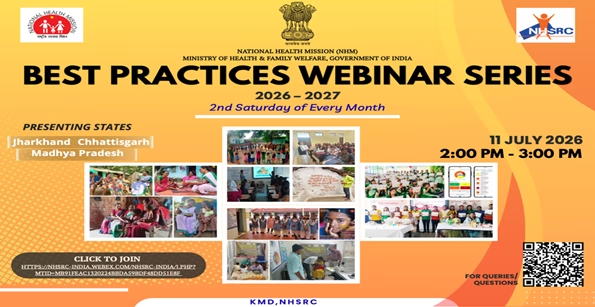
NEW DELHI — In a major bid to modernize public healthcare delivery and bridge regional disparities, the Union Ministry of Health and Family Welfare (MoHFW) has officially launched a nationwide monthly webinar series dedicated to scaling up grassroots health innovations.
Launched on July 11, 2026—coinciding with World Population Day—the initiative operates under the aegis of the National Health Mission (NHM). The virtual platform is designed as a year-round knowledge-sharing mechanism, enabling India’s diverse States and Union Territories (UTs) to present successful, evidence-based healthcare models, exchange implementation strategies, and replicate localized breakthroughs on a national scale.
The inaugural session drew over 500 public health administrators, medical officers, and policy experts from national, state, and district levels. The focus centered on critical, interconnected demographics: anemia, child survival, and adolescent health.
Driving Resilience Through Cross-Learning
Public health administration across a nation of 1.4 billion people frequently suffers from a documentation bottleneck. Highly effective, locally engineered solutions often remain confined to specific districts because frontline teams are fully consumed by daily clinical implementation rather than academic publishing or national reporting.
Smt. Aradhana Patnaik, Additional Secretary and Mission Director of the NHM, chaired the inaugural session and highlighted innovation as the bedrock of responsive healthcare infrastructure.
“Innovation lies at the heart of responsive and resilient public health systems,” Patnaik stated during her opening address. She emphasized that the series serves as a formal institutional mechanism to identify, document, and disseminate these emerging models.
To systematically address the documentation gap, Patnaik announced that the National Health Systems Resource Centre (NHSRC)—a premier technical support institution under the Health Ministry—will provide dedicated analytical and documentation backing. This collaboration aims to transform isolated field successes into highly structured, scalable blueprints capable of integration into the broader National Summit on Good and Replicable Innovative Practices.
From the Field: Three State-Led Interventions
The debut webinar showcased three distinct, data-driven interventions designed to combat entrenched public health challenges. These models were selected for their alignment with existing national frameworks and their measurable community impact.
1. Jharkhand: Digitalizing Anemia Tracking and Neonatal Care
Jharkhand presented a dual-pronged approach targeting maternal and child mortality. Central to their strategy is the Anemia Mukt Bharat (AMB) T4 App. The digital platform streamlines the “Test, Treat, Talk, and Anemia Mukt Status” strategy by tracking hemoglobin levels in real-time among pregnant women and adolescents, ensuring targeted iron-folic acid (IFA) supplementation.
Alongside the app, Jharkhand detailed its integrated Home-Based Newborn Care (HBNC) and Home-Based Young Child Care (HBYC) initiative. By structuring community health worker (ASHA) home visits, the state has improved early detection of neonatal illnesses, breastfeeding compliance, and nutritional monitoring during the critical first 1,000 days of life.
2. Chhattisgarh: Enhancing Early Intervention via ‘Chirayu Day’
Under the framework of the Rashtriya Bal Swasthya Karyakram (RBSK), Chhattisgarh showcased its Chirayu Day initiative. RBSK is mandated to screen children from birth to 18 years for the “4 Ds”: Defects at birth, Diseases, Deficiencies, and Development delays including disability.
Chhattisgarh’s dedicated “Chirayu Day” clusters screening and referral logistics into dedicated, predictable service windows. This approach reduces the drop-out rate between initial field screening and tertiary medical intervention, ensuring that children requiring specialized surgeries or therapies receive them without prolonged administrative delays.
3. Madhya Pradesh: Confronting the Dual Burden of Malnutrition
While undernutrition remains a critical focus, urbanizing regions face an escalating crisis of non-communicable risks. Madhya Pradesh presented an innovative framework explicitly targeting Adolescent Obesity.
By embedding screening metrics, lifestyle counseling, and peer-led physical literacy programs into school health wellness frameworks, the state is addressing metabolic health early. This shift acknowledges that adolescent obesity strongly correlates with adult cardiovascular diseases, type 2 diabetes, and psychological stress.
The Public Health Perspective: Independent Analysis
Independent public health experts view the structured cross-learning model as a necessary evolutionary step for the National Health Mission, provided it maintains rigorous quality control.
“India’s health challenges are highly heterogeneous; what works in Kerala may fail in Jharkhand due to varying socio-economic determinants and health system capacities,” said Dr. Sunitha Narayan, a senior public health policy consultant based in New Delhi, who was not involved in the webinar. “A centralized platform that allows states to dissect why a project succeeded—including its budgetary and staffing realities—is invaluable. It prevents states from wastefully reinventing the wheel.”
However, Dr. Narayan urged caution regarding replication fidelity. “When scaling a localized innovation, the translation often gets diluted. Digital tools like Jharkhand’s T4 app depend heavily on uninterrupted rural internet connectivity and digital literacy among frontline ASHA workers. The NHSRC must ensure that replication guidelines account for varying infrastructural baselines across states.”
Statistical Context: The Scale of the Challenge
The urgency behind these innovations is underscored by national health data. According to the National Family Health Survey (NFHS-5):
| Health Indicator | National Status (NFHS-5 Data) | Target Focus Area |
| Anemia in Women (15-49 years) | 57.0% | Jharkhand’s T4 App & Supplementation Tracking |
| Anemia in Children (6-59 months) | 67.1% | Integrated HBNC / HBYC Home Visits |
| Childhood Screening Coverage | Variable by State | Chhattisgarh’s Chirayu Day Systemization |
| Adolescent Metabolic Shift | Rising urban/semi-urban obesity | Madhya Pradesh’s School Wellness Framework |
Practical Implications for Citizens
For the everyday health consumer, this institutional shift directly impacts care delivery at the grassroots level. When a state replicates a successful model, patients can expect:
-
Decreased Referral Times: Streamlined community-to-hospital pathways mean faster access to free corrective surgeries for congenital conditions under RBSK.
-
Proactive Digital Tracking: Expectant mothers and young children receive more consistent, data-tracked nutritional interventions from local health workers.
-
Preventive Youth Care: School-going adolescents gain access to structured screening for lifestyle diseases, moving public health away from purely reactive medicine.
As the monthly series progresses through 2026, the MoHFW plans to cover themes ranging from maternal health indicators and non-communicable disease screening to digital health health-records integration under the Ayushman Bharat Digital Mission (ABDM).
References
-
Press Information Bureau (PIB) Delhi. Union Ministry of Health and Family Welfare launched Monthly Webinar Series on Best Practices under NHM to promote innovation and strengthen public health systems. Published July 11, 2026. [MoHFW Statement].
Medical Disclaimer: This article is for informational purposes only and should not be considered medical advice. Always consult with qualified healthcare professionals before making any health-related decisions or changes to your treatment plan. The information presented here is based on current research and expert opinions, which may evolve as new evidence emerges.