 0
0
 0
0
WASHINGTON — A high-stakes corporate initiative to combat mosquito-borne illnesses using bioengineered insects has ignited intense public debate as the federal regulatory review window draws to a close. Verily Life Sciences, a health-focused subsidiary of Google’s parent company Alphabet Inc., is currently seeking an Experimental Use Permit from the U.S. Environmental Protection Agency (EPA).
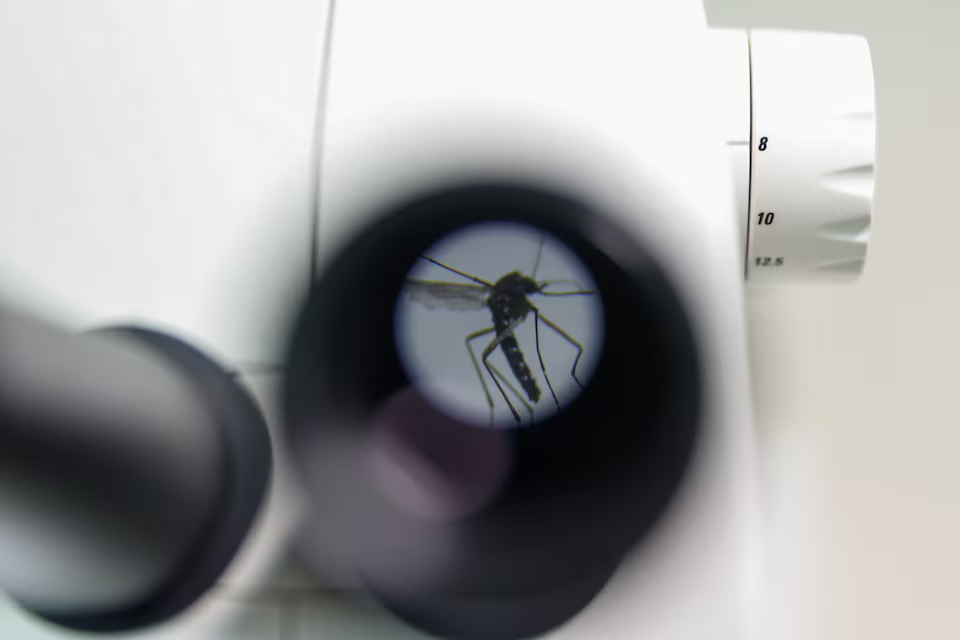
The proposal outlines a plan to release up to 32 million lab-reared male mosquitoes annually across target locations in Florida and California over the next two years, totaling 64 million insects. Operating under Verily’s “Debug” initiative, the project intends to flood wild populations of Aedes aegypti—the primary vector responsible for spreading debilitating viruses like dengue fever, Zika, yellow fever, and chikungunya—with functionally sterile males to crash the local insect population.
While public health officials broadly support novel biological vector controls, the federal public comment period, which officially closed on June 5, 2026, revealed a deep undercurrent of public anxiety regarding the role of multi-billion-dollar tech conglomerates modifying local ecosystems.
The Strategy: “Good Bugs” as Biological Controls
The core science behind the Debug project relies on a naturally occurring bacterium called Wolbachia, which is present in roughly 40 to 60 percent of all insect species globally, though not natively in Aedes aegypti.
When male mosquitoes are intentionally infected with a specific strain of Wolbachia in a lab and released into the wild, they mate with wild, uninfected females. Because of a biological phenomenon known as cytoplasmic incompatibility, the bacterial strain alters the sperm, rendering it incapable of fertilizing the wild female’s eggs. Over successive generations of continuous releases, the number of viable offspring plummets, causing the targeted pest population to collapse.
[Lab-Reared Male (With Wolbachia)] + [Wild Female (No Wolbachia)]
                               ↓
                 [Cytoplasmic Incompatibility]
                               ↓
                     (Eggs Fail to Hatch)
                               ↓
                 Target Population Suppressed
Public health professionals emphasize that the approach does not rely on chemical pesticides or permanent genetic modification (GM). Crucially, male mosquitoes do not bite; they feed exclusively on plant nectar. Because only females consume blood to develop eggs, releasing millions of males poses no direct physical biting threat to local human populations.
High Efficiency vs. Local Anxiety
Data from previous, smaller-scale pilot programs suggest that the Wolbachia method can be highly effective. Field trials conducted by Verily in Fresno, California, achieved up to a 95% reduction in biting female Aedes aegypti populations during peak periods. Similarly, Singapore’s national utility program, which collaborated with Verily’s Debug program in its Tampines neighborhood, logged a 90% suppression of the target species and an associated 70% drop in local dengue fever cases.
Despite these figures, public feedback submitted to the EPA indicates significant discomfort with a for-profit technology giant spearheading environmental interventions.
“Ask yourself who is to benefit most from this, and why is it being done?” wrote one anonymous citizen during the public comment window. “Corporations should not play a part in regulating or artificially altering ecosystems.” Another commentator, Brooke Davis, expressed concerns about long-term commercial dependencies: “It artificially creates a need for mosquito eradication, forcing Americans to spend their own money on a problem that a corporation only made to advertise their solution.”
Independent environmental ethicists note that while some public pushback borders on corporate skepticism, the core concern regarding transparency and systemic accountability is shared by parts of the academic community.
Technical Challenges and Ecosystem Risk Factors
Beyond public relations hurdles, independent scientists point to substantial logistical and biological hurdles that must be meticulously managed to prevent project failure.
The Problem of “Female Contamination”
The entire foundational logic of the Wolbachia suppression technique requires releasing only males. If a lab-reared female carrying the identical strain of Wolbachia is accidentally released into the wild, cytoplasmic incompatibility disappears. The Wolbachia-infected female can successfully mate with Wolbachia-infected males, allowing them to reproduce and permanently establish the bacteria in the wild population. Once the entire wild population carries the bacteria, the sterilization effect is completely neutralized, rendering further male releases useless.
To prevent this, Verily employs proprietary artificial intelligence and computer-vision sorting systems to mechanically separate males from females by size and physical attributes during the pupae stage. However, achieving absolute perfection at an industrial scale is difficult. Historically, standard mechanical sex-sorting protocols have carried a female contamination rate of up to 0.3 percent. While Verily asserts its AI-driven methods are vastly more accurate, federal regulators are scrutinizing the exact error margins of the technology.
The Treadmill of Migration and Scale
A recent academic review compiled by a collaborative team of researchers from Colombia and the University of California, Santa Cruz, highlighted that Wolbachia-based sterile insect techniques face distinct spatial boundaries. Because mosquitoes have a limited flight range, treated urban blocks remain highly vulnerable to the inward migration of wild, untreated mosquitoes from surrounding zones.
Maintaining population suppression requires continuous, intensive weekly releases, creating an ongoing operational demand. The researchers noted that while the biopesticide approach is significantly more environmentally friendly than traditional chemical spraying, failures in execution could leave localized gene pools vulnerable to unexpected evolutionary pressures.
Public Health Implications and Next Steps
For the average resident in California or Florida, the immediate daily health reality remains unchanged while the EPA reviews the data. The agency is now tasked with weighing the documented public health benefits of vector suppression against the technological limitations and environmental safeguards outlined during the review.
If the EPA grants the experimental use permit, regional vector control districts will maintain independent oversight of how and where the insects are distributed. Public health officials reiterate that citizens should continue standard mosquito mitigation practices, such as eliminating standing water around homes and using EPA-registered repellents, as these automated biological trials move through the regulatory pipeline.
The ultimate determination will set a vital regulatory precedent for how private biotechnology assets are deployed to manage public health risks in the United States.
References
-
- https://futurism.com/science-energy/google-mosquitoes
Medical Disclaimer: This article is for informational purposes only and should not be considered medical advice. Always consult with qualified healthcare professionals before making any health-related decisions or changes to your treatment plan. The information presented here is based on current research and expert opinions, which may evolve as new evidence emerges.