 0
0
 0
0
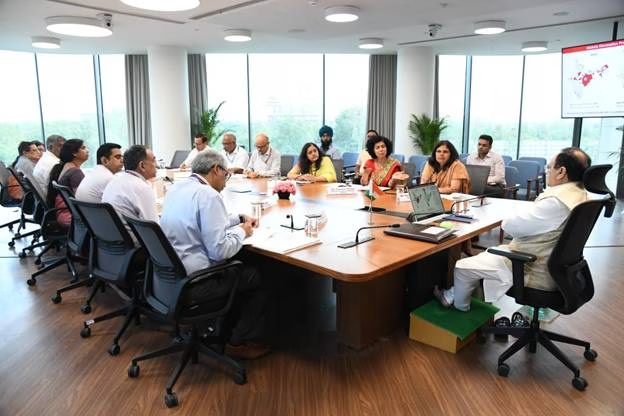
NEW DELHI — With the annual monsoon season approaching, India’s Ministry of Health and Family Welfare has initiated a comprehensive nationwide offensive against vector-borne diseases. Union Health Minister Shri Jagat Prakash Nadda chaired a critical high-level review meeting in New Delhi to assess national preparedness, coordinate strategies across state borders, and reinforce protocols to prevent potential outbreaks of dengue and malaria.
The high-level gathering comes at a crucial juncture as the country enters its peak transmission season. Top health officials—including Union Health Secretary Smt. Punya Salila Srivastava, ICMR Director General Dr. Rajiv Bahl, and senior executives from the National Centre for Vector Borne Diseases Control (NCVBDC)—gathered to finalize district-specific micro-plans, assess logistical supply chains, and outline immediate vector control measures.
Directives from the Top: Speed, Surveillance, and Supplies
During the review, Minister Nadda emphasized that minimizing the national disease burden relies on a proactive, highly coordinated response between the Central Government, States, Union Territories (UTs), and local civic bodies. The Ministry has directed states to immediately scale up their active surveillance frameworks to detect localized case spikes before they evolve into full-scale community outbreaks.
Key Action Items Mandated by the Health Ministry:
1. Intensive vector control including source reduction and focal fogging.
2. Mandatory district-specific hotspot mapping and localized micro-plans.
3. Uninterrupted supply chains for diagnostics, blood components, and therapeutics.
4. Active mobilization of community groups (RWAs and Panchayats).
Hospital administrators nationwide have been ordered to audit their internal capacities. Facilities must ensure an uninterrupted availability of testing kits, essential medicines, dedicated hospital beds, and adequate stocks of blood components—particularly platelets, which frequently drop to critical levels in severe dengue patients.
The Historical Context: Progress and the Shifting Threat
India’s current strategy operates against a backdrop of historic victories against malaria, contrasted by a growing and unpredictable dengue footprint.
According to data acknowledged in the World Malaria Report 2025, India has achieved remarkable success, cutting total malaria cases and deaths by nearly 80% between 2015 and 2025. This sustained progress allowed India to officially exit the World Health Organization’s (WHO) “High Burden to High Impact” (HBHI) core group. Furthermore, rigorous localized interventions enabled 160 districts across the country to report zero indigenous malaria cases throughout the 2022–2025 period, aligning with the national target of complete elimination by 2030.
| Vector-Borne Disease Indicator | Public Health Status (2015 vs. 2025/2026) |
| Malaria Incidence & Mortality | Declined by ~80% since 2015; exited WHO HBHI group. |
| Malaria-Free Districts | 160 districts reported zero indigenous cases (2022–2025). |
| Dengue Geographic Footprint | Expanded from urban hotspots into peri-urban and rural areas. |
| Dengue Case Trajectory | Steadily rising; over 289,000 cases reported nationally in recent peak years. |
However, public health experts note that dengue presents a completely different challenge. While malaria has receded due to targeted indoor residual spraying and insecticide-treated bed nets, dengue transmission has expanded beyond traditional urban centers into peri-urban and rural communities. Rapid urbanization, inadequate solid waste management, and changing rainfall patterns have provided ideal breeding grounds for the Aedes aegypti mosquito, which propagates rapidly in clean, stagnant water inside and around residential properties.
Expert Perspectives: The Clinical Reality on the Ground
Independent public health experts stress that the intersection of the monsoon with vector ecology creates complex clinical challenges.
“Early diagnosis is the single most critical factor in preventing dengue mortality,” notes Dr. Sandeep Sharma, an infectious disease specialist based in Mumbai, who was not present at the review meeting. “By the time a patient presents with warning signs like persistent vomiting, severe abdominal pain, or mucosal bleeding, they are already entering the critical phase. The Ministry’s emphasis on strictly adhering to standard clinical management protocols is vital to preventing preventable deaths.”
Epidemiologists also point out that managing vector-borne illnesses during the monsoon requires a high index of suspicion for co-infections. Data published in regional medical journals indicate that concurrent infections—such as a patient suffering from both dengue and malaria, or dengue alongside enteric fever—frequently occur during high-transmission months. These overlapping infections significantly complicate the clinical picture, often leading to severe systemic inflammation, rapid platelet drops, and prolonged hospital stays.
The Citizen’s Toolkit: From Awareness to Action
A central pillar of the government’s pre-monsoon strategy is a massive push for Information, Education, and Communication (IEC) campaigns. Health authorities are pivoting away from top-down administrative mandates, urging active community ownership through Resident Welfare Associations (RWAs), educational institutions, and Panchayati Raj organizations.
To protect household environments, public health officials recommend a systematic weekly checking routine:
-
Eliminate Stagnant Water: Empty, scrub, and turn over flower pots, desert coolers, old tires, and plastic containers weekly to disrupt the 7-to-10-day breeding cycle of the Aedes mosquito.
-
Optimize Personal Protection: Install window screens, utilize insect-repellent bed nets, and apply approved topical insect repellents containing DEET, Picardin, or IR3535 during daylight hours when Aedes mosquitoes are most active.
-
Seek Early Medical Attention: Avoid self-medicating with over-the-counter non-steroidal anti-inflammatory drugs (NSAIDs) like ibuprofen or aspirin if a sudden, high fever strikes. These medications can exacerbate bleeding tendencies in dengue patients. Acetaminophen (paracetamol) remains the standard recommended therapy pending professional evaluation.
Operational Challenges and Critical Limitations
While the government’s directives establish a robust operational roadmap, independent observers highlight structural gaps that could challenge implementation.
A primary constraint is the well-documented variance between official surveillance data and actual community disease burdens. Community cohort studies conducted across major Indian metropolitan areas suggest that mild or asymptomatic dengue cases frequently go underreported, meaning official registries capture only a fraction of the total viral transmission.
Additionally, vector control measures like municipal fogging provide only temporary relief, as they target adult flying mosquitoes rather than larvae. If local municipal bodies fail to conduct rigorous, door-to-door larval source reduction before the heavy rains begin, health infrastructure may face heavy patient volumes later in the autumn months.
The Health Ministry has assured full financial and technical backing to all state governments to bridge these operational gaps, positioning early diagnostics and aggressive community action as the primary shields against the seasonal surge.
References
-
Government Directive: Press Information Bureau (PIB) Delhi. “Union Health Minister Shri J.P. Nadda Reviews Dengue and Malaria Preparedness Ahead of the Monsoon Season.” Published June 18, 2026.
Medical Disclaimer: This article is for informational purposes only and should not be considered medical advice. Always consult with qualified healthcare professionals before making any health-related decisions or changes to your treatment plan. The information presented here is based on current research and expert opinions, which may evolve as new evidence emerges.