 0
0
 0
0
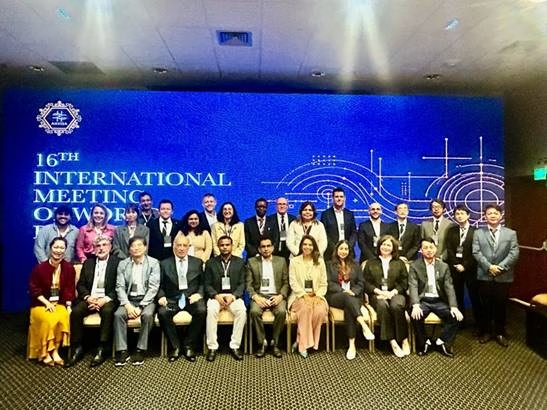
BRASÍLIA, Brazil — In a major step forward for global healthcare quality, a delegation from the Indian Pharmacopoeia Commission (IPC) represented India at the 16th International Meeting of World Pharmacopoeias (IMWP) and its accompanying Stakeholders’ Meeting, held here from June 15 to 17, 2026. Coordinated by the World Health Organization (WHO), the high-level summit brought together regulatory leaders from the world’s most influential economies to harmonize the scientific benchmarks that ensure the safety, purity, and strength of medicines. During the three-day convention, global health authorities formally reaffirmed that India’s pharmaceutical quality standards are fully comparable with leading international benchmarks, positioning the nation as a primary architect of global public health standards.
Setting the Global Benchmark for Quality
A pharmacopoeia is an official compendium of reference standards used by scientists and regulators to test whether a drug contains the correct active ingredients in the precise amounts, free from dangerous contaminants. When multiple nations align these definitions—a process known as pharmacopoeial convergence—it streamlines international supply chains, reduces manufacturing bottlenecks, and ensures that a patient buying a life-saving medication in one country receives the exact same standard of care as a patient anywhere else.
The Indian delegation was led by Dr. V. Kalaiselvan, Secretary-cum-Scientific Director of the IPC, alongside senior scientists Dr. Pawan Saini and Dr. Shruti Rastogi. Dr. Kalaiselvan presented comprehensive updates on the recent modernization initiatives integrated into the Indian Pharmacopoeia (IP). The assembly, which included representatives from the United States, the United Kingdom, the European Union, Japan, South Korea, Brazil, Mexico, Russia, Uzbekistan, and Vietnam, validated India’s rigorous regulatory framework.
“Achieving recognized parity with the world’s leading pharmacopoeias is a monumental milestone for patient safety,” said Dr. Kalaiselvan during his address to the stakeholders. “It establishes that affordable medicines produced under our guidelines are scientifically indistinguishable in quality from those manufactured under Western or East Asian frameworks.”
Leadership in Complex Therapeutics
Beyond validating its core standards, the international assembly recognized India’s specialized leadership in developing and establishing stringent quality metrics for highly complex medical treatments. The IPC was explicitly commended for setting global standards in several critical therapeutic categories:
-
Anti-Tuberculosis (TB) Medications: Establishing baseline purities to prevent under-dosing, which is a major driver of multi-drug resistant strains.
-
Anti-Cancer Therapeutics: Providing precise protocols for highly sensitive oncology molecules that require exact dosing to maximize efficacy while protecting fragile patients.
-
Anaemia Management: Formulating benchmarks for iron-based treatments and critical regulatory protocols for blood and blood-derived products.
-
Complex Molecules: Creating reference standards for advanced biologics and large-molecule drugs that are notoriously difficult to replicate consistently.
As a primary global supplier of generic medications, India’s role in establishing these benchmarks directly impacts the daily health decisions of millions. When a consumer selects a generic medication, their trust relies entirely on these invisible standards. The IMWP’s recognition ensures that global regulatory bodies accept Indian-manufactured treatments with identical confidence, preventing costly import delays and safeguarding access to affordable care.
Innovation, Microbes, and Green Pharmacy
The 16th IMWP also addressed emerging challenges at the intersection of technology and medicine. The Indian delegation actively contributed to shaping global frameworks on three critical fronts:
1. Modern Microbiological Methods
Traditional safety testing for bacterial contamination often relies on growing cultures, which can take days or weeks. The IPC highlighted the integration of rapid, DNA-based microbiological assays. These modern testing techniques allow manufacturers to detect contamination in hours, accelerating the distribution of critical therapeutics to patients without compromising safety.
2. Environmental Sustainability
Pharmaceutical manufacturing has historically carried a heavy environmental footprint. The convention held focused panels on introducing “green pharmacy” standards. This involves updating pharmacopoeial monographs to encourage manufacturing methodologies that reduce hazardous chemical waste, utilize safer solvents, and minimize carbon output during the high-volume synthesis of active pharmaceutical ingredients (APIs).
Strategic Implications and Public Health Impact
For health-conscious consumers and healthcare providers alike, this international convergence brings profound practical benefits. Doctors can prescribe affordable, internationally sourced medications with absolute therapeutic confidence. For public health infrastructure, standardized guidelines act as a bulwark against the proliferation of substandard or falsified medical products.
To offer an independent perspective, health policy experts emphasize the systemic value of this global coordination.
“When global pharmacopoeias converge, we remove redundant testing layers,” notes Dr. Elena Vance, an independent regulatory analyst specializing in global health distribution systems, who was not involved in the IMWP proceedings. “Historically, a drug approved under one country’s compendium might face months of re-testing to satisfy another country’s minor procedural differences. Alignment means faster deployment during public health crises and steadier daily pharmacy inventories worldwide.”
Limitations and Evolving Challenges
Despite the significant progress celebrated in Brasília, harmonizing global standards involves distinct challenges. While the intent to converge standards is unanimous, implementation timelines vary wildly between nations based on local legal frameworks and technological readiness.
Furthermore, the fast-paced evolution of biotechnology—such as personalized mRNA therapies and gene-editing technologies—presents an ongoing hurdle. Pharmacopoeias worldwide are racing to write standards for complex therapies that did not exist a decade ago. Independent watchdogs note that maintaining parity requires continuous financial investment and unrelenting laboratory surveillance, as even a minor deviation in reference standards can have cascading effects across the international drug supply chain.
As the 16th IMWP concluded, the participating nations committed to an ongoing framework of data sharing and scientific exchange to meet these emerging challenges collectively. Reaffirming India’s leadership role within this elite body ensures that the perspectives of developing nations remain central to the future of international medicine quality control.
Reference Section
-
Ministry of Health and Family Welfare, Government of India. Press Information Bureau (PIB) Delhi. “Indian Pharmacopoeia Commission Represents India at the 16th International Meeting of World Pharmacopoeias in Brazil.” Published June 18, 2026. Release ID: 2274525.
Medical Disclaimer: This article is for informational purposes only and should not be considered medical advice. Always consult with qualified healthcare professionals before making any health-related decisions or changes to your treatment plan. The information presented here is based on current research and expert opinions, which may evolve as new evidence emerges.