 0
0
 0
0
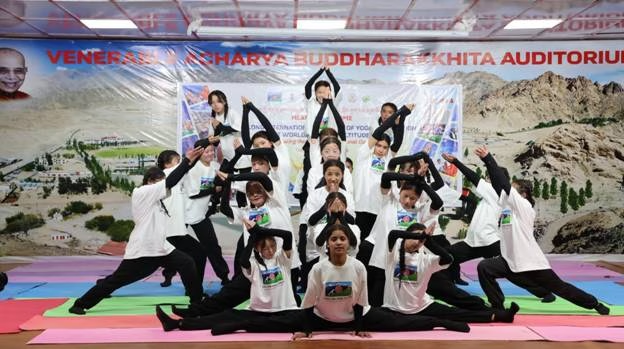
LEH, LADAKH — As the high-altitude deserts of Ladakh resonate with the quiet rhythms of the 12th UN International Day of Yoga, leading healthcare pioneers and traditional medicine experts gathered in Leh on June 18, 2026, to address a critical modern crisis: the global surge in lifestyle disorders and mental health challenges.
Organized by the National Institute of Sowa Rigpa (NISR) in partnership with the Mahabodhi International Meditation Centre (MIMC), a landmark national seminar titled “Integration of Yoga for Public Health” brought together policymakers, traditional physicians, and research scholars. Their objective was clear—evaluating how ancient mind-body practices can be formally woven into mainstream preventive medicine to address public health gaps.
A Synergy of Two Ancient Sciences
The seminar served as the intellectual anchor of the week-long International Festival of Yoga and Meditation 2026, running from June 15 to 21 across the Ladakh region. While massive public outdoor sessions took place at striking, high-altitude landscapes—ranging from the serene waters of Pangong Lake to the unforgiving terrain of the Siachen Base Camp—the proceedings inside the NISR focused heavily on scientific and operational integration.
Sowa Rigpa, popularly known as the Amchi system of medicine, is one of the world’s oldest surviving medical traditions. Deeply rooted in Himalayan culture and recognized formally by the Government of India in 2010, the system treats health as a delicate balance between the body’s cosmo-physical elements and its three core primary energies: Lung (Wind), Thripa (Bile), and Bedkan (Phlegm).
Dr. Padma Gurmet, Director of the National Institute of Sowa Rigpa, explained that this framework shares profound philosophical and practical common ground with traditional Yogic sciences. Both systems view disease not merely as an isolated physical malfunction, but as a systemic imbalance stemming from environmental stressors, incorrect diet, and psychological unrest.
“The integration of Yoga with Sowa Rigpa offers a highly sustainable model for strengthening preventive healthcare,” Dr. Gurmet stated during his address. “By combining the physical alignment and breathing techniques of Yoga with the personalized lifestyle and dietary guidance of Sowa Rigpa, we can build a robust shield against chronic diseases at the community level.”
Tackling the Modern Mental Health Epidemic
A major focal point of the presentation was the shifting nature of global public health crises. While infectious diseases remain a persistent challenge, non-communicable lifestyle disorders—such as cardiovascular diseases, type 2 diabetes, hypertension, and clinical anxiety—now constitute the leading causes of premature mortality worldwide.
The seminar featured specialized research tracks targeting these issues, including:
-
Building Emotional Resilience through Yoga: Utilizing specific pranayama (breath control) and visual meditation to modulate the autonomic nervous system.
-
Emotional Fitness as a Skill for the Future: Re-framing mental health not as a passive state, but as an active skill cultivated through structured behavioral regimens.
Chief Guest Dr. Ishwar V. Basavaraddi, Former Director of the Morarji Desai National Institute of Yoga, detailed how clinical research increasingly validates these traditional methods. Modern neuroimaging studies demonstrate that regular meditation and conscious breathing can downregulate the amygdala—the brain’s fear center—while thickening the prefrontal cortex, which governs executive decision-making and emotional regulation.
Supplementing this perspective, Ven. Bhikkhu Sanghasena, Founder of the Mahabodhi International Meditation Centre, emphasized the societal benefits of inner well-being. He remarked that cultivating mental peace, compassion, and mindfulness is fundamental to developing long-term health equity and social harmony, serving as a non-pharmaceutical buffer against daily stressors.
The Public Health Outlook: Scalability and Hurdles
From a public health standpoint, incorporating Yoga and Sowa Rigpa into rural and urban health frameworks presents a highly attractive, cost-effective opportunity. Because these disciplines focus heavily on self-care, dietary logic, and physical movement, they empower individuals to take direct responsibility for their health outcomes without relying exclusively on expensive medical interventions.
However, mainstream public health experts urge measured optimism and emphasize distinct systemic limitations. Incorporating these ancient traditions into modern, evidence-based medical policies presents several significant challenges:
-
The Standardization Gap: Unlike pharmaceutical drugs with exact molecular properties, traditional therapeutic interventions like Sowa Rigpa formulations and individual Yogic regimens vary based on the practitioner and the patient’s constitution. Scaling these treatments uniformly across large populations requires strict quality controls and comprehensive baseline metrics.
-
The Need for Rigorous Data: While retrospective studies and smaller clinical trials support the benefits of Yoga for stress mitigation and metabolic control, large-scale, multi-center Randomized Controlled Trials (RCTs) remain scarce.
-
Safety at High Altitudes: The festival’s high-altitude events highlighted another clinical reality: while mild yogic breathing can assist with acclimatization, strenuous physical postures at extreme elevations (such as Pangong Lake or Siachen) can pose cardiovascular risks to unacclimatized individuals or those with underlying respiratory vulnerabilities.
Practical Takeaways for Consumers
For health-conscious individuals, the key takeaway from the Leh seminar is the value of proactive prevention. Rather than waiting for symptoms to manifest and requiring clinical treatment, individuals can actively implement several foundational principles from both sciences into their daily routines:
-
Circadian Alignment: Both systems strongly advocate for alignment with natural cycles—such as regularizing sleep-wake schedules and adjusting diets according to seasonal shifts.
-
Mindful Consumption: Sowa Rigpa places extraordinary emphasis on digestion (digestive heat). Practices include avoiding incompatible food combinations and consuming meals based on individual metabolic types.
-
Daily Emotional Hygiene: Dedicating even 10 to 15 minutes daily to structured breathing exercises or secular mindfulness meditation can measurably decrease resting heart rates and lower systemic cortisol levels.
As the International Festival of Yoga and Meditation 2026 draws to a close, the consensus from the mountains of Ladakh is clear: the future of global medicine may very well rest on a hybrid model—one that skillfully pairs the acute diagnostic and therapeutic precision of modern allopathy with the timeless, preventative wisdom of traditional holistic systems.
Reference Section
-
Press Information Bureau (PIB) Delhi. (2026, June 18). International Festival of Yoga and Meditation 2026 Celebrated in Leh: Seminar on ‘Integration of Yoga for Public Health’ Held at National Institute of Sowa Rigpa. Ministry of Ayush, Government of India. Press Release ID: 2274909.
Medical Disclaimer: This article is for informational purposes only and should not be considered medical advice. Always consult with qualified healthcare professionals before making any health-related decisions or changes to your treatment plan. The information presented here is based on current research and expert opinions, which may evolve as new evidence emerges.