 0
0
 0
0
NEW DELHI — In a major structural shift for public health delivery, India’s pharmaceutical and medical device sectors have completed a 12-year transformation, moving from a heavy reliance on medical imports toward domestic self-reliance. This evolution is reshaping how healthcare is accessed both domestically and globally.
According to data released by the Ministry of Chemicals and Fertilizers on June 17, 2026, a combination of community-focused generic drug expansions and aggressive industrial manufacturing incentives has saved Indian consumers tens of thousands of crores in out-of-pocket medical expenses while positioning the nation as an autonomous healthcare manufacturing power.
The dual strategy focuses on two main goals: solving the immediate crisis of affordable medicine access for the general public, and building the heavy industrial infrastructure required to secure long-term medical supply chains.
Expanding the Safety Net: The Rise of Jan Aushadhi Kendras
For decades, the high cost of brand-name medicines has been a primary driver of healthcare-induced poverty in India. The Pradhan Mantri Bhartiya Janaushadhi Pariyojana (PMBJP) was expanded to counter this challenge by delivering high-quality generic drugs—medications that contain the exact same active ingredients as brand-name versions but cost significantly less.
The scale of this expansion represents a major shift in public health infrastructure:
-
National Footprint: The network of functional Jan Aushadhi Kendras (low-cost pharmacy outlets) grew from a mere 84 shops in 2014 to more than 19,200 operating hubs across India in 2026.
-
Economic Impact: Public health data reveals that the availability of these low-cost generic alternatives has saved Indian citizens more than ₹40,000 crore in out-of-pocket healthcare expenses over the 12-year period.
-
Geographic Reach: The expansion has actively targeted historically underserved locales. The country’s remote North Eastern states, which possessed only a single functional Jan Aushadhi Kendra in 2014, now house 417 operational outlets.
State-by-State Breakdown of Low-Cost Pharmacy Outlets (2026)
| State / Union Territory | Number of Functional Kendras |
| Uttar Pradesh | 4,042 |
| Kerala | 1,791 |
| Karnataka | 1,665 |
| Tamil Nadu | 1,591 |
| Bihar | 1,183 |
| New Delhi (National Capital) | 645 |
| Jammu & Kashmir | 358 |
Industrial Architecture: PLI Schemes and Bulk Drug Parks
While community pharmacies handle immediate consumer access, the underlying vulnerability of India’s healthcare system historically lay in its supply chains. Prior to recent policy interventions, Indian drug manufacturers relied heavily on imported Active Pharmaceutical Ingredients (APIs)—the raw chemical components required to manufacture finished medications.
To mitigate this systemic risk, the government implemented Production Linked Incentive (PLI) schemes alongside dedicated industrial zones.
+-----------------------------------------------------------------+
|               PHARMACEUTICALS PLI SCHEME IMPACT                 |
+-----------------------------------------------------------------+
|  Cumulative Investment Attracted:   ₹42,694.89 Crore            |
|  Total Cumulative Sales Generated:  ₹3,43,215.27 Crore          |
|  High-Value Sector Focus:           Biopharma, Complex Generics |
|  New Industrial Jobs Created:       113,000+                    |
+-----------------------------------------------------------------+
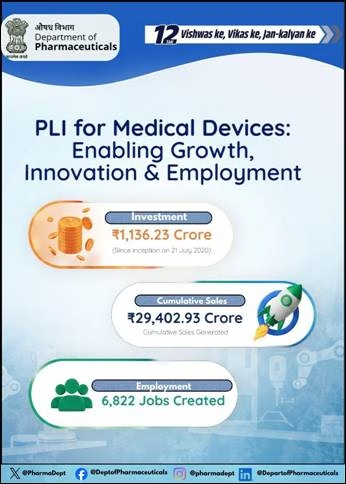
Simultaneously, the Medical Devices PLI scheme addressed highly complex diagnostic machinery and surgical equipment, generating cumulative sales of ₹29,402.93 crore and drawing ₹1,136.23 crore in targeted industrial investments.
To anchor these operations, physical infrastructure clusters are currently being constructed. Three dedicated Bulk Drug Parks are anchoring manufacturing lines in Andhra Pradesh, Gujarat, and Himachal Pradesh, while specialized Medical Device Parks are being established across Tamil Nadu, Uttar Pradesh, and Madhya Pradesh to consolidate production costs through shared regional infrastructure.
The Next Frontier: Biologics and the Biopharma SHAKTI Initiative
As global medicine transitions from chemical-based small molecules toward highly complex biologic therapies—medicines derived from living organisms, such as monoclonal antibodies and advanced vaccines—India is shifting its public health strategy accordingly.
The recently introduced Biopharma SHAKTI (Strategy for Healthcare Advancement through Knowledge, Technology, and Innovation) initiative features a dedicated budget allocation of ₹10,000 crore over the next five years. The program is designed to build a self-reliant ecosystem for complex biologics and biosimilars (the generic equivalents of biologic drugs), ensuring that advanced therapies for chronic conditions like autoimmune diseases and oncology treatments remain financially accessible to the public.
Expert Perspectives and Public Health Implications
Independent public health experts view these developments as significant structural progress, though they emphasize that infrastructural expansion must be paired with stringent regulatory vigilance.
“Scaling up generic drug access from under 100 stations to nearly 20,000 is an historic public health milestone,” notes Dr. Amrita Roy, an independent health systems researcher based in New Delhi. “For the average consumer, this means managing chronic ailments like diabetes or hypertension no longer requires compromising on household nutrition or education costs.”
However, Dr. Roy highlights an important consideration for ongoing policy:
“The primary barrier to universal generic adoption has always been trust. As India scales domestic production of both APIs and finished formulations, maintaining absolute transparency in quality control and batch testing is essential. The government must ensure that quality assurance systems scale at the exact same velocity as manufacturing volume.”
Industry analysts also point out that while the PLI schemes have successfully reduced dependency on external raw materials, complete independence in chemical precursors remains a long-term goal. Continued investment in basic chemical manufacturing will be necessary to fully insulate the domestic drug pipeline from global supply shocks.
Medical Disclaimer
This article is for informational purposes only and should not be considered medical advice. Always consult with qualified healthcare professionals before making any health-related decisions or changes to your treatment plan. The information presented here is based on current research and expert opinions, which may evolve as new evidence emerges.
Reference Section
- https://www.pib.gov.in/PressReleasePage.aspx?PRID=2274104®=48&lang=1