 0
0
 0
0
NEW DELHI — India’s public health landscape has fractured into two parallel, deeply troubling realities. While frontline health centers continue their decades-long battle against severe wasting and stunting in children, a rapid, quiet epidemic of weight gain and metabolic disease is sweeping across both urban and rural communities. This phenomenon—known medically as the “double burden of malnutrition”—means that undernutrition and obesity are no longer separate socioeconomic issues. Today, they thrive simultaneously within the same states, the same neighborhoods, and frequently even the same households. As the country’s healthcare architecture struggles to pivot, leading medical experts warn that treating these conditions as opposing problems rather than two sides of the same coin is causing public health interventions to fail.
The Numbers Tell a Stark Story
The latest data from the National Family Health Survey (NFHS-6), conducted by the Ministry of Health and Family Welfare across 6.79 lakh households, provides an unsettling look at this shifting landscape. The survey reveals that nearly one in three Indian women (30.7%) and more than one in four men (27.3%) are now classified as overweight or obese.
This represents a steep, rapid escalation from the NFHS-5 data collected just a few years prior, where the share of overweight or obese individuals stood at 24% for women and 22.9% for men.
NFHS-6 Body Mass Index (BMI) Key Indicators:
==================================================
[Women] Overweight/Obese: 30.7% (Up from 24.0%)
[Men]   Overweight/Obese: 27.3% (Up from 22.9%)
[Men]   Below-Normal BMI: 19.7% (Up from 16.2%)
Crucially, this rise in weight metrics has not meant the eradication of severe thinness. The proportion of Indian men with a below-normal Body Mass Index (BMI) actually worsened, climbing from 16.2% to 19.7%. While undernutrition among women showed a minor reduction down to 15%, nearly one-third of all Indian children continue to suffer from chronic undernutrition.
Obesity Has Become a National Epidemic
The sheer scale of the overnutrition crisis was mapped out by the Indian Council of Medical Research (ICMR-INDIAB) national study. The landmark survey concluded that 254 million people in India meet the criteria for generalized obesity. Even more concerning to cardiologists is the finding that 351 million Indians—nearly 40% of the population—exhibit abdominal obesity, which is the accumulation of visceral fat around the abdomen and vital internal organs.
Unlike subcutaneous fat (the layer just beneath the skin), abdominal visceral fat is highly active metabolically. It continuously releases inflammatory proteins and free fatty acids into the bloodstream, directly damaging how the body processes insulin.
“Doctors today are looking far beyond absolute body weight and standard BMI charts,” explains Dr. Ashish Gautam, Principal Director of Robotic and Laparoscopic Surgery at Max Super Speciality Hospital in New Delhi. “We are intensely focused on exactly where fat is stored. Fat distribution gives us a profoundly clearer, more accurate picture of a patient’s future risk for type 2 diabetes, fatty liver disease, and heart attacks.”
Children Are Caught in the Middle
This metabolic shift is catching India’s youngest demographic in a dangerous crossfire. According to the World Obesity Atlas, India now ranks second globally in childhood obesity, with an estimated 41 million children classified as overweight or obese.
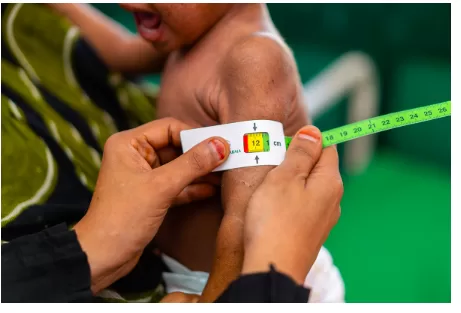
Simultaneously, the country reports some of the starkest undernutrition metrics in the world. While child stunting (being short for one’s age due to chronic malnutrition) dropped from 35.5% to 29.3% in the latest NFHS-6 cycle, India’s wasting rate (being dangerously thin for one’s height) remains a severe public health emergency at 18.7% for children under five—marking it the highest rate of childhood wasting of any nation globally.
The primary driver behind this bizarre overlap is a drastic shift in childhood diets. Across both low-income and affluent areas, traditional, nutrient-dense meals are being replaced by ultra-processed foods, packaged snacks, and sugar-sweetened drinks. These foods provide an excess of empty calories but lack essential vitamins, iron, and high-quality protein, leaving a child simultaneously overweight and severely malnourished.
Why Both Extremes Coexist
“The NFHS-6 data reflects a growing double burden of malnutrition where undernutrition and obesity are present together in the same communities and sometimes within the same families,” notes Dr. Ravikeerthy M, a Senior Consultant in Internal Medicine at Kauvery Hospital, Bengaluru.
This paradox is driven by three intersecting systemic pressures:
-
The Dietary Transition: Highly processed, energy-dense foods have become significantly cheaper, more shelf-stable, and more aggressively marketed than fresh produce, whole grains, or lean proteins. For families on tight budgets, buying cheap calories is often the only viable way to prevent hunger.
-
The Sedentary Squeeze: Rapid urbanization has engineered physical activity out of daily life. Recent data published in The Lancet Global Health shows that insufficient physical activity among Indian adults skyrocketed from 22.4% in 2000 to 45.4% in 2022. Nearly half the adult population fails to get the World Health Organization’s recommended 150 minutes of moderate exercise per week.
-
The Economics of Healthy Food: According to the State of Food Security and Nutrition in the World (SOFI) report, an astounding 55.6% of India’s population—roughly 788 million people—cannot afford a nutritionally adequate, healthy diet, forcing a heavy reliance on cheap, refined carbohydrates.
The “Metabolic Mismatch”
The biological bridge linking early-life undernutrition to adult obesity is an area of intense medical research. When a fetus or infant experiences nutritional deprivation, their body undergoes “metabolic programming” to survive in a high-scarcity environment. The metabolism slows down, muscle mass development is restricted, and the body becomes highly efficient at storing fat.
When that individual is exposed to a calorie-dense, low-activity environment later in childhood or adulthood, a severe “metabolic mismatch” occurs. Because the body’s underlying physiology was programmed to preserve energy, it rapidly stores excess calories as visceral abdominal fat, triggering insulin resistance and early-onset metabolic syndrome. A long-term birth cohort study published in Nature tracking children in southern Indian urban slums confirmed this exact trajectory, noting that the double burden stabilizes in mid-childhood, sharply accelerating between ages seven and nine.
The Health System’s Uneven Focus
For generations, India’s public health infrastructure has been single-mindedly directed at eradicating starvation and caloric deficiency. Landmark programs like the Integrated Child Development Services (ICDS) and the Mid-Day Meal Scheme were explicitly designed to deliver cheap calories and micronutrient supplements to vulnerable groups.
While these safety nets remain essential, the public health system has been slow to construct defenses against rising obesity rates. Primary health centers are rarely equipped to offer structured dietary counseling, preventative metabolic screenings, or lifestyle intervention programs.
“India’s nutrition challenge now has two distinct faces, and both deserve equal, synchronized attention,” warns Dr. Gautam. By continuing to view nutrition policy solely through the lens of scarcity, public health agencies run the risk of inadvertently worsening obesity through programs that incentivize refined sugars and processed carbohydrates over diverse, balanced whole foods.
Limitations in Current Data
Epidemiologists caution that while national averages point to a dual crisis, India’s vast geography features intense fragmentation. Large-scale surveys like the NFHS-6 can underrepresent highly transient migrant worker populations and informal sector laborers who carry a disproportionate burden of severe undernutrition.
Additionally, the methodology used by international bodies to calculate the affordability of a healthy diet remains a subject of intense debate among local economists. Critically, socioeconomic segregation still plays a heavy role: severe undernutrition remains heavily concentrated within the lowest income quartiles and marginalized rural groups, whereas generalized obesity is historically more prevalent among urban, wealthier households—meaning public health solutions cannot afford to be one-size-fits-all.
What This Means for Your Daily Health
For health-conscious individuals navigating this complex environment, experts recommend shifting away from outdated nutritional assumptions:
| Health Priority | Old Approach | Corrected Approach |
| Dietary Assessment | Counting absolute calories in and out. | Focusing on nutrient density—prioritizing lean protein, bioavailable iron, and dietary fiber over empty carbohydrates. |
| Snack Selection | Choosing low-calorie or “diet” processed items. | Eliminating ultra-processed foods completely to restore natural metabolic and hormonal balance. |
| Exercise Focus | Exercising purely for weight management. | Utilizing physical activity to increase insulin sensitivity and protect vital muscle mass. |
| Preventative Care | Waiting for physical symptoms to appear. | Seeking early, comprehensive screenings for blood pressure, blood sugar, and waist-to-hip ratios. |
A Call for Integrated Action
If current trends go unchecked, public health authorities warn that India faces a catastrophic collision of diseases: an ongoing battle with infectious conditions alongside an explosive epidemic of diabetes, cardiovascular failures, and chronic kidney disease. This dual pressure could overwhelm healthcare infrastructure and compromise national economic productivity for a generation.
Addressing the crisis requires a unified strategy. Nutrition policies must stop separating deficiency from excess, and instead focus on promoting balanced food systems that ensure fresh, unrefined, whole foods are affordable and accessible to every income level across the country.
Medical Disclaimer
This article is for informational purposes only and should not be considered medical advice. Always consult with qualified healthcare professionals before making any health-related decisions or changes to your treatment plan. The information presented here is based on current research and expert opinions, which may evolve as new evidence emerges.
References
- https://www.ndtv.com/health/weight-management/india-is-facing-two-epidemics-at-once-undernutrition-and-obesity-we-are-only-talking-about-one-11627838