 0
0
 0
0
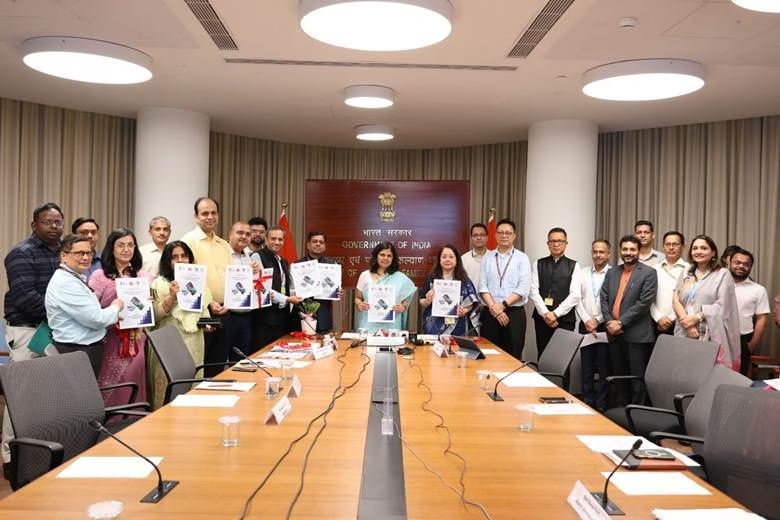
NEW DELHI — In a major push to shield children from aggressive tobacco marketing, India’s Union Health Ministry has launched a digital monitoring platform designed to enforce tobacco-free zones around educational institutions.
Announced by Union Health Secretary Smt. Punya Salila Srivastava on May 29, 2026, ahead of World No Tobacco Day, the new Tobacco-Free Educational Institutions (ToFEI) mobile application will instantly track compliance, reporting, and the illegal sale of tobacco products within 100 yards of schools and colleges.
The digital initiative launches alongside a strict new Standard Operating Procedure (SOP) for tobacco product sampling, signaling a synchronized crackdown on both illegal vendors and deceptive product formatting. The pilot phase of the app will roll out immediately across three states: Rajasthan, Meghalaya, and Maharashtra.
Digital Surveillance in the Schoolyard
The ToFEI application moves tobacco enforcement away from paper checklist monitoring into real-time, data-driven compliance. Under existing national guidelines, schools are mandated to maintain strict tobacco-free environments. However, physical monitoring has historically been inconsistent across India’s vast network of educational facilities.
The new app simplifies this process by allowing schools to perform digital self-assessments, snap photos of mandatory tobacco control signage, and report vendor violations directly to law enforcement.
ToFEI App Core Functions:
├── School Self-Assessment & Compliance Tracking
├── Mandatory Anti-Tobacco Signage Verification
├── Geotagging & Reporting of Vendors within 100 Yards
└── Student & Teacher Awareness Metric Logging
“Tobacco and nicotine products are often designed and marketed in ways that make them appear attractive, particularly to youth, through appealing flavors, packaging, surrogate advertising, and portrayals on social media,” Union Health Secretary Srivastava stated during the national launch at Kartavya Bhawan. “This platform enhances accountability and promotes healthier, tobacco-free environments for children and adolescents.”
Stopping the “Aesthetic” Trap
The launch aligns with the World Health Organization’s (WHO) 2026 World No Tobacco Day theme: “Unmasking the Appeal – Countering Nicotine and Tobacco Addiction.” Global public health agencies have grown increasingly alarmed by the tobacco industry’s pivot toward sleek, high-tech nicotine delivery systems, colorful packaging, and candy-like chemical flavor profiles engineered to attract young demographics.
According to data from the Global Youth Tobacco Survey (GYTS), nearly one in five adolescents aged 13 to 15 globally now use some form of tobacco or nicotine product. In India, public health officials warn that while traditional cigarette smoking has seen shifts due to heavy taxation, the rise of smokeless tobacco, flavored oral pouches, and clandestine e-cigarette marketing poses an immediate threat to pediatric health.
The Pediatric Risk: Nicotine exposure during adolescence can permanently alter brain development, harming the sections governing attention, learning, mood, and impulse control.
Public health experts not involved in the government’s project praised the digital shift but noted that software is only as good as the human enforcement behind it.
“Moving to a digital application is an excellent step for data collection and transparency,” says Dr. Arjan Singh, a community medicine specialist based in New Delhi. “However, the true test will be how quickly local law enforcement responds when a school uses the app to report a vendor illegally selling tobacco products within the 100-yard restricted boundary. Technology flags the problem; human enforcement solves it.”
Standardizing the Fight: New Lab Testing Guidelines
Beyond school gates, the Ministry of Health and Family Welfare released a rigorous framework to tighten regulatory surveillance on the chemical composition of tobacco products.
The newly instituted Standard Operating Procedure (SOP) for Sample Collection of Tobacco Products establishes uniform rules for how government agents collect, store, transport, and document tobacco samples.
Standardized Tobacco Sampling Pipeline:
[Scientific Collection] ➔ [Chain-of-Custody Documentation] ➔ [Temperature-Controlled Transport] ➔ [Reliable Lab Testing]
This structural change ensures that when states test products for banned additives, illegal nicotine concentrations, or unauthorized flavor agents, the evidence will hold up to strict legal and scientific scrutiny.
“Strengthening regulatory and enforcement mechanisms is a critical component of tobacco control,” Srivastava explained. “Scientific sample collection, proper testing procedures, and maintenance of the integrity of the entire chain are essential for ensuring effective enforcement and regulatory action.”
The Public Health Stakes
The economic and physical toll of tobacco usage in India remains staggering. The World Health Organization estimates that tobacco use kills more than 1.3 million people in India every year. It stands as a primary driver of non-communicable diseases (NCDs), including:
-
Cardiovascular disease and stroke: Nicotine constricts blood vessels and accelerates heart rate, spiking blood pressure.
-
Chronic respiratory illnesses: Chronic Obstructive Pulmonary Disease (COPD) and severe asthma exacerbations.
-
Oncology: Tobacco use is linked to roughly 27% of all cancer cases in India, specifically oral and lung malignancies.
To counter this burden, the government has established more than 2,000 Tobacco Cessation Centres across district hospitals, medical colleges, and alternative medicine (AYUSH) institutions to assist those already struggling with dependency.
Next Steps for Consumers and Educators
For parents and school administrators, the pilot rollout in Rajasthan, Meghalaya, and Maharashtra represents a window to test local reporting pipelines before the app goes live nationwide.
The Health Ministry has also opened an online “No Tobacco Pledge” portal, encouraging public participation and civilian monitoring. School administrators in the pilot states are urged to download the application, utilize the self-assessment tool, and systematically audit their perimeters to ensure commercial compliance.
Reference Section
Government & Institutional Sources
-
Ministry of Health and Family Welfare (MoHFW), Government of India: Press Release, “Union Health Secretary launches pilot Tobacco-Free Educational Institutions (ToFEI) Application,” Posted May 29, 2026, PIB Delhi.
-
Standard Operating Procedure (SOP): Sample Collection and Management Draft Guidelines, National Tobacco Control Programme (NTCP). Official Framework Document.
Medical Disclaimer
Medical Disclaimer: This article is for informational purposes only and should not be considered medical advice. Always consult with qualified healthcare professionals before making any health-related decisions or changes to your treatment plan. The information presented here is based on current research and expert opinions, which may evolve as new evidence emerges.