 0
0
 0
0
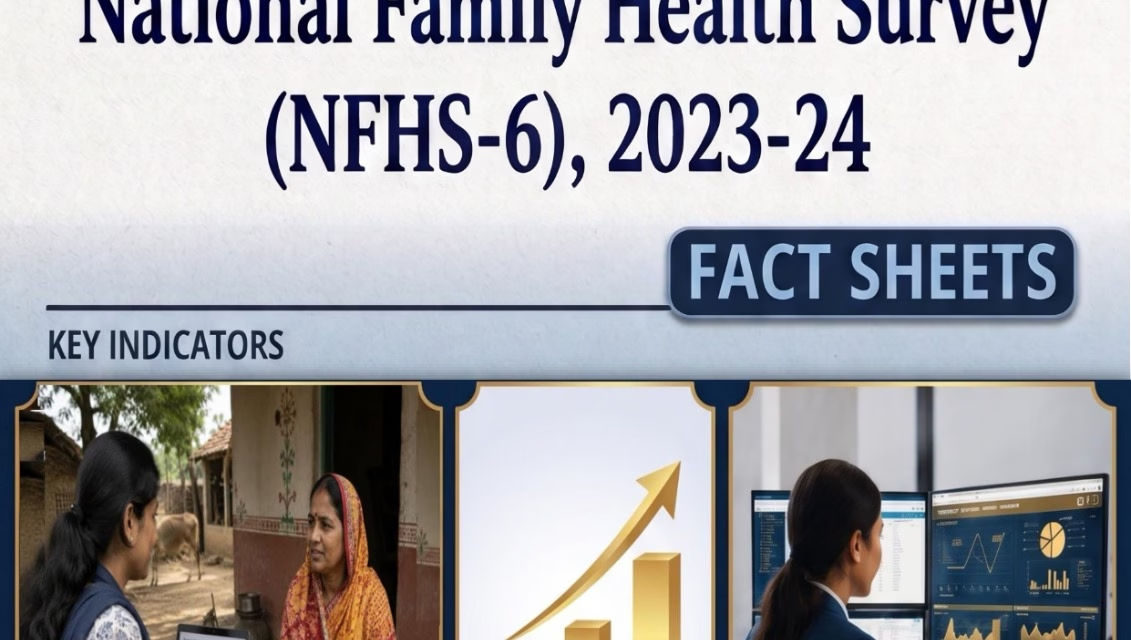
NEW DELHI — In a landmark development for public health in South Asia, India’s Ministry of Health and Family Welfare (MoHFW) has released the definitive results of the National Family Health Survey-6 (NFHS-6). The massive, data-driven assessment reveals an accelerated trajectory in maternal and child health, substantial turnarounds in childhood malnutrition, and an unprecedented expansion of financial protection against catastrophic healthcare costs.
Conducted throughout 2023–24 by the MoHFW alongside the nodal agency, International Institute for Population Sciences (IIPS) in Mumbai, the survey acts as the gold standard for Indian demographic data. Spanning an immense sample size of nearly 6.79 lakh households across 715 districts, the findings trace a multi-year shift toward institutionalized public healthcare and robust digital empowerment for women.
Moving Toward Universal Birth Care and Immunization
Among the most immediate successes highlighted in the data is the stabilization of maternal healthcare networks. Institutional deliveries across India have climbed to 90.6%, up from the 88.6% documented during the NFHS-5 (2019–21). Concurrently, births attended by skilled health personnel ticked upward to 91.3%, effectively shrinking the margins of high-risk home births.
The data reveals that 95.9% of pregnant women received some form of antenatal care (ANC), with the crucial metric of first-trimester ANC registration jumping from 70.0% to 76.2%. Continuity of care also saw an uptick: mothers achieving at least four standard ANC visits increased from 58.5% to 65.2%.
In child immunization, the public health sector has maintained a commanding lead. Full vaccination coverage among children aged 12–23 months grew from 83.8% to 87.1%. Notably, 95.6% of families reported utilizing public health facilities as their preferred provider for these immunizations, underscoring deep community trust in state-administered care.
NFHS-6 Immunization & Motherhood Metrics at a Glance:
• Any Vaccine Received (12-23 months): Consistently >96%
• Rotavirus Vaccination Coverage: 36.4% ──> 85.4% (More than Doubled)
• Second Dose Measles Vaccine: 58.6% ──> 71.8%
• Postnatal Care Within 2 Days: 79.1% ──> 85.3%
Public health experts point directly to infrastructure improvements like the Universal Immunization Programme and the new digital vaccine tracking system, U-WIN, to explain the data. The most striking breakthrough occurred in Rotavirus vaccine coverage, which more than doubled, skyrocketing from 36.4% to 85.4% to drastically mitigate childhood diarrheal mortality.
Reversing Stunting and Wasting: A Nutrition Turnaround
For decades, India’s persistent struggle with childhood malnutrition has drawn international concern. However, the NFHS-6 numbers signal that targeted interventions may finally be breaking the cycle. Childhood stunting—defined as low height for a child’s age, which indicates chronic long-term undernutrition—declined by approximately 17% relatively, dropping from 35.5% to 29.3%.
Even more pronounced was the reduction in severe wasting, where a child is dangerously thin for their height. Severe wasting declined sharply by nearly 32% relatively, falling from 7.7% to 5.2%.
“A drop in stunting from 35.5% to under 30% in a few years is a massive structural win for India’s rural health networks,” says Dr. Anuradha Sen, an independent public health policy researcher and former consultant for global maternal-child health initiatives. “This points to the success of convergent programming. When you link clean water initiatives, local Anganwadi nutrition centers, and direct cash transfers for pregnant mothers, you tackle the root environmental causes of chronic growth restriction, not just the symptoms.”
| Child Nutrition Indicator | NFHS-5 (2019-21) | NFHS-6 (2023-24) | Relative Change Trend |
| Child Stunting (Under 5 Years) | 35.5% | 29.3% | Substantial Decline (~17% Relative Drop) |
| Severe Wasting (Under 5 Years) | 7.7% | 5.2% | Sharp Improvement (~32% Relative Drop) |
| Underweight (Under 5 Years) | 32.1% | 31.8% | Marginal Decline |
| Solid/Semi-Solid Food Introduction (6-8 Months) | 45.9% | 59.5% | Significant Upward Progress |
Closing the Financial Gap and Empowering Women
Historically, out-of-pocket medical expenses have been a primary driver of poverty for vulnerable Indian families. The NFHS-6 results show a dramatic expansion in health security, with household health insurance or financing scheme coverage leaping from 41.0% to 60.2%. This 19.2 percentage-point expansion is largely attributed to the scaled deployment of flagship social security programs like Ayushman Bharat–Pradhan Mantri Jan Arogya Yojana (PM-JAY), which offers subsidized secondary and tertiary hospital care to low-income citizens.
Simultaneously, the survey demonstrates that health outcomes are closely linked with women’s financial and digital autonomy. The percentage of women who have ever used the internet nearly doubled, shifting from 33.3% to 64.3%. Women possessing and actively using an independent bank or savings account rose to 89.0%, while personal mobile phone ownership among women climbed to 63.6%.
Nuances and Missing Links: The Remaining Challenges
Despite these clear programmatic victories, independent epidemiologists emphasize that the raw data requires careful interpretation. While childhood stunting and severe wasting have decreased, the overall percentage of children classified as underweight saw only a minimal decrease, moving from 32.1% to 31.8%. This discrepancy suggests that while acute, life-threatening malnourishment is being brought under control by clinical interventions like Nutrition Rehabilitation Centres, systemic caloric and micronutrient deficits remain widespread.
Furthermore, the MoHFW report explicitly acknowledges that India is encountering a complex, dual burden of malnutrition. Even as rural areas combat undernutrition, urban and semi-urban populations are experiencing a steady rise in non-communicable diseases (NCDs), adult lifestyle-related risks, and escalating rates of overweight and obesity.
Health commentators note that future iterations of national health strategies must pivot heavily toward preventative health behaviors, structured dietary education, and non-communicable disease screening frameworks if India intends to protect these hard-won demographic dividends.
Reference Section
-
Data Source: National Family Health Survey – 6 (NFHS-6), 2023-24, Ministry of Health and Family Welfare (MoHFW), Government of India, managed by the International Institute for Population Sciences (IIPS), Mumbai. Released May 29, 2026. Official Repository: MoHFW Publications Portal.
Medical Disclaimer
Medical Disclaimer: This article is for informational purposes only and should not be considered medical advice. Always consult with qualified healthcare professionals before making any health-related decisions or changes to your treatment plan. The information presented here is based on current research and expert opinions, which may evolve as new evidence emerges.