 0
0
 0
0
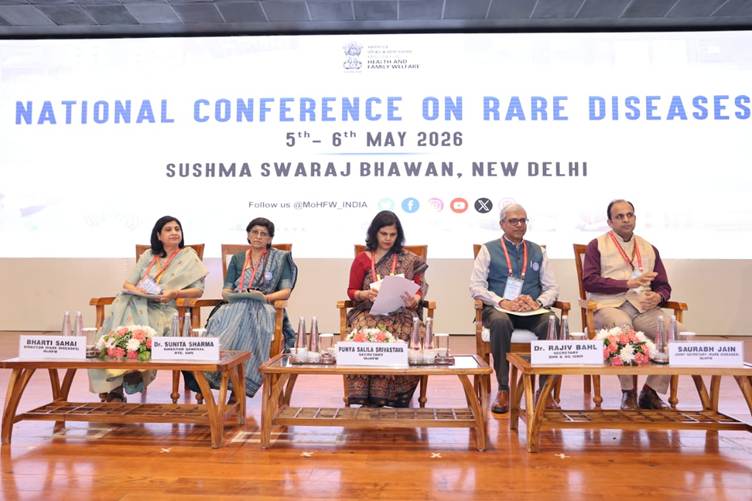
NEW DELHI — In a decisive move to reshape the landscape of specialized healthcare, the Union Ministry of Health and Family Welfare inaugurated a landmark two-day National Conference on Rare Diseases today. The event, held on May 5–6, 2026, brings together a high-level assembly of policymakers, medical researchers, and clinicians to address the “silent crisis” of rare conditions that impact millions of families across the nation.
During the opening session, Union Health Secretary Smt. Punya Salila Srivastava emphasized that India is transitioning from merely recognizing rare diseases to institutionalizing a robust, indigenous framework for treatment and financial support. The conference aims to bridge the gap between cutting-edge genomic science and the bedside care provided to patients in every corner of the country.
Expanding the Safety Net: Financial and Clinical Growth
A central theme of the conference is the evolution of the National Policy for Rare Diseases (NPRD), 2021. Secretary Srivastava highlighted that the government has significantly bolstered the national architecture for clinical care. The number of designated Centres of Excellence (CoEs)—premier tertiary hospitals equipped to handle these complex cases—has expanded from 8 to 15. This expansion notably includes two new centers in Northeast India, ensuring that geographical barriers do not dictate a patient’s survival.
Perhaps most impactful for families is the increase in financial assistance. “The financial support under the policy has been progressively enhanced to ₹50 lakh (5 million INR) per patient,” Srivastava informed the delegation. This funding is critical, as many rare disease therapies are among the most expensive medical interventions in the world.
To further reduce the financial burden, the government has:
-
Exempted several life-saving rare disease drugs from basic customs duty.
-
Called upon stakeholders to identify additional medications for future tax exemptions.
-
Operationalized the UMMID (Unique Methods for Management of Inherited Disorders) initiative to provide genetic counseling through NIDAN Kendras.
The Shift Toward an “India-Specific” Model
Dr. Rajiv Bahl, Director General of the Indian Council of Medical Research (ICMR), provided a sobering yet hopeful perspective on the history of rare disease management. Reflecting on the 1990s, he noted that a rare disease diagnosis was once a “death sentence” due to a lack of diagnostic tools and treatment.
“Today, while the high cost of therapies remains a challenge, we are now able to meaningfully support children who were previously left without hope,” Dr. Bahl stated. He argued, however, that India cannot simply copy Western medical models. Because rare diseases are often genetic, India’s unique genetic diversity requires a localized approach.
ICMR’s Strategy for Sustainability:
-
Repurposed Drugs: ICMR has identified six existing medications that, while originally designed for other conditions, can significantly improve the quality of life for rare disease patients.
-
Indigenous Innovation: Collaborative efforts are underway to produce affordable, domestic alternatives to prohibitively expensive foreign drugs.
-
Frontier Technologies: India is making strides in Gene Therapy and CAR-T cell therapy, aiming to provide curative treatments rather than just lifelong management.
The Importance of Early Detection
Rare diseases, while individually “rare,” collectively affect an estimated 70 to 96 million people in India. Approximately 50% of new cases are diagnosed in children, and these conditions contribute significantly to infant mortality.
Dr. Sunita Sharma, Director General of Health Services, stressed that the key to reducing this burden is a “population-based approach.” This includes strengthening prenatal screening and parental genetic analysis to identify risks before a child is born.
“Enhancing awareness at both community and provider levels will be key to improving outcomes,” Dr. Sharma noted. “We must ensure that a primary care doctor in a rural district knows when to refer a child to a Centre of Excellence.”
Challenges and the Path Forward
Despite the progress, the conference acknowledged significant hurdles. Rare diseases are notoriously difficult to identify, often taking years—and multiple doctor visits—to diagnose correctly. This “diagnostic odyssey” places an immense emotional and financial strain on families.
The conference will spend the next 24 hours focusing on genomic technologies and patient-centric care models. The goal is to move toward a health system where “rare” does not mean “forgotten.”
Key Statistics at a Glance:
| Feature | Progress (2021 vs. 2026) |
| Centres of Excellence | Increased from 8 to 15 |
| Financial Assistance | Increased from ₹20 Lakh to ₹50 Lakh |
| Patients Treated | ~1,800 supported under current policy |
| Workshops Conducted | 50+ nationwide sensitization programs |
References
- https://www.pib.gov.in/PressReleasePage.aspx?PRID=2257977®=3&lang=1
Medical Disclaimer: This article is for informational purposes only and should not be considered medical advice. Always consult with qualified healthcare professionals before making any health-related decisions or changes to your treatment plan. The information presented here is based on current research and expert opinions, which may evolve as new evidence emerges.