 0
0
 0
0
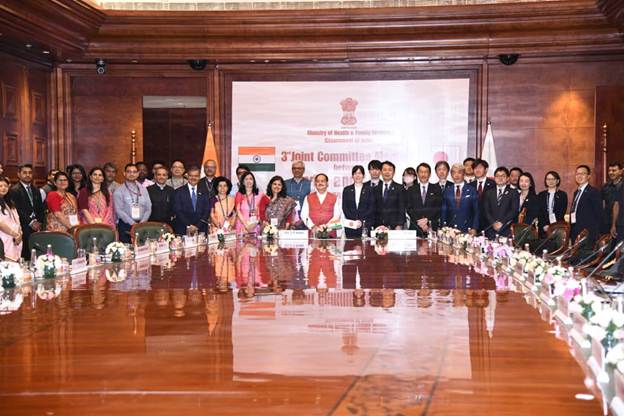
NEW DELHI – In a landmark diplomatic and scientific assembly at the Bharat Mandapam, high-ranking officials from India and Japan have formalized a sweeping expansion of their healthcare partnership. The 3rd Joint Committee Meeting (JCM) on Healthcare, held today, signals a strategic pivot toward integrating Japan’s technological precision with India’s massive digital public infrastructure to tackle the global rise of chronic diseases and supply chain fragility.
The summit, co-chaired by India’s Union Minister of Health and Family Welfare, Shri Jagat Prakash Nadda, and Japan’s Minister in charge of Healthcare Policy, Ms. Kimi Onoda, focused on four pillars: non-communicable diseases (NCDs), digital health innovation, medical supply chain resilience, and human resource exchange.
“India-Japan cooperation in healthcare is guided by a shared vision of strengthening health systems and promoting innovation for better health outcomes,” stated Shri Nadda, emphasizing India’s “Sabka Saath, Sabka Vikas” (Together with all, Development for all) philosophy.
1. Tackling the “Silent Killers”: Non-Communicable Diseases (NCDs)
As both nations face aging populations and shifting lifestyles, the burden of NCDs—such as cancer, diabetes, and cardiovascular disease—has become a shared priority. According to the World Health Organization (WHO), NCDs kill 41 million people each year, equivalent to 74% of all deaths globally.
During the session, India presented its comprehensive response framework, which focuses on early screening and the “continuum of care.” Japan, a world leader in oncology and geriatric medicine, committed to sharing technical expertise in:
-
Early Cancer Diagnosis: Implementing Japanese screening protocols to catch malignancies at more treatable stages.
-
Institutional Capacity Building: Strengthening hospital systems to manage long-term rehabilitation for stroke and heart disease patients.
“The integration of Japanese early-detection technology within the Indian primary healthcare framework could revolutionize how we manage the NCD epidemic,” says Dr. Arvinder Singh, a public health consultant not involved in the proceedings. “Early diagnosis is the difference between a manageable condition and a public health crisis.”
2. A Digital Health Revolution: AI and Interoperability
A major highlight of the meeting was the convergence of India’s Ayushman Bharat Digital Mission (ABDM) with Japan’s advanced Artificial Intelligence (AI) capabilities.
India has built a “Digital Public Infrastructure” that allows for secure, interoperable health records. Japan intends to leverage this ecosystem to test and deploy AI-enabled medical technologies. This partnership aims to create a “citizen-centric” digital health model that could serve as a blueprint for other developing nations.
“The goal is an ecosystem where a patient’s medical history is accessible, secure, and useful for AI-driven diagnostics, regardless of where they seek care,” noted Smt. Punya Salila Srivastava, India’s Union Health Secretary.
3. Strengthening the Global Pharmacy
The COVID-19 pandemic exposed the extreme vulnerability of global medical supply chains. To prevent future shortages, the two nations discussed a “coordinated public-private collaboration model.”
-
India’s Role: Often called the “Pharmacy of the World,” India aims to scale its domestic manufacturing of active pharmaceutical ingredients (APIs) and medical devices to reduce global dependency on single-source suppliers.
-
Japan’s Role: Japan will provide structured partnerships for technology deployment, ensuring that medical products manufactured in India meet the highest international quality standards.
4. Human Capital: Training the Next Generation
The meeting also addressed the global shortage of healthcare workers. The delegations outlined structured pathways for:
-
Personnel Exchanges: Indian healthcare professionals will have expanded opportunities for joint training in Japan.
-
Mutual Recognition: Aligning regulatory standards so that medical competencies are recognized across borders, facilitating a more mobile and skilled global workforce.
Public Health Implications: What This Means for You
For the average citizen in India or Japan, this high-level diplomacy translates into tangible health benefits:
-
Lower Costs: Improved supply chains and local manufacturing of medical devices generally lead to lower out-of-pocket expenses for patients.
-
Smarter Care: AI-driven tools may soon assist local doctors in reading X-rays or identifying skin cancers with higher accuracy.
-
Preventive Focus: A shift from “sick care” to “healthcare,” with more accessible screening programs for common NCDs.
Limitations and Challenges
While the vision is ambitious, experts warn of significant hurdles. “The primary challenge lies in data privacy and the integration of diverse regulatory frameworks,” says Michael Reiter, a global health policy analyst. “Ensuring that AI technologies are culturally and biologically calibrated for the Indian population is also a technical hurdle that will require years of collaborative research.”
Furthermore, the success of the human resource exchange depends on overcoming language barriers and differing medical certification standards between the two nations.
Conclusion
The 3rd JCM concluded with a reaffirmed commitment to the India-Japan Special Strategic and Global Partnership. As Ms. Onoda noted, the collaboration is not merely about bilateral trade, but about “advancing healthcare through innovation and research” for the global good. In an era of emerging pathogens and rising chronic illness, this alliance may prove to be a vital cornerstone of 21st-century global health security.
References
Official Sources & Studies:
-
Ministry of Health and Family Welfare (India): Press Release on the 3rd Joint Committee Meeting on Healthcare, May 5, 2026.
Medical Disclaimer: This article is for informational purposes only and should not be considered medical advice. Always consult with qualified healthcare professionals before making any health-related decisions or changes to your treatment plan. The information presented here is based on current research and expert opinions, which may evolve as new evidence emerges.