 0
0
 0
0
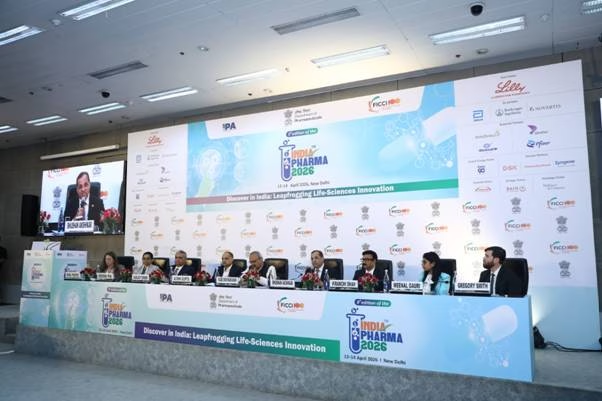
NEW DELHI — The 9th edition of India Pharma 2026 opened its doors at Federation House on Monday, signaling a watershed moment for the nation’s life sciences sector. Bringing together a high-powered assembly of policymakers, global industry titans, and regulatory experts, the conference’s inaugural day focused on a singular, ambitious goal: transitioning India from the “Pharmacy of the World” by volume to a global leader in value-driven medical innovation.
The two-day event, themed “Discover in India: Leapfrogging Life-Sciences Innovation,” is organized by the Department of Pharmaceuticals in collaboration with the Federation of Indian Chambers of Commerce and Industry (FICCI) and the Indian Pharmaceutical Alliance (IPA).
A Shift Toward High-Value Innovation
For decades, India has dominated the global market in affordable generic medicines, currently providing 20% of the world’s supply. However, the discussions on Day 1 made it clear that the next frontier lies in biologics, biosimilars, and precision medicine.
Addressing the summit, Shri Jagat Prakash Nadda, Union Minister of Chemicals & Fertilizers, emphasized that while India’s foundation in generics is unshakable, the global shift toward advanced therapies requires a new “Bharat Model” of Research and Development (R&D). To support this, the government highlighted the ₹10,000 crore Biopharma Shakti programme, designed to bolster biopharmaceutical research and domestic manufacturing resilience.
Bridging the Gap: Policy and Execution
The first plenary session, “Policy Thrust for Catalysing Innovation,” addressed the long-standing challenge of translating policy intent into on-ground results.
Shri Manoj Joshi, Secretary of the Department of Pharmaceuticals, advocated for an industry-led R&D model. He noted that for India to compete globally, regulatory models must be increasingly attuned to international standards, specifically those of European systems.
Key takeaway for consumers: A shift toward “Discover in India” means that future life-saving treatments for conditions like cancer or rare genetic disorders could be researched, developed, and manufactured locally, potentially reducing costs and increasing accessibility for Indian patients.
Regulatory Transformation: Speed Meets Safety
One of the most significant developments discussed was the New Drugs and Clinical Trials (NDCT) Amendment Rules 2026. Dr. Rajeev Singh Raghuvanshi, the Drug Controller General of India (DCGI), outlined how the regulatory ecosystem is becoming more “predictable and efficient.”
| Feature | Old Framework | New 2026 Framework |
| Test License Approval | 90 Working Days | 45 Working Days |
| Approval Mechanism | Prior Permission Required | “Prior Intimation” System* |
| NOC for Lab Testing | Subject to Prior Scrutiny | Granted Upfront (Fast-track) |
| For specific non-clinical and analytical testing categories. |
“A future-ready regulatory ecosystem is the bedrock of innovation,” stated Dr. Raghuvanshi. He highlighted the move toward dossier-based licensing, which aims to replace individual evaluations with a more transparent, streamlined process.
AI: Reimagining the Drug Discovery Pipeline
The third session explored how Artificial Intelligence (AI) is moving beyond a buzzword into a functional tool for public health. Industry experts argued that AI’s true potential lies in accelerating drug discovery—a process that traditionally takes over a decade and billions of dollars.
By using AI to simulate how new drug molecules interact with human cells, researchers can identify viable candidates in months rather than years. Beyond discovery, leaders emphasized the role of “Digital Twins” in manufacturing—virtual replicas of physical systems that allow companies to predict failures and optimize production without wasting physical resources.
The Rise of India’s CRDMO Sector
The final session of the day turned its lens toward the Contract Research, Development, and Manufacturing Organization (CRDMO) landscape. Currently valued at approximately $8 billion and growing at a rate of 10–12% annually, India’s CRDMO sector is becoming a preferred partner for global pharma companies.
Panelists noted that as global demand for complex modalities increases, India’s ability to offer “end-to-end” services—from initial research to large-scale commercial production—will be its greatest competitive advantage.
The Road Ahead: Challenges and Considerations
While the mood was overwhelmingly optimistic, experts raised critical points regarding the need for:
-
Venture Capital: Increased private investment is needed to sustain long-term, high-risk research.
-
Industry-Academia Trust: Strengthening the link between university laboratories and commercial manufacturing.
-
Data Integrity: As AI becomes central, maintaining rigorous data standards is non-negotiable to ensure patient safety and global trust.
What This Means for You
For the average health-conscious consumer, the outcomes of India Pharma 2026 suggest a future where:
-
Newer treatments reach the Indian market faster due to halved regulatory timelines.
-
Affordability extends beyond generics to complex biologics as domestic “Discovery” scales up.
-
Precision Medicine becomes more viable, as AI helps tailor treatments to individual genetic profiles.
As the conference moves into its second day, the focus remains on ensuring that these high-level policy shifts result in tangible benefits for the patient at the pharmacy counter.
Medical Disclaimer: This article is for informational purposes only and should not be considered medical advice. Always consult with qualified healthcare professionals before making any health-related decisions or changes to your treatment plan. The information presented here is based on current research and expert opinions, which may evolve as new evidence emerges.
References and Sources
Official Reports and Press Releases:
-
Press Information Bureau (PIB) Delhi. “India Pharma 2026 to be held on April 13–14 in New Delhi, showcasing Sectoral Innovation.” Released April 13, 2026. [PRID: 2251112]