 0
0
 0
0
NEW DELHI — In a move set to democratize scientific knowledge across the Indian subcontinent, the Anusandhan National Research Foundation (ANRF) has announced the development of SARAL AI, a groundbreaking artificial intelligence platform designed to translate dense, technical research into accessible social media content.
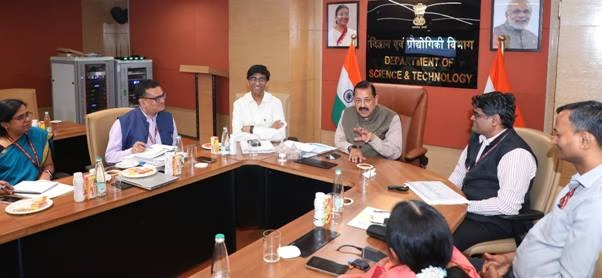
Union Minister Dr. Jitendra Singh, reviewing the ANRF’s progress on April 13, 2026, emphasized that the initiative aims to dismantle the “ivory tower” of academia. By converting complex publications and patents into podcasts, short videos, and infographics in 18 Indian languages, the government seeks to ensure that scientific breakthroughs—particularly those in public health and sustainable technology—reach the citizens they are intended to benefit.
SARAL AI: Making Science “Simple”
The acronym SARAL (suggesting “simple” in Hindi) reflects the core mission of the new platform. For decades, a significant barrier to public health literacy has been the linguistic and technical complexity of medical journals. Research published in English with high-level jargon often remains inaccessible to rural populations and non-specialist healthcare workers.
“Research outcomes must be presented in formats that citizens can clearly understand,” stated Dr. Jitendra Singh during the review. SARAL AI is engineered to ingest complex data and output:
-
Multi-lingual Podcasts: Summarizing key findings in 18 regional languages.
-
Visual Storytelling: Short-form videos and posters for platforms like Instagram and WhatsApp.
-
Business Briefs: Simplifying patents for local entrepreneurs and startups.
For the health-conscious consumer, this means a study on “metabolic dysregulation” might be transformed into a clear, 60-second video explaining how local dietary habits affect blood sugar, delivered in their native tongue.
The ‘MAHA’ Mission: Science for Societal Impact
Beyond communication, the ANRF is pivoting toward a “mission-mode” approach. The Minister highlighted the launch of the MAHA (Mission for Advancement in High Impact Areas) programs. A standout among these is the “Leapfrog Demonstrators for Societal Innovation.”
This program is specifically designed to bypass traditional, slow-moving research cycles to deliver immediate solutions for:
-
Community Health: Rapid deployment of diagnostic tools and wellness protocols.
-
Climate Resilience: Technologies to mitigate the health impacts of extreme heat and pollution.
-
Sustainable Agriculture: Enhancing food security and nutritional quality.
By focusing on “Leapfrog” technology, the ANRF aims to bridge the gap between early-stage laboratory discovery and real-world application, particularly in sectors where India faces unique demographic challenges.
Supporting the Scientists: 250 Nodal Officers
Recognizing that administrative hurdles often stifle innovation, the ANRF has deployed Nodal Officers across 250 institutions. These officers serve as liaisons to simplify the “ease of doing research,” allowing scientists to focus on discovery rather than paperwork.
This structural support has already seen a massive response. In just four months, the ANRF has evaluated nearly 20,000 research applications. This includes the Prime Minister’s Early Career Research Grant (PM-ECRG), which targets young scientists who will be the primary contributors to the SARAL AI content pipeline through the new “Lightning Talk Series.”
Expert Perspective: The Importance of Health Literacy
Public health experts who were not involved in the ANRF meeting suggest that while the technology is promising, the “human element” remains critical.
“The challenge with AI-driven simplification is maintaining nuance,” says Dr. Arvinder Singh, a public health policy consultant. “In medicine, oversimplification can sometimes lead to the loss of vital context, such as contraindications or study limitations. If SARAL AI can balance simplicity with scientific accuracy, it will be a game-changer for health literacy in India.”
According to the World Health Organization (WHO), low health literacy is linked to higher hospitalization rates and poor management of chronic diseases. By providing evidence-based information in a user’s primary language, SARAL AI could theoretically improve adherence to medical advice and vaccination programs.
Potential Challenges and Limitations
While the initiative is ambitious, several factors will determine its ultimate success:
-
Language Nuance: Translating technical medical terms into 18 different languages requires high levels of accuracy to avoid “hallucinations” common in some AI models.
-
Digital Divide: While social media usage is high, the most vulnerable populations may still require offline interventions.
-
Verification: There must be a robust peer-review process for the AI-generated content to ensure it does not inadvertently promote misinformation.
What This Means for You
For the average reader, these developments signal a future where you won’t need a medical degree to understand the latest health guidelines. Whether it is understanding the air quality index in your city or the benefits of a new indigenous vaccine, the information will likely arrive via a WhatsApp channel or a short video in your preferred language.
As the ANRF moves forward, the focus remains clear: Science is only successful when it serves the society that funds it.
Reference Section
Official Sources:
-
Press Information Bureau (PIB) Delhi: “ANRF developing AI-based platform ‘SARAL AI’…” Posted 13 APR 2026.
Medical Disclaimer: This article is for informational purposes only and should not be considered medical advice. Always consult with qualified healthcare professionals before making any health-related decisions or changes to your treatment plan. The information presented here is based on current research and expert opinions, which may evolve as new evidence emerges.