 0
0
 0
0
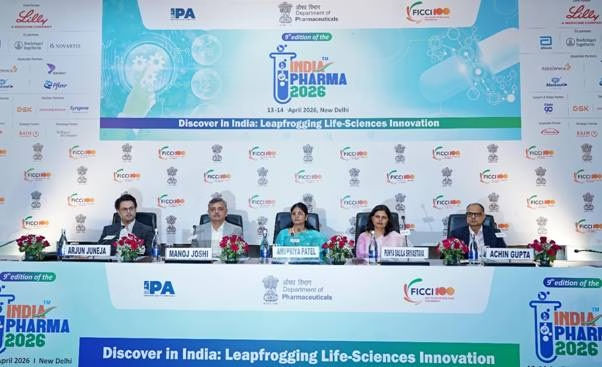
NEW DELHI – In a move signaling a structural shift in the global healthcare landscape, the 9th edition of India Pharma 2026 kicked off in the capital today, unveiling a roadmap to transition India from a volume-driven generics leader to a value-led innovation hub. The two-day flagship event, organized by the Department of Pharmaceuticals in collaboration with FICCI and the Indian Pharmaceutical Alliance (IPA), arrives at a critical juncture as the industry pivots toward high-tech biologics, biosimilars, and artificial intelligence in drug discovery.
The conference, which concludes on April 14, has brought together policymakers, global healthcare CEOs, and researchers to address a singular challenge: ensuring India captures a significant share of the global biopharmaceutical market, projected to be dominated by innovative drugs that currently account for 87% of global market value.
A ₹10,000 Crore “Shakti” for Innovation
Addressing the inaugural session virtually, Union Minister of Health & Family Welfare, Shri J.P. Nadda, underscored that India is no longer content with just being the “pharmacy of the world.” While the country currently supplies 20% of global generic medicines and 70% of global vaccine demand, the Minister highlighted the launch of the Biopharma Shakti Initiative.
“The global landscape is shifting toward biologics and specialty medicines,” Nadda stated. “With an outlay of ₹10,000 crore, the Biopharma Shakti Initiative is designed to advance our capabilities in biopharmaceutical innovation, ensuring India doesn’t just adapt to the future but leads it.”
This initiative is bolstered by the PRIP (Promotion of Research and Innovation in Pharma-MedTech) scheme, which allocates funds specifically for industry-academia collaboration. The goal is to move beyond “copying” existing molecules to discovering new chemical entities (NCEs) and complex biologics.
The $75 Billion Biosimilar Opportunity
The shift is not merely a matter of prestige; it is an economic and public health necessity. Smt. Anupriya Patel, Minister of State for Health & Family Welfare, pointed out that the global biosimilars market is expected to reach $75 billion by 2030.
Biosimilars—highly similar versions of original biological medicines—offer the potential to treat chronic conditions like cancer, diabetes, and rheumatoid arthritis at a fraction of the cost of “originator” drugs.
“India is undergoing a significant transition,” Patel noted. She emphasized that the integration of Artificial Intelligence (AI) in drug discovery would be a force multiplier, reducing the traditional decade-long timelines for bringing new life-saving treatments to market.
Strengthening the Backbone: Manufacturing and Talent
Despite the push for high-end innovation, the government remains focused on self-reliance. Shri Manoj Joshi, Secretary of the Department of Pharmaceuticals, stressed the need for:
-
Infrastructure: Building robust sites for clinical trials and advanced research.
-
Talent: Strengthening human capital through premier institutions like the National Institutes of Pharmaceutical Education and Research (NIPERs) and IITs.
-
Supply Chain: Utilizing Production Linked Incentive (PLI) schemes and Bulk Drug Parks to reduce dependence on imported raw materials (APIs).
Shri Arjun Juneja, Chair of the FICCI Pharma Committee and COO of Mankind Pharma, reminded attendees of India’s formidable starting point: the country hosts over 10,500 manufacturing facilities, including the highest number of USFDA-compliant plants outside the United States.
Perspectives from the Field: The Road Ahead
While the policy push is historic, independent experts suggest the transition will not be without hurdles. Dr. S. K. Gupta, a veteran pharmaceutical consultant not affiliated with the conference, notes that discovery-led innovation requires a different risk appetite than generic manufacturing.
“Indian companies traditionally invest 7–8% of their revenue into R&D, whereas global innovators often spend 15–25%,” Dr. Gupta explains. “The Biopharma Shakti initiative is a vital bridge, but the private sector must also step up its long-term risk capital to compete with the likes of Pfizer or Roche.”
Furthermore, Smt. Punya Salila Srivastava, Health Secretary, highlighted that the Central Drugs Standard Control Organisation (CDSCO) is undergoing structural changes to provide faster, more scientifically rigorous approvals for these complex new therapies.
What This Means for Patients
For the average consumer, this “Policy Push” translates to two major outcomes:
-
Lower Costs for Complex Care: As India masters biosimilars, expensive treatments for autoimmune diseases and cancer will become more affordable through initiatives like the Jan Aushadhi Pariyojana.
-
Access to Cutting-Edge Therapy: Domestic innovation means Indian patients may soon have access to “Made in India” cell and gene therapies, rather than waiting years for them to be imported from the West.
Reference Section
-
Expert Source: Interview with Shri J.P. Nadda (Union Minister) and Smt. Anupriya Patel (MoS), India Pharma 2026 Inaugural Session (April 13, 2026).
Medical Disclaimer: This article is for informational purposes only and should not be considered medical advice. Always consult with qualified healthcare professionals before making any health-related decisions or changes to your treatment plan. The information presented here is based on current research and expert opinions, which may evolve as new evidence emerges.