 0
0
 0
0
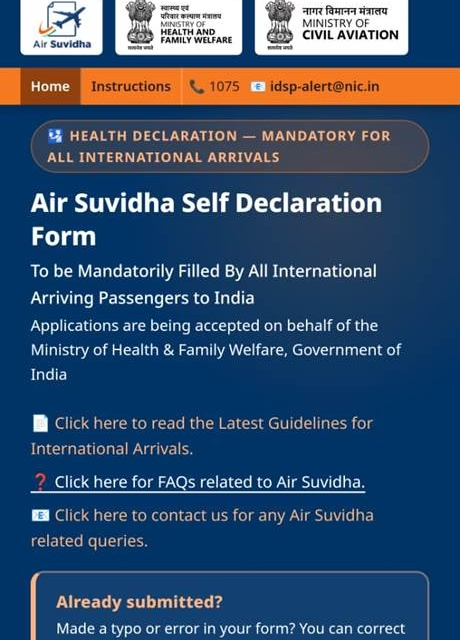
NEW DELHI — In a swift regulatory response to global health alarms, the Ministry of Civil Aviation, in partnership with Delhi International Airport Limited (DIAL), officially launched the AIR SUVIDHA 2.0 portal today. The upgraded digital platform mandates a contactless, paperless health self-declaration for all international arriving passengers. This measure aims to prevent the importation of the Ebola virus into India following a surge in cases across Central Africa.
The rollout follows the World Health Organization’s (WHO) decision on May 17, 2026, to declare the ongoing Ebola outbreak in the Democratic Republic of the Congo (DRC) and Uganda a Public Health Emergency of International Concern (PHEIC). Implemented in close coordination with the Directorate General of Health Services (DGHS), the revamped portal introduces real-time data integration across health, immigration, and disease surveillance networks to flag at-risk travelers before they step foot past the arrivals terminal.
Real-Time Tracking Combats an Evolving Threat
The updated portal requires international travelers to submit their health profiles online up to 24 hours before boarding. The digital form captures an individual’s 21-day travel history, potential exposure risks, and any active symptoms aligned with Ebola virus disease.
Unlike the previous iteration of the Air Suvidha platform used during the COVID-19 pandemic, version 2.0 features instant data-sharing protocols. When a passenger submits their form, the data routes simultaneously to:
-
The Airport Health Officer (APHO) at the destination airport.
-
The Bureau of Immigration to streamline physical passport control.
-
The Integrated Disease Surveillance Programme (IDSP) and State Surveillance Officers for community-level monitoring if a traveler requires home isolation.
This backend integration cuts out the administrative lag associated with physical paperwork, allowing authorities to isolate or redirect potentially exposed passengers immediately upon landing.
Understanding the Strain: Bundibugyo Virus Disease
The current emergency centers on the Bundibugyo virus disease (BVD), one of the six identified species within the Ebolavirus genus. While less frequent than the notorious Zaire strain, the Bundibugyo variant carries a historically significant case-fatality rate, ranging from 30% to 40% based on past outbreaks tracked by the WHO.
Ebola is not an airborne virus; it spreads through direct contact with the blood, secretions, organs, or other bodily fluids of infected people, or with surfaces contaminated with these fluids. The incubation period—the window from initial infection to the onset of symptoms—ranges from 2 to 21 days. This specific timeline explains why the Indian government is mandating a strict 21-day travel history log on the new portal.
An independently consulted public health expert, Dr. Arunkumar Govindakajaraju, Head of the Manipal Centre for Infectious Diseases (who was not involved in the portal’s development), explained the rationale behind the immediate digital enforcement:
“Because the incubation period for Ebola can span up to three weeks, an individual might board a flight perfectly healthy but develop symptoms mid-transit or days after arrival. Digital systems like AIR SUVIDHA 2.0 ensure that if an outbreak cluster is identified mid-flight or post-landing, epidemiologists can trace every contact within minutes rather than sorting through thousands of paper cards.”
Seamless Transit: What Travelers Need to Know
For the average international traveler, the Ministry of Civil Aviation has designed the portal to minimize airport friction. The government urges passengers to complete the form during their routine airline web check-in process.
[Web Check-In] ➔ [Access airsuvidha.civilaviation.gov.in] ➔ [Submit 21-Day History] ➔ [Download PDF Receipt]
Upon landing at any Indian international airport, travelers skip traditional health desks entirely. They simply show the downloaded PDF receipt or a printed copy at the Immigration counter, completing a fully contactless health clearance.
Public Health Implications and Port Safety
The implementation underscores a critical shift in global biosecurity: shifting from reactive border closures to proactive digital screening. India’s massive population density means an uncontained viral entry could strain metropolitan health infrastructures rapidly.
By monitoring points of entry (PoEs) digitally, health authorities can identify travelers coming from designated high-risk zones—which currently include the DRC, Uganda, and neighboring border tracts like South Sudan—and steer them toward secondary medical screenings at the airport without disrupting the broader flow of low-risk travel.
System Limitations and the “Honesty Gap”
Despite the technological upgrade, public health analysts point out inherent limitations in self-declaration portals. The primary vulnerability is user compliance and accuracy.
-
The Honesty Dependent Window: The system relies entirely on travelers reporting their symptoms and exposure histories honestly. Passengers fearful of quarantine or travel delays may intentionally omit transit stops through high-risk African regions.
-
Asymptomatic Testing Gaps: Because there is no rapid, non-invasive diagnostic test that can detect Ebola during its incubation phase before symptoms appear, thermal scanners and self-declarations will miss individuals who are infected but not yet showing signs.
To counter these gaps, airport authorities confirmed that AIR SUVIDHA 2.0 cross-references flight manifests and passport scan histories at immigration desks to verify the 21-day trajectory entered by passengers.
Medical Disclaimer
Medical Disclaimer: This article is for informational purposes only and should not be considered medical advice. Always consult with qualified healthcare professionals before making any health-related decisions or changes to your treatment plan. The information presented here is based on current research and expert opinions, which may evolve as new evidence emerges.
References
Government & Official Sources
-
Press Information Bureau (PIB) Delhi: Ministry of Civil Aviation & DIAL Launch AIR SUVIDHA 2.0 Portal for Ebola Health Screening at Points of Entry (PoEs) in India. Published June 25, 2026.
-
Ministry of Civil Aviation, Government of India: Official Air Suvidha Portal portal registry. https://airsuvidha.civilaviation.gov.in/