 0
0
 0
0
March 21, 2026
NEW DELHI — In a strategic pivot toward hyper-local public health management, the Union Ministry of Health & Family Welfare has launched the “Suraksha Sankalp Karyashala” (Security Pledge Workshop), an intensified initiative designed to decentralize India’s HIV/AIDS response. The program specifically targets 219 priority districts across the country, with 11 in Haryana and 7 in Delhi identified as critical zones for immediate, data-driven intervention.
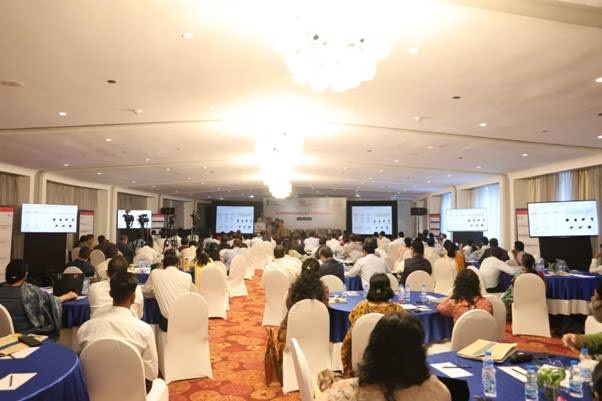
The workshop, convened yesterday in the capital, marks a significant shift from broad national policies to granular, district-level execution. Chaired by Dr. Rakesh Gupta, Additional Secretary and Director General of the National AIDS Control Organisation (NACO), the initiative aims to bridge the “care continuum” gaps—the spaces between diagnosis, treatment, and long-term viral suppression.
“HIV/AIDS continues to pose a significant public health challenge, necessitating sustained vigilance and coordinated action across all tiers of governance,” Dr. Gupta stated during his keynote address. He emphasized that the goal is not just management, but declaring the HIV/AIDS epidemic “under control” in India by World AIDS Day, 2027.
The Math of Control: From 95:95:95 to 95:95:99
For over a decade, the global gold standard for ending the AIDS epidemic has been the “95:95:95” framework. This target envisions that 95% of people living with HIV (PLHIV) know their status, 95% of those diagnosed are on Anti-Retroviral Therapy (ART), and 95% of those on treatment achieve viral suppression.
However, the Ministry is now raising the stakes. Dr. Gupta outlined an ambitious “95:95:99” milestone for the upcoming program cycle. The move to a 99% viral suppression target among those on treatment reflects a “U=U” (Undetectable = Untransmittable) philosophy: when the virus is suppressed to undetectable levels in the blood, it cannot be transmitted to others.
A Tale of Two Regions: Delhi and Haryana
Despite being geographic neighbors, Delhi and Haryana present distinct epidemiological challenges.
-
Delhi: With an adult HIV prevalence of 0.33% and approximately 59,079 PLHIV, the capital faces a “linkage gap.” Currently, only about 70% of identified individuals are receiving treatment. The workshop identified North, New Delhi, Shahdara, Central, South East, South, and North West as priority districts.
-
Haryana: The state shows a prevalence of 0.24% with roughly 59,642 PLHIV. While its “cascade” (the step-by-step progress of patients through the health system) stands at 81:83:95—outperforming Delhi in treatment linkage—it still falls short of the 95% national targets for diagnosis. Priority districts include Gurugram, Faridabad, Panipat, and Rohtak, among others.
Eliminating Mother-to-Child Transmission
A cornerstone of the Suraksha Sankalp strategy is the absolute elimination of Vertical Transmission (mother-to-child). Transmission can occur during pregnancy, labor, or breastfeeding, but medical experts stress it is almost entirely preventable.
“Transmission is preventable through timely testing and universal access to prevention services,” Dr. Gupta noted. By strengthening antenatal screening—testing every pregnant woman early in her term—the Ministry aims to ensure that no child in these 18 priority districts is born with the virus.
Expert Perspective: The Challenge of the “Last Mile”
Independent public health experts suggest that while the district-level focus is correct, the “last mile” remains the hardest.
“Moving from 70% to 95% treatment linkage in a dense urban environment like Delhi requires more than just clinical facilities; it requires overcoming deep-seated social barriers,” says Dr. Anjali Nayyar (not involved in the NACO workshop), a global health advocate. “We must address the ‘hidden’ populations—migrant workers and marginalized groups—who may fear the stigma of a diagnosis more than the disease itself.”
Indeed, the workshop explicitly highlighted the need for “inter-sectoral convergence”—working with labor, education, and social justice departments to ensure that a person’s HIV status does not lead to job loss or social isolation, which often causes patients to drop out of treatment.
What This Means for the Public
For residents in the 18 identified districts of Delhi and Haryana, this initiative translates to more accessible testing and more robust support systems at local clinics.
Key Takeaways for Readers:
-
Know Your Status: Regular testing is now integrated into more primary health settings.
-
Treatment is Prevention: Modern ART allows those with HIV to live long, healthy lives and prevents them from passing the virus to partners.
-
Vertical Prevention: Pregnant women are encouraged to seek early HIV screening as part of routine prenatal care to protect their newborns.
Limitations and Challenges
While the data-driven approach is a leap forward, critics point out that “data-driven” strategies are only as good as the data collected. In rural Haryana or crowded Delhi colonies, many cases remain “uncounted” due to private-sector treatments that go unreported to NACO. Furthermore, achieving 99% viral suppression requires near-perfect adherence to daily medication—a high bar for populations facing economic instability or food insecurity.
As India marches toward its 2027 goal, the Suraksha Sankalp Karyashala serves as a reminder that the fight against HIV is no longer a broad national struggle, but a local, district-by-district effort to ensure no one falls through the cracks of the healthcare system.
References
-
PIB Delhi: “Union Ministry of Health & Family Welfare convenes ‘Suraksha Sankalp Karyashala’.” Release ID: 210456.
Medical Disclaimer: This article is for informational purposes only and should not be considered medical advice. Always consult with qualified healthcare professionals before making any health-related decisions or changes to your treatment plan. The information presented here is based on current research and expert opinions, which may evolve as new evidence emerges.