 0
0
 0
0
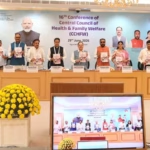
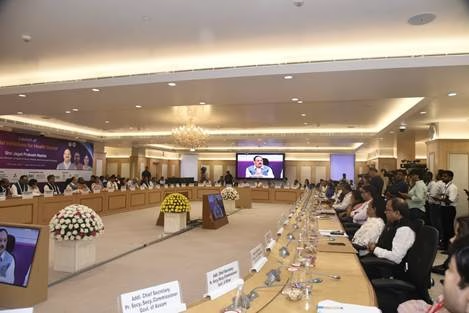
NEW DELHI — In a major structural shift for public health delivery, the Government of India has formally repurposed its wartime pandemic infrastructure into a permanent peacetime digital asset. On June 29, 2026, Union Minister of Health and Family Welfare Shri Jagat Prakash Nadda officially launched Aarogya Setu 2.0 at a high-level national assembly in New Delhi. Originally engineered in 2020 as a rapid-response bluetooth tool for COVID-19 contact tracing, the platform has been completely overhauled by the National Health Authority (NHA). It will now serve as India’s primary citizen-centric Personal Health Record (PHR) application and the universal consumer portal for the Ayushman Bharat Digital Mission (ABDM).
The launch comes at a critical juncture. While India’s digital health network has achieved staggering backend scale—surpassing 90 crore Ayushman Bharat Health Account (ABHA) registrations and 100 crore linked medical records—front-facing citizen adoption has remained a challenge. By deploying the updated application to an existing user base of nearly 20 crore downloads, the Ministry of Health aims to bridge this implementation gap and consolidate fragmented medical infrastructure under a single, highly accessible mobile interface.
The Strategic Pivot: Repurposing Pandemic Tech
The transformation represents a sophisticated case of digital utility recycling. Following the containment of the pandemic, the Ministry of Electronics and Information Technology (MeitY) transferred Aarogya Setu to the NHA. The objective was clear: leverage an established digital public good to drive everyday preventative health management.
Instead of tracking viral exposures, Aarogya Setu 2.0 acts as an integrated health management center. The platform allows individuals and family units to consolidate unstructured medical paperwork into a portable digital format, facilitating continuous care across public and private hospitals nationwide.
Inside the Core Features of Version 2.0
The upgraded architecture introduces several tools designed to streamline clinical data and personal health maintenance:
-
AI-Driven Medical Document Digitization: The application utilizes Google’s open-source Medical Data Toolkit to analyze unstructured medical documents. When a user uploads a photo or scanned PDF of a laboratory report, the integrated artificial intelligence interprets and transforms the text into standardized, machine-readable data. This data automatically populates a personalized health metrics dashboard.
-
Integrated Vitals Tracking and Wearable Syncing: Users can monitor their foundational metrics over time. The application syncs directly with commercial fitness trackers and medical wearables to aggregate active steps, caloric burn, heart rate variability, and continuous glucose monitoring (CGM) inputs.
-
The PM-JAY and Private Insurance Wallets: A dedicated interface gives beneficiaries of the Pradhan Mantri Jan Arogya Yojana (PM-JAY) transparent visibility into their state-sponsored financial coverage. The wallet displays the total family balance, current consumption tracking, and remaining limits. A parallel framework allows users to upload private health insurance policies to track claims and active wallet balances.
-
Central Armed Police Forces (CAPF) Module: A customized segment displays active policy terms, reimbursement limits, and designated family beneficiaries specifically for CAPF personnel.
-
Medication Reminders and Family Profiles: A multi-profile family management feature allows one primary user to oversee the health documentation of children, spouses, or elderly parents under a unified account. This is paired with an adjustable medication engine that sends push notifications based on complex prescription intervals and dosages.
-
Critical Care and Location-Based Routing: Utilizing real-time GPS coordinates, the app helps users locate nearby clinics, diagnostic laboratories, and PM-JAY empanelled hospitals providing cashless treatment. The system integrates directly with the national e-RaktKosh database to show real-time blood unit availability across regional blood banks, alongside emergency ambulance booking functions.
Driving Equity and Access in Public Health
Public health administrators emphasize that the digital ecosystem could significantly rebalance systemic healthcare gaps, particularly regarding structural inequities in family care.
Speaking at the launch event, Smt. Anupriya Patel, Union Minister of State for Health & Family Welfare, highlighted the gendered implications of centralized medical portals:
“Women often shoulder the responsibility of safeguarding their family’s health while neglecting their own. Digital health initiatives can empower them to take charge of their healthcare. Portable digital health records will enable women to seamlessly access their medical information wherever they go, ensuring continuity of care.”
Furthermore, officials noted that standardizing documentation through the app will lower the administrative burden currently borne by frontline community workers, such as Accredited Social Health Activists (ASHA) and Anganwadi staff, effectively freeing up hours for active clinical delivery in rural environments.
Expert Perspectives: The Interoperability Advantage
Independent medical informatics specialists point out that the real long-term value of the update does not lie in the standalone app features, but in its baseline architecture. Aarogya Setu 2.0 operates concurrently with a suite of new systemic infrastructure elements also launched at the assembly, including the National Health Claims Exchange (NHCX) and the Unified Health Interface (UHI).
“The fundamental challenge of Indian healthcare has always been extreme fragmentation,” explains Dr. Sandeep Agrawal, a public health policy researcher and digital health specialist based in Mumbai, who was not involved in the platform’s development. “A patient will get a blood draw at a private lab, see a specialist at a corporate hospital, and fill prescriptions at a local pharmacy. Historically, those medical records lived in silos. An interoperable application allows a single, patient-controlled longitudinal record to move smoothly between these disparate touchpoints.”
Dr. Agrawal notes that the open-protocol nature of the UHI infrastructure will allow users to look for and consult with traditional medicine practitioners via the AYUSH framework just as easily as they do with conventional allopathic doctors. This addresses a major cross-disciplinary gap in Indian clinical care.
Operational Challenges and the “Digital Divide”
Despite the technological advancements, public health researchers urge a cautious approach regarding implementation velocity. The primary challenge facing Aarogya Setu 2.0 is India’s documented internal digital divide.
Data from the National Family Health Survey (NFHS-5) indicates a stark gender and geographical imbalance in baseline digital literacy: while approximately 57% of men across the country have ever utilized the internet, that figure drops to just 37% among women, with even steeper drops observed in remote rural sectors. For a portal designed to serve as an equalizer, structural smartphone access remains a significant barrier.
Furthermore, moving hundreds of millions of clinical documents onto a digital network introduces clear data security considerations. The National Health Authority has sought to mitigate these concerns by implementing an explicit “My Consent” architecture within the application.
                  +---------------------------------------+
                  |      Aarogya Setu 2.0 App User        |
                  +-------------------+-------------------+
                                      |
                         [Requests Data Access]
                                      v
                  +---------------------------------------+
                  |       "My Consent" Dashboard          |
                  |  (Tracks: Requested, Approved, Denied) |
                  +-------------------+-------------------+
                                      |
                     [User Grants Explicit Approval]
                                      v
+-------------------------------------+-------------------------------------+
|                                                                           |
v                                                                           v
+-----------------------------------+     +---------------------------------+
|      Public Health Provider       |     |     Private Insurance Payer     |
|   (ABHA Connected Hospital/Lab)   |     |    (NHCX Standardized Claim)    |
+-----------------------------------+     +---------------------------------+
Under this structure, no clinic, hospital, or insurance company can access a user’s medical files or metrics without an explicit, time-bound digital sign-off from the patient. Users retain the capability to track requested, active, pending, or expired permissions, establishing a strict, consumer-driven audit trail for individual data.
Practical Implementation: What This Means for Patients
For the average citizen, the immediate utility of Aarogya Setu 2.0 lies in the elimination of repetitive testing and physical medical folders. When arriving at an ABDM-enabled hospital, a patient can utilize the app’s Scan & Share capability to instantly transfer their basic registration profile and medical background via a localized QR code, bypassing long hospital registration lines.
Because previous laboratory results, diagnostic imaging interpretations, and specialist notes are indexed sequentially within the platform, attending physicians can review a patient’s historical medical trends instantly. This long-term clinical visibility reduces the likelihood of duplicative diagnostics, prevents adverse drug-to-drug interactions through active medication tracking, and provides clear cost savings for families managing chronic lifestyle illnesses.
References
-
National Health Authority (NHA). (2026, June 29). Launch of Aarogya Setu 2.0 and Digital Health Infrastructure Frameworks under ABDM. Ministry of Health and Family Welfare, Government of India. PIB Delhi.
Medical Disclaimer: This article is for informational purposes only and should not be considered medical advice. Always consult with qualified healthcare professionals before making any health-related decisions or changes to your treatment plan. The information presented here is based on current research and expert opinions, which may evolve as new evidence emerges.