 0
0
 0
0
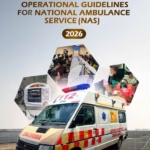
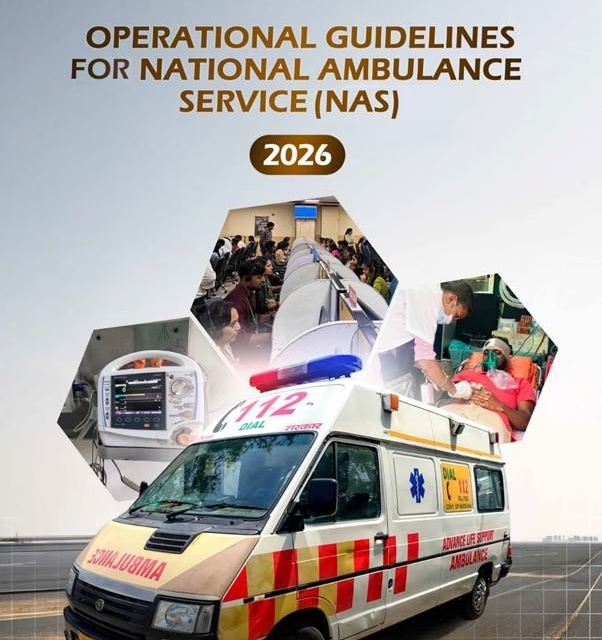
NEW DELHI — In a major move to address one of the most critical gaps in India’s healthcare infrastructure, the Union Ministry of Health and Family Welfare has launched a comprehensive national framework to standardize emergency medical transport. Union Health Minister Shri Jagat Prakash Nadda unveiled the Operational Guidelines on National Ambulance Services (NAS), 2026, establishing uniform standards for planning, operating, and monitoring emergency vehicles across all States and Union Territories.
For a country where emergency response times and pre-hospital care quality have historically varied wildly by geography, this framework marks the first unified effort to ensure timely, safe, and high-quality emergency medical transport for every citizen.
Standardizing the Lifeline of Pre-Hospital Care
Ambulance services are the foundation of effective emergency medical care, serving as the first point of contact between patients and the healthcare system. The new guidelines aim to transform these vehicles from mere transport vans into mobile stabilization units.
At the core of this overhaul is the mandatory enforcement of AIS-125 standards for all emergency vehicles. The Automotive Industry Standards (AIS)-125 code specifies strict engineering and medical requirements for ambulances, ensuring uniformity in vehicle design, crash safety, and onboard medical equipment.
Beyond the vehicles themselves, the framework comprehensively maps out:
-
Population-Based Fleet Deployment: Strategically placing ambulances based on regional population density rather than arbitrary administrative boundaries.
-
Human Resource Norms: Defining strict staffing requirements and introducing competency-based training for Emergency Medical Technicians (EMTs).
-
Clinical Protocols: Specifying mandatory inventories for medicines and consumables, alongside standardized infection prevention and control practices.
Harnessing Digital Infrastructure for Faster Response
A critical highlight of the 2026 guidelines is the shift toward technology-driven dispatch and tracking. The Ministry is advocating for the creation of Integrated Command and Dispatch Centres (ICDCs) across states. These centers will utilize Global Positioning System (GPS) tracking, digital call management, and structured triage protocols—the process of determining the priority of patients’ treatments based on the severity of their condition.
Furthermore, the framework envisions a progressive integration with India’s unified emergency response number, 112, creating a seamless access point for citizens in distress.
[Emergency Call to 112]
       │
       ▼
[Integrated Command & Dispatch Centre (ICDC)] ───► GIS Mapping & Real-Time Bed Tracking
       │
       ▼
[Intelligent Dispatch of Nearest AIS-125 Ambulance]
       │
       ▼
[Optimized Route to the Right Hospital]
By leveraging Geographic Information System (GIS) mapping, dispatch teams can overlay ambulance locations with real-time data on traffic density, accident hotspots, and, crucially, hospital bed availability and critical care preparedness. Instead of racing to the nearest hospital only to find an overcrowded emergency room, ambulances will be dynamically routed to the nearest appropriate facility capable of treating the patient’s specific condition.
Expert Perspectives: The Shift to Data-Driven Logistics
Public health experts not involved in drafting the guidelines have expressed optimism about the framework’s focus on evidence-based deployment.
“Historically, ambulance allocation in India has been reactive rather than proactive,” says Dr. Arvinder Singh, a public health policy consultant based in New Delhi. “By analyzing emergency call trends, historical accident hotspots, and geographical constraints, we can transition to a predictive model. This is especially vital for rural and remote areas, where the ‘golden hour’—the critical first hour after a traumatic injury or acute medical event—is frequently lost due to logistical delays.”
Medical professionals also emphasize that standardizing EMT training is a massive leap forward.
“An ambulance without trained personnel is just a taxi with a siren,” notes Dr. K. Radhakrishnan, an emergency medicine specialist. “Standardizing competency-based training ensures that whether a patient suffers a myocardial infarction (heart attack) in a major metro or a remote village, the baseline stabilization care they receive en route remains high.”
Public Health Implications and Daily Health Decisions
For the general public, the implementation of these guidelines aims to eliminate the chaotic guesswork often associated with medical emergencies in India.
Currently, many families resort to private vehicles or unequipped local transport during crises due to distrust or delays in public ambulance availability. A reliable, integrated ‘112’ system backed by GPS-tracked, high-quality units could significantly lower out-of-pocket expenses and improve survival rates for time-sensitive conditions like strokes, severe trauma, and cardiac arrests.
Potential Bottlenecks and Limitations
While the framework is structurally robust, independent analysts point out several systemic challenges to its execution:
-
State-Level Implementation Variances: Because healthcare is primarily a state subject under the Indian Constitution, the speed and efficiency of execution will depend heavily on individual state budgets and political will.
-
Supply Chain and Infrastructure Costs: Upgrading existing fleets to meet strict AIS-125 engineering standards requires substantial capital injection, which may strain the resources of financially weaker states.
-
The Digital Divide: While GIS mapping and intelligent dispatch work seamlessly in urban centers with strong cellular connectivity, implementing real-time data synchronization in remote, topographically challenging terrains remains a formidable hurdle.
The Road Ahead
The Operational Guidelines on National Ambulance Services, 2026, represent a landmark structural shift. By combining strict vehicular standards with modern digital logistics, the framework lays the groundwork for a digitized, equitable, and highly responsive emergency network designed to safeguard patient outcomes across the country.
References
-
Government Framework: Ministry of Health and Family Welfare, Government of India. (2026). Operational Guidelines on National Ambulance Services (NAS), 2026. Published via Press Information Bureau (PIB), Delhi.
Medical Disclaimer: This article is for informational purposes only and should not be considered medical advice. Always consult with qualified healthcare professionals before making any health-related decisions or changes to your treatment plan. The information presented here is based on current research and expert opinions, which may evolve as new evidence emerges.