 0
0
 0
0
NEW DELHI — On June 29, 2026, marking India’s 20th National Statistics Day, the Ministry of Statistics and Programme Implementation (MoSPI) officially released its highly anticipated comprehensive tracking reports on the United Nations Sustainable Development Goals (SDGs). Culminating in the baseline publication of the National Indicator Framework (NIF) Progress Report 2026, the newly unveiled data reveals a country undergoing a massive socio-economic and public health transformation. Among the most notable achievements is a significant reduction in maternal mortality and a drastic expansion of the national health and social safety net over the last decade.
The baseline tracking structure relies on 277 national indicators meticulously monitored across line ministries, UN agencies, and NITI Aayog to establish an evidence base for ongoing public policy. Accompanying the core data, MoSPI released a specialized thematic bulletin, Transforming Lives: India’s Achievements under the People Dimension of the SDGs, highlighting distinct breakthroughs in poverty reduction, zero hunger, quality education, gender equality, and public health.
Maternal Mortality Plummets as Social Safety Nets Expand
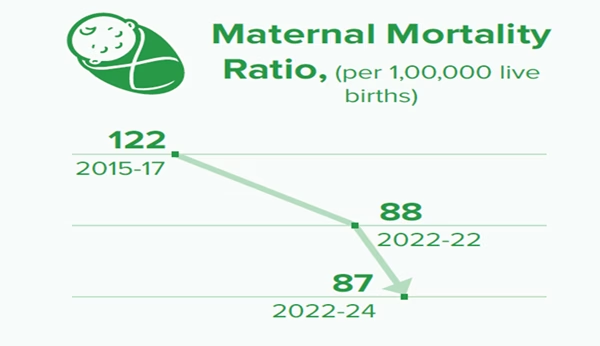
For public health professionals and policymakers, the standout metric in the 2026 report is the steady drop in the Maternal Mortality Ratio (MMR). The MMR fell from 122 deaths per 100,000 live births during the 2015–2017 tracking period down to 87 deaths per 100,000 live births in the 2022–2024 window.
Medical experts point to a combination of enhanced rural healthcare infrastructure, cleaner institutional delivery environments, and targeted nutritional frameworks as driving forces behind these numbers.
Maternal Mortality Ratio (per 100,000 live births)

2015-17: ████████████ 122
2022-24: █████████ 87
Simultaneously, India has scaled up its social protection floors—systems designed to prevent families from falling into catastrophic poverty due to sudden health crises or economic shocks. According to the data, the proportion of the population covered by these social protection systems skyrocketed from a modest 22.0% in 2016 to 65.3% in 2026.
Independent health policy analysts emphasize that protecting nearly two-thirds of the population with structural safety nets creates a critical shield against out-of-pocket medical expenditure, which historically acts as a primary driver of household debt in developing economies.
Emerging Gender Balance and Economic Realignment
The 2026 publications highlight structural shifts in gender demographics and employment equity. The national Sex Ratio at Birth—measured as the number of female live births per 1,000 male live births—showed a vital upward trajectory, climbing from 896 in 2015–17 to 918 in 2022–24.
Parallel to improving birth metrics, women are asserting a stronger presence in high-skill sectors of the formal economy. The ratio of female to male workers employed as professionals and technical workers crossed an important equity threshold, rising from 48.7% in 2023–24 to 51.3% in 2025. This means women now comprise more than half of the country’s specialized technical workforce.
Female-to-Male Ratio: Professional & Technical Workers

2023-24: ███████████████████ 48.7%
2025:    ████████████████████ 51.3%
Concurrently, overall economic indicators pointed toward stabilizing labor markets. The national unemployment rate registered a significant drop, falling from 6.1% in 2017–18 down to 3.1% by the close of 2025.
Comprehensive National Transformations (2015–2026)
Beyond healthcare and professional equity, the NIF Progress Report underscores massive, interconnected infrastructure developments across green energy, digital access, and environmental conservation.
| Indicator / Sector | Baseline Metric (Past Year) | Current Metric (2025–2026) | Long-Term Trend |
| Installed Renewable Energy | 64.04 watts per capita (2014–15) | 193.36 watts per capita (2025–26) | Threefold expansion in green energy infrastructure |
| Total Internet Subscriptions | 302.36 million (2015) | 969.10 million (2025) | Tripled digital access and telemedicine readiness |
| Waste Recycling Plants | 829 operational units (2019–20) | 3,236 operational units (2025–26) | Nearly fourfold increase in urban sanitation capacity |
| Ramsar Wetland Sites | 4.15% of total wetland area (2016) | 8.66% of total wetland area (2026) | Doubled area under international eco-protection |
| Animal Genetic Resources | 140,364 conserved units (2014–15) | 3,61,794 conserved units (2025–26) | Substantial boost to agricultural food security |
Expert Perspectives: Infrastructure and Regional Variations
Public health officials view the intersection of these data streams as proof of a broad, multi-sector approach to human welfare.
“When you look at the rapid expansion of digital access—now nearing a billion internet subscriptions—alongside the tripling of per-capita renewable energy, you are looking at the modern determinants of health,” notes Dr. Arisvitha Sen, an independent public health policy consultant not involved in compiling the MoSPI report. “Digital connectivity enables telemedicine networks to reach formerly isolated villages, while clean energy stabilizes power grids for rural surgical theaters. You cannot isolate a drop in maternal mortality from the broader physical infrastructure supporting these communities.”
However, medical researchers warn against broad generalizations. While the national average indicates excellent progress, sub-national variations often mask deep regional disparities. Health equities in advanced southern or western states routinely outpace milestones achieved in heavily populated northern pockets.
Furthermore, independent analysts point out that while the unemployment rate drop to 3.1% is economically encouraging, monitoring the quality of employment and the vast underemployed informal sector remains a vital, ongoing challenge for absolute social security.
What This Means for Individual Health Decisions
For health-conscious consumers and families, the 2026 SDG updates present a roadmap of a changing healthcare landscape. The rapid growth of social protection systems means that more households now have access to subsidized medical care, state-backed insurance initiatives, and institutional safety nets than at any prior point in the nation’s history.
Individuals and families are encouraged to actively inquire about localized public health schemes, institutional delivery incentives, and regional preventive care programs. Utilizing these expanded state-supported infrastructures not only reduces immediate out-of-pocket financial strain but guarantees standardized, regulated clinical intervention during critical health events.
References
-
Study Citation: Ministry of Statistics and Programme Implementation (MoSPI), Government of India. (Released June 29, 2026). Sustainable Development Goals – National Indicator Framework Progress Report, 2026. New Delhi: MoSPI.
- The reports are available on the official website of the Ministry (https://mospi.gov.in/)
Medical Disclaimer: This article is for informational purposes only and should not be considered medical advice. Always consult with qualified healthcare professionals before making any health-related decisions or changes to your treatment plan. The information presented here is based on current research and expert opinions, which may evolve as new evidence emerges.