 0
0
 0
0
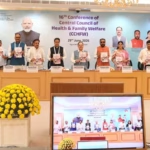
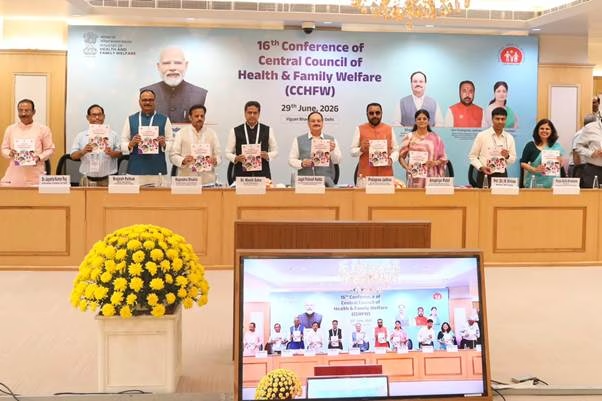
NEW DELHI — In a major bid to dismantle regional healthcare disparities and secure the well-being of mothers and infants, Union Health Minister Shri Jagat Prakash Nadda officially launched the “SUMAN Roadmap 2030” on Monday, June 29, 2026. Unveiled during the 16th Conference of the Central Council of Health and Family Welfare (CCHFW), this comprehensive strategic framework marks a tactical shift in India’s public health policy. Moving away from a “one-size-fits-all” model, the new roadmap implements an evidence-driven, localized approach specifically engineered to meet the United Nations Sustainable Development Goal (SDG) targets by 2030.
The high-profile launch took place in the presence of Union Ministers of State for Health and Family Welfare, Smt. Anupriya Patel and Shri Prataprao Jadhav, alongside State Health Ministers and senior ministry officials. The central mission of the roadmap is clear: reduce India’s Maternal Mortality Ratio (MMR) to below 70 per 100,000 live births, substantially lower the Neonatal Mortality Rate (NMR) and Infant Mortality Rate (IMR), and ultimately achieve “zero preventable maternal and newborn deaths” across all States and Union Territories.
Moving Beyond Uniform Care: The 130-District Focus
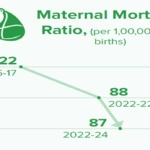
Over the last decade, India has made undeniable strides in reproductive and neonatal care. According to recent data from the Ministry of Statistics and Programme Implementation (MoSPI), the nation’s MMR dropped from 122 per 100,000 live births during 2015–17 down to 87 during 2022–24. Yet, severe geographical disparities persist. Maternal and infant mortality risks remain concentrated in remote, tribal, and economically vulnerable pockets.
To bridge this gap, the SUMAN (Surakshit Matritva Aashwasan) Roadmap 2030 introduces aggressive, time-bound clinical interventions across 130 high-burden districts spread over 13 specific states:
-
North & Central: Uttar Pradesh, Madhya Pradesh, Bihar, Rajasthan, Chhattisgarh, Jharkhand, Uttarakhand, Haryana.
-
East & Northeast: West Bengal, Odisha, Assam.
-
South: Karnataka.
Instead of stretching resources thinly across the subcontinent, the Ministry of Health and Family Welfare is concentrating clinical upgrades and financial support exactly where the mortality numbers are highest.
A Micro-Targeted Toolkit for Vulnerable Pregnancies
For these 130 critical districts, the roadmap introduces a heavily structured, four-stage protocol to identify, track, and manage high-risk pregnancies across the entire continuum of care:
[Antenatal Care] ➔ [Third-Trimester Care] ➔ [Intrapartum Care] ➔ [Postnatal Period]
To support this framework, the government has introduced concrete, community-level interventions:
-
Bi-Weekly Frontline Monitoring: Accredited Social Health Activists (ASHAs) will conduct mandatory, bi-weekly home visits during the crucial eighth and ninth months of pregnancy. These visits focus on early danger-sign recognition, birth preparedness, and nutritional counseling.
-
Infrastructure Expansion: The policy funds the construction of Birth Waiting Homes, specialized Maternal and Child Health (MCH) Wings, Obstetric High Dependency Units (HDUs), and Intensive Care Units (ICUs) in hard-to-reach and tribal areas.
-
Caregiver Incentives: Recognizing that postpartum recovery is a high-risk window for hemorrhage and sepsis, the roadmap provides direct financial support to designated caregivers during the postnatal period, alongside specialized transport incentives for obstetric emergencies.
Universal Interventions and Digital Upgrades
While the 130 districts receive intensive funding, the SUMAN Roadmap 2030 simultaneously outlines a universal blueprint for all States and Union Territories. This comprehensive approach expands the traditional focus on childbirth to address the entire lifecycle of maternal health.
               [ Pre-Pregnancy Care ]
             (Folic acid & preconception nutrition)
                       │
                       ▼
             [ Continuous Surveillance ]
            (Early high-risk tracking via JANANI)
                       │
                       ▼
          [ Intrapartum & Postnatal Support ]
    (AI labour rooms, Anti-Shock garments, SSBSK home-care)
Key universal measures include institutionalizing pre-pregnancy care through widespread folic acid supplementation to prevent neural tube defects, expanding maternal anemia screening, and deploying Non-Pneumatic Anti-Shock Garments (NASG)—a low-cost, life-saving compression wrapper used to stabilize mothers experiencing severe postpartum hemorrhage.
Furthermore, the roadmap leans heavily into digital health innovation. It mandates the rollout of artificial intelligence (AI)-enabled labor rooms to monitor fetal heart rates and labor progression in real time, a centralized SUMAN Call Centre for immediate patient grievance redressal, and tracking via the updated JANANI digital portal. Crucially, the roadmap integrates the Samagra Shishu Bal Swasthya Karyakram (SSBSK), ensuring seamless, home-based clinical follow-ups for infants from birth up to 36 months.
The Expert Perspective: Implementation is Everything
Public health experts have widely praised the roadmap’s emphasis on localized, data-driven healthcare, though many note that its success hinges entirely on execution.
“Shifting from a generalized national strategy to a granular, district-level approach is epidemiologically sound,” says Dr. Arisudan Deva, a global maternal health consultant and independent policy analyst not involved in drafting the roadmap. “We have known for years that a mother in rural Madhya Pradesh faces vastly different systemic risks than a mother in urban Kerala. However, executing bi-weekly ASHA visits and maintaining AI-enabled labor rooms requires an incredibly robust supply chain and continuous, hands-on training for frontline workers. Without strict, independent auditing, infrastructure in difficult terrains can rapidly deteriorate.”
Dr. Deva also highlighted the roadmap’s ground-breaking acknowledgment of climate change. “Pregnant women and newborns are physiologically more vulnerable to extreme heat waves and vector-borne disease shifts. Including climate-responsive planning directly into a maternal health framework is a highly progressive step for India.”
Potential Limitations and Challenges
Despite its strengths, independent health advocates point out several systemic challenges that the roadmap must navigate:
-
The Surgical Conundrum: The roadmap explicitly calls for the “optimization of Caesarean section practices.” Public health advocates note that India faces a dual crisis: a severe deficit of emergency C-sections in rural public hospitals due to a shortage of anesthetists and obstetricians, contrasted against an alarmingly high rate of medically unnecessary C-sections in private urban clinics. Striking a regulatory balance will prove difficult.
-
Frontline Strain: Increasing the workload of ASHAs with mandatory bi-weekly third-trimester visits requires a serious look at their compensation. Frontline worker burnout remains a persistent bottleneck in rural healthcare delivery.
-
Community Trust: While the initiative introduces “SUMAN Panchayats” and “Mothers’ Picnic” events to foster local ownership, overcoming deeply entrenched cultural preferences for home deliveries without skilled birth attendants in remote tribal belts demands sustained, sensitive community engagement.
What This Means for Citizens
For the average citizen, the SUMAN Roadmap 2030 reinforces a strict policy of zero-tolerance for denial of services at public health facilities. Every pregnant woman and newborn entering a public healthcare center is legally entitled to completely free, dignified, and high-quality care—covering everything from essential diagnostics and blood products to delivery services and emergency transport, entirely eliminating out-of-pocket expenses.
By grounding high-tech digital innovations like AI monitoring alongside robust, localized community tracking, the roadmap builds a more equitable healthcare ecosystem, working to ensure that a safe delivery and a healthy childhood are guaranteed rights for every mother and child in India.
Reference Section
Policy & Institutional Sources
-
Primary Document: “SUMAN Roadmap 2030,” Maternal Health Division, Ministry of Health and Family Welfare (MoHFW), Government of India. Released June 29, 2026, at the 16th Conference of the Central Council of Health and Family Welfare, New Delhi.
Medical Disclaimer: This article is for informational purposes only and should not be considered medical advice. Always consult with qualified healthcare professionals before making any health-related decisions or changes to your treatment plan. The information presented here is based on current research and expert opinions, which may evolve as new evidence emerges.