 0
0
 0
0
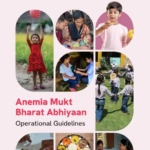
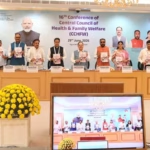
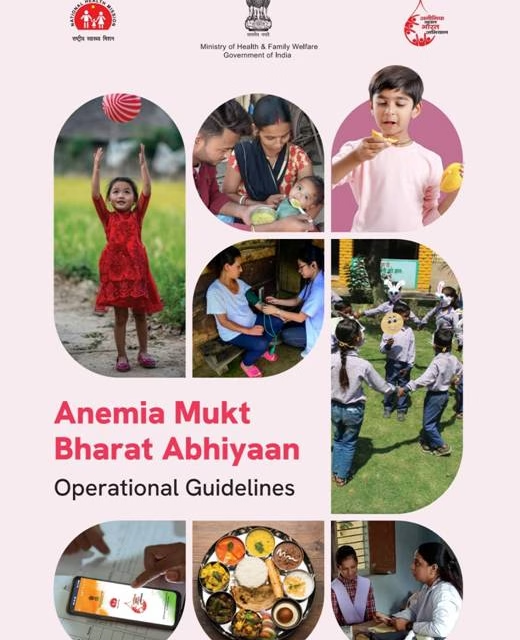
NEW DELHI — In a major pivot to combat one of the country’s most persistent public health challenges, India’s Union Minister of Health and Family Welfare, Shri Jagat Prakash Nadda, officially launched the operational guidelines for the Anemia Mukt Bharat Abhiyaan (Anemia-Free India Mission) on June 29, 2026. Released during the 16th meeting of the Central Council of Health and Family Welfare (CCHFW) at Vigyan Bhawan, the revised framework transitions the national program from basic prevention (prophylactic care) to active, targeted treatment (therapeutic care). By expanding its target demographics to include low birth weight infants and deploying an aggressive “T4” medical strategy—Test, Treat, Talk, and Track—the government aims to accelerate reductions in maternal and child mortality across the nation.
The Evolution to ‘Abhiyaan’: What is Changing?
For nearly a decade, India’s primary defense against anemia relied heavily on the mass distribution of Iron and Folic Acid (IFA) tablets. While supplementation helped stabilize baseline deficiencies, public health data indicated that iron deficiency remained deeply entrenched due to gaps in screening, dietary diversity, and patient follow-up.
The newly minted Anemia Mukt Bharat Abhiyaan marks a structural evolution into a comprehensive mission. Rather than merely handing out supplements, health workers will now focus on point-of-care clinical testing, individualized therapeutic management, structured dietary counseling, and aggressive community mobilization (Jan Chetna).
The cornerstone of this reboot is the transition from the older 6x6x6 strategy to an ambitious 7x7x7 framework. This expansion introduces three critical pillars designed to close existing loopholes in the continuum of care:
-
A New Beneficiary Group: Low Birth Weight (LBW) babies aged 0 to 6 months.
-
A New Intervention: The “Eating Right” approach, which integrates iron-rich, diversified diets into daily community habits.
-
A New Institutional Mechanism: A unified digital ecosystem to eliminate under-reporting and track patient recovery.
Breaking the Intergenerational Cycle at Birth
The decision to introduce low birth weight babies as a distinct beneficiary group represents a highly targeted clinical shift. Anemia frequently operates as an intergenerational trap: anemic mothers often give birth to premature or low birth weight infants who enter the world with severely depleted iron stores.
“Iron stores are primarily accumulated during the third trimester of pregnancy,” explains Dr. Anita Sen, a public health maternal specialist based in New Delhi, who was not involved in drafting the new guidelines. “When a baby is born prematurely or under-weight, they miss out on this crucial window. By explicitly targeting these infants from birth instead of waiting until early childhood, the government is intervening at the absolute biological baseline.”
To support severe cases among adults, particularly pregnant and lactating women who do not respond to oral iron supplements, the guidelines formalize the use of advanced clinical interventions. Hospitals and clinics will now systematically deploy Intravenous (IV) Iron Therapy, utilizing Ferric Carboxymaltose (FCM) and Iron Sucrose to rapidly restore hemoglobin levels and prevent peripartum complications.
From T3 to T4: The Power of Digital Tracking
Previously, the program relied on the “T3” approach: Test, Treat, and Talk. However, patients frequently dropped out of the system after their initial diagnosis. The revised strategy introduces a vital fourth “T”: Track.
[Screening & Diagnosis] ➔ [Clinical Treatment] ➔ [Dietary Counseling] ➔ [Digital Follow-up]
       (TEST)                    (TREAT)                 (TALK)                  (TRACK)
To achieve this, the Ministry of Health is unifying several fragmented health databases. Hemoglobin testing records for pregnant women captured via the JANANI portal, and children’s data logged through U-WIN and Rashtriya Bal Swasthya Karyakram (RBSK), will automatically pipe into a single, centralized Anemia Mukt Bharat Abhiyaan Portal. This digital pipeline ensures that if a child or mother tests positive for anemia in a rural clinic, their subsequent treatment, secondary testing, and recovery vector are tracked seamlessly by healthcare providers over time.
Public Health Implications and Nutritional Barriers
Public health experts widely view the policy update as a necessary step to alter India’s vital health ratios. According to the World Health Organization (WHO), severe anemia significantly increases the risk of maternal hemorrhage—a leading cause of postpartum mortality—and impairs cognitive development in early childhood. By combining aggressive medical treatment with the “Eating Right” campaign, the government anticipates a direct downward trajectory in both the Infant Mortality Rate (IMR) and the Maternal Mortality Ratio (MMR).
However, translating clinical guidelines into rural realities presents steep challenges. A core component of the new intervention is changing dietary habits. While the guidelines promote iron-rich food consumption, systemic inflation, localized food insecurity, and deep-seated cultural dietary preferences often limit a family’s access to diverse, nutrient-dense foods.
Furthermore, past public health initiatives have shown that distributing medical supplies is much easier than ensuring long-term patient compliance. Oral iron supplements are notorious for causing mild but uncomfortable gastrointestinal side effects, such as nausea and constipation, which frequently cause patients to stop taking them prematurely.
Journalistic Assessment: Limitations and Next Steps
While the Anemia Mukt Bharat Abhiyaan offers a robust, multi-sectoral blueprint, its success hinges entirely on execution at the grassroots level.
First, the transition to point-of-care hemoglobin testing requires a steady, uninterrupted supply of diagnostic kits and digital infrastructure across thousands of Sub-Health Centres and Anganwadi centres. In remote or economically disadvantaged districts, erratic electricity and poor internet connectivity could severely hamper real-time updates to the unified portal.
Second, frontline health workers, such as Accredited Social Health Activists (ASHAs), are already heavily burdened with various tracking, immunization, and maternal care portfolios. Forcing an entirely new layer of digital tracking and “Jan Bhagidari” (community mobilization) onto this workforce without corresponding increases in administrative support or compensation could trigger operational bottlenecks.
Ultimately, the policy shift from generalized prevention to individualized therapeutic care is scientifically sound. If the infrastructure can successfully sustain the demands of the T4 strategy, India may finally possess the logistical mechanism required to break its historic cycle of nutritional deficiency.
Medical Disclaimer
Medical Disclaimer: This article is for informational purposes only and should not be considered medical advice. Always consult with qualified healthcare professionals before making any health-related decisions or changes to your treatment plan. The information presented here is based on current research and expert opinions, which may evolve as new evidence emerges.
References
Government and Official Institutional Sources
-
Press Information Bureau (PIB) Delhi. (2026, June 29). Union Health Minister Shri J.P. Nadda Releases Anemia Mukt Bharat Abhiyaan Operational Guidelines during the 16th CCHFW Meeting. Ministry of Health and Family Welfare, Government of India.