 0
0
 0
0
HEARD ISLAND, Feb 20, 2026 — In a milestone for Australia’s wildlife biosecurity, federal health and environmental authorities confirmed today that Gentoo penguins have become the first bird species in an Australian external territory to contract the highly pathogenic H5N1 avian influenza. The virus was detected on Heard Island, a remote sub-Antarctic outpost, marking an expansion of the disease that has already devastated avian and marine mammal populations across the globe.
A New Frontier for the “Panzootic”
The detection was confirmed by preliminary laboratory results from the CSIRO’s Australian Centre for Disease Preparedness. Samples collected during a research voyage on February 3, 2026, revealed the presence of the H5N1 clade 2.3.4.4b—a strain scientists have termed a “panzootic” due to its unprecedented global reach.
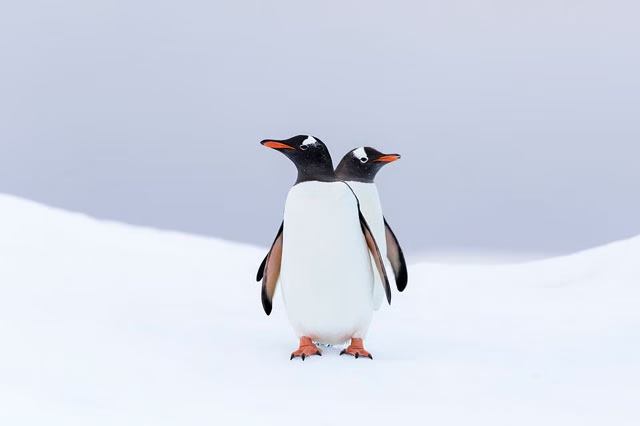
While the virus was first confirmed in southern elephant seals on the island in November 2025, these latest results confirm that the pathogen has successfully jumped to local bird populations, specifically the Gentoo penguin (Pygoscelis papua). Antarctic fur seals on the island also tested positive in this latest round of screening.
Geographic and Statistical Context
Heard Island is situated roughly 4,000 kilometers southwest of Perth and 1,700 kilometers north of the Antarctic mainland. Its isolation has long acted as a natural shield, but the migratory patterns of seabirds and the movements of marine mammals have increasingly turned sub-Antarctic islands into “stepping stones” for the virus.
| Species Affected (Heard Island) | Date of First Confirmation |
| Southern Elephant Seal | November 2025 |
| Antarctic Fur Seal | February 2026 |
| Gentoo Penguin | February 2026 |
Expert Insights and Public Health Risk
Despite the grim discovery, officials are urging calm regarding the risk to the Australian mainland and human health.
Dr. Beth Cookson, Australia’s Chief Veterinary Officer, noted that while the detections indicate a widening impact on the island’s ecosystem, there is no evidence of a “mass mortality event” currently underway. “The voyage’s aerial survey data continues to be analyzed, but on-ground observations indicated no signs of ongoing mass die-offs in the areas visited,” Dr. Cookson stated.
Human Health Implications
For the general public, the risk remains low. According to the World Health Organization (WHO) and the Centers for Disease Control and Prevention (CDC), H5N1 primarily spreads through close contact with infected birds or contaminated environments.
Public health experts emphasize that while mammalian infections (like those in seals) are a point of concern for viral evolution, the current strain does not yet demonstrate the ability for sustained human-to-human transmission.
Australia’s A$100 Million Preparedness Strategy
The Australian Government has responded to the encroaching threat with a A$100 million investment aimed at strengthening national preparedness.
Environment and Water Minister Murray Watt emphasized that researchers have been on the frontline for months. “Our researchers in the Southern Ocean work in trying conditions to provide the early warning systems we need to protect our unique biodiversity,” Watt said.
The funding is allocated toward:
-
Rapid response equipment for all states and territories.
-
Targeted protection for vulnerable native species.
-
Enhanced biosecurity protocols for personnel returning from sub-Antarctic regions.
Implications for the Mainland
Importantly, Agriculture Minister Julie Collins clarified that Australia’s H5 bird flu-free status for mainland poultry remains intact. Commercial poultry sectors are under strict biosecurity mandates, and the remote location of Heard Island provides a significant buffer against immediate spread to the mainland.
Limitations and Uncertainties
While the lack of mass mortality is a positive sign, scientists warn against complacency. The H5N1 virus is notorious for “silent” spread in certain species before reaching a tipping point.
“The challenge with H5N1 in the sub-Antarctic is the sheer density of breeding colonies,” says Dr. Meagan Dewar, a leading researcher in Antarctic wildlife health not involved in the government’s latest voyage. “In species like the Gentoo penguin, which nest in close proximity, the potential for rapid transmission remains a significant concern for the coming breeding seasons.”
Reference Section
- https://www.daijiworld.com/news/newsDisplay?newsID=1307072
Medical Disclaimer: This article is for informational purposes only and should not be considered medical advice. Always consult with qualified healthcare professionals before making any health-related decisions or changes to your treatment plan. The information presented here is based on current research and expert opinions, which may evolve as new evidence emerges.