 0
0
 0
0
The strategic push comes at a time when global demand for preventative and integrative health therapies is surging. By establishing strict quality benchmarks and streamlined travel pathways, Indian health authorities aim to reassure international patients while formalizing an industry that has historically struggled with inconsistent quality controls.
Standardizing Ancient Wisdom for the Modern Patient
A cornerstone of the initiative is the implementation of Standard Treatment Guidelines (STGs) across all Ayush disciplines. These protocol-driven manuals aim to standardize therapeutic decisions, replacing variable clinical practices with uniform, evidence-based approaches.
To bolster global confidence, the Ministry of Ayush launched the Ayush Quality Mark during the Second Global Traditional Medicine Summit in December 2025. This quality seal evaluates products and services against stringent international safety and efficacy benchmarks, giving prospective foreign patients a verified standard to rely on.
“The primary hurdle for traditional medicine globally has rarely been a lack of interest—it has been a lack of standardization,” notes Dr. Rajesh Sharma, an independent health policy researcher specializing in integrative medicine. “By introducing standardized treatment protocols and a centralized quality mark, India is adopting the language of modern clinical governance. This protects vulnerable patients seeking genuine care while weeding out unaccredited wellness retreats.”
In addition to clinical standardization, regulatory oversight has been expanded globally through the Ayurveda Training Accreditation Board (ATAB). Operating under Rashtriya Ayurveda Vidyapeeth, ATAB accredits traditional medicine training programs both within India and internationally, ensuring that practitioners adhering to these therapies meet uniform competency criteria.
Streamlined Travel: Dedicated Ayush Visas
To eliminate administrative hurdles for international travelers seeking extended therapies—such as Panchakarma (a multi-week detoxification procedure in Ayurveda)—the government introduced dedicated visa categories.
The Ayush Visa (M-3) and the Ayush Attendant Visa (M-4) now operate as dedicated sub-categories within India’s medical visa framework. These visas allow patients and their caregivers prolonged stays with simplified renewal procedures, aligning traditional medicine trips with standard medical travel protocols.
       Global Patient Path for Ayush Medical Travel
  ┌──────────────────────────────────────────────────┐
  │ 1. Verification: Accreditation via ATAB & Quality Mark │
  ├──────────────────────────────────────────────────┤
  │ 2. Visa Processing: Dedicated Ayush (M-3/M-4) Visas   │
  ├──────────────────────────────────────────────────┤
  │ 3. Clinical Care: Standardized Treatment Guidelines    │
  └──────────────────────────────────────────────────┘
The Ministry of Ayush has also partnered directly with the India Tourism Development Corporation (ITDC) to build specialized travel packages, offer verified transportation options, and ensure seamless coordination between certified wellness centers and international arrival hubs.
Global Integration and Academic Exchange
India’s strategy extends far beyond domestic tourism, actively engaging international regulatory bodies. During the Second WHO Global Summit on Traditional Medicine—co-hosted by India and the World Health Organization in New Delhi—Indian officials conducted 16 bilateral meetings with foreign healthcare delegates to align regulatory frameworks and facilitate cross-border patient mobility.
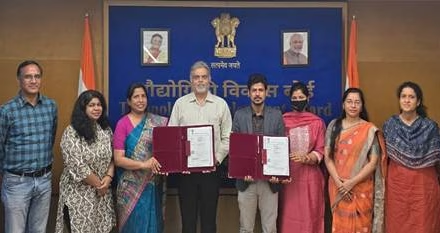
Under its International Cooperation (IC) Scheme, the Ministry of Ayush has signed:
-
27 Country-to-Country MoUs for health system cooperation.
-
16 Ayush Academic Chair MoUs to fund research and teaching roles in foreign universities.
-
57 Institute-to-Institute MoUs supporting collaborative research and academic exchange.
Furthermore, international students seeking formal education in traditional medicine systems can now access dedicated scholarships through the International Ayush Fellowship Program, fostering a new generation of globally trained practitioners.
Public Health Implications and Practical Advice
For health-conscious consumers, integrative medicine offers promising complementary options for managing chronic conditions such as osteoarthritis, stress-induced anxiety, and functional digestive disorders. Research indicates that when traditional therapies are combined with conventional medical care, patient-reported outcomes for quality of life and pain management often improve.
However, medical experts urge patients to approach medical tourism with informed caution. Integrative therapies should complement, rather than replace, essential conventional treatments for acute or life-threatening conditions.
| Considerations for Travelers | Recommended Steps for Patients |
| Facility Accreditation | Verify that the retreat or hospital holds the Ayush Quality Mark or NABH (National Accreditation Board for Hospitals & Healthcare Providers) approval. |
| Purity & Safety | Ensure all herbal formulations prescribed are certified free from heavy metals and contaminants. |
| Continuity of Care | Consult your primary physician at home before starting new herbal regimens, especially if taking blood thinners or immunosuppressants. |
Limitations and Clinical Nuance
While the initiative marks a significant step forward in health regulation, counterarguments from mainstream medical groups persist. Clinical researchers point out that while standard treatment guidelines improve consistency, large-scale, double-blind randomized controlled trials (RCTs) for many herbal formulations remain limited compared to pharmaceutical standards.
“Integrative health tourism holds genuine value, but transparency is paramount,” cautions Dr. Aris Thorne, a global health analyst. “Patients must understand what traditional medicine can and cannot achieve. It excels at lifestyle modification, stress management, and palliative support, but should never be marketed as a substitute for emergency surgical care or oncological protocols.”
As India expands its medical value travel sector, balancing centuries-old therapeutic traditions with modern evidence-based clinical science remains crucial to earning lasting international trust.
References
-
Ministry of Ayush, Government of India. (2026, July 21). Promotion of Ayush based medical tourism. Press Information Bureau (PIB), Delhi.
Medical Disclaimer: This article is for informational purposes only and should not be considered medical advice. Always consult with qualified healthcare professionals before making any health-related decisions or changes to your treatment plan. The information presented here is based on current research and expert opinions, which may evolve as new evidence emerges.