 0
0
 0
0
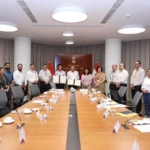
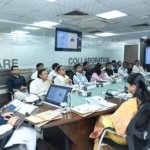
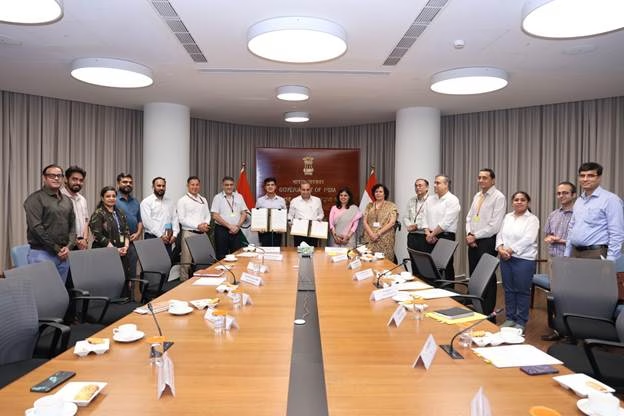
NEW DELHI — In a major move to elevate India’s elite sporting ecosystem, the Union Ministry of Health and Family Welfare and the Ministry of Youth Affairs and Sports have established a strategic healthcare partnership. On July 10, 2026, the Sports Injury Centre (SIC) at Safdarjung Hospital and the Sports Authority of India (SAI) signed a Memorandum of Understanding (MoU) in the national capital.
The agreement marks the beginning of a long-term institutional collaboration designed to provide an integrated, world-class healthcare ecosystem for Indian athletes and their support staff. By combining the tertiary clinical expertise of the SIC with SAI’s extensive national athlete network, the initiative aims to institutionalize evidence-based injury prevention, rapid diagnostics, advanced arthroscopic treatment, and tailored rehabilitation protocols to ensure athletes achieve and sustain peak physical performance on the global stage.
Establishing an Indigenous, Evidence-Based Ecosystem
For years, sports medicine practitioners in India have relied heavily on Western diagnostic benchmarks and rehabilitation protocols. However, sports scientists increasingly recognize that body composition, anthropometric profiles, and physiological adaptations can vary significantly across different populations.
During the signing ceremony, Shri Hari Ranjan Rao, Secretary of the Department of Sports, emphasized the urgent need to transition toward localized, data-driven medicine.
“Many of the existing sports medicine protocols, assessment tools, and scientific benchmarks are based on American and Western data, which may not always be suitable for Indian athletes due to differences in body composition and physiology,” Rao stated.
The partnership is mandate-driven to bridge this gap. By gathering clinical data from thousands of athletes across SAI’s national Centres of Excellence, researchers at the SIC plan to develop indigenous, evidence-based treatment and training models specifically tailored to the Indian physiology.
Key Focus Areas of the Partnership
-
Tailored Injury Prevention: Designing specialized screening protocols to identify biomechanical vulnerabilities before injuries occur.
-
Decentralized Healthcare Delivery: Linking regional SAI Centres of Excellence with local government medical colleges to ensure athletes do not have to travel to New Delhi for elite care.
-
Expanding Specialized Disciplines: Incorporating mental health, sports nutrition, and load management into traditional orthopedic care pathways.
Expanding the Medical Network: Beyond Orthopedics
The Sports Injury Centre at Safdarjung Hospital has long been recognized as India’s premier public facility for arthroscopy and sports-related musculoskeletal trauma. However, modern athletic performance requires comprehensive systemic care.
Acknowledging this complexity, Union Health Secretary Smt. Punya Salila Srivastava announced that the Ministry of Health would look beyond standard orthopedic interventions. The ministry plans to engage apex institutions like the National Institute of Mental Health and Neurosciences (NIMHANS) to address cognitive load, sports psychology, and neurological recovery.
Furthermore, Srivastava indicated plans to encourage newer All India Institutes of Medical Sciences (AIIMS) to establish dedicated sports medicine wings and expand postgraduate medical education in the discipline to overcome the current shortage of specialized sports physicians in India.
Perspective from the Field: The Clinical Implication
Independent sports medicine experts view the development as a crucial structural step forward. While elite athletes representing India internationally often have access to top-tier support, domestic developmental athletes frequently navigate fragmented medical networks when faced with sudden injuries.
“An integrated pipeline between a primary athletic body like SAI and a dedicated tertiary surgical facility like the SIC streamlines the pathway from injury to operating room to rehabilitation,” says Dr. A. K. Sharma, a Delhi-based independent orthopedic surgeon and sports rehabilitation consultant not involved in the drafting of the MoU. “The integration of sports science with clinical medicine ensures that an athlete is not just ‘healed,’ but is systematically conditioned to return to sport without high recurrence risks.”
However, medical experts also note potential hurdles. The success of decentralizing this model to regional medical colleges will heavily depend on standardizing equipment, maintaining uniform clinical compliance, and ensuring that local facilities possess the highly specific diagnostic tools required for sub-clinical athletic evaluations.
What This Means for India’s Health-Conscious Public
While the primary beneficiaries of this MoU are competitive athletes, the broader implications for the general public are significant. The development of indigenous protocols and the training of a larger pool of sports medicine specialists are expected to trickle down to community healthcare levels.
As more young adults and fitness enthusiasts engage in high-intensity recreational sports, the demand for specialized care for conditions like anterior cruciate ligament (ACL) tears, rotator cuff injuries, and stress fractures has surged. A robust national network of trained sports physicians will ultimately make advanced, evidence-based rehabilitation accessible to the everyday runner, weekend sports player, and recreational athlete across India.
References
Institutional Sources
-
Ministry of Health & Family Welfare & Ministry of Youth Affairs & Sports, Government of India. Official Press Release: Sports Injury Centre, Safdarjung Hospital and Sports Authority of India Sign MoU to Strengthen Sports Medicine and Athlete Care. Published July 10, 2026.
Medical Disclaimer: This article is for informational purposes only and should not be considered medical advice. Always consult with qualified healthcare professionals before making any health-related decisions or changes to your treatment plan. The information presented here is based on current research and expert opinions, which may evolve as new evidence emerges.