 0
0
 0
0
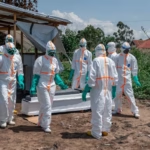
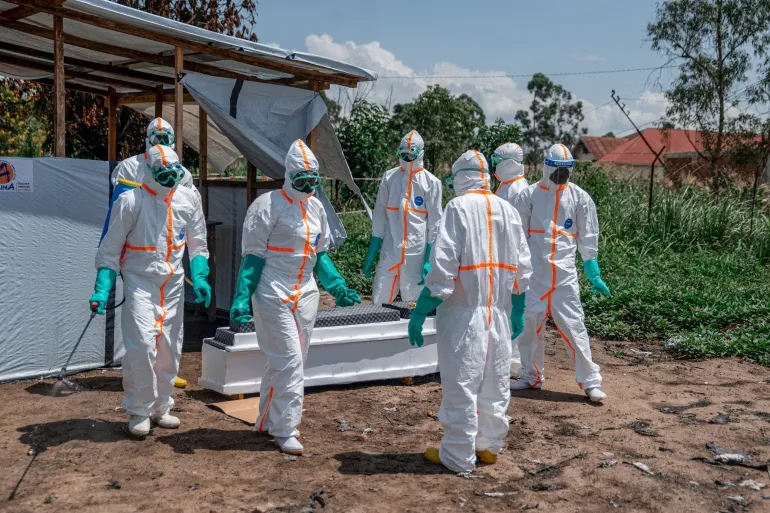
KINSHASA, DEMOCRATIC REPUBLIC OF CONGO — In a milestone moment for global health security, a randomized clinical trial evaluating experimental antiviral therapies against the rare Bundibugyo strain of Ebola has officially commenced in the Democratic Republic of Congo (DRC). The World Health Organization (WHO) confirmed early this month that the first patient has been enrolled in the study. This development marks an aggressive, evidence-backed step forward as frontline medical teams combat a rapidly intensifying regional outbreak that has already eclipsed 1,000 reported cases and claimed hundreds of lives across the wider Central African region.
Working under highly demanding fieldwork conditions with virtually zero prior data on treatment efficacy for this specific subvariant, researchers aim to compress years of traditional laboratory evaluation into weeks of real-time, actionable science. The goal is twofold: immediately improve individual survival rates and rapidly validate a medical countermeasure for future outbreaks.
Evaluating Two Antiviral Candidates in Real-Time
The randomized trial is specifically evaluating two distinct antiviral therapies to determine whether treatments successful against more common variants can neutralize the less familiar Bundibugyo strain. While the better-known Zaire strain has been the target of extensive vaccine and drug development over the last decade, therapeutic options for Bundibugyo have remained entirely theoretical until now.
Rather than deploying these therapies via emergency compassionate use without tracking metrics, the WHO and local health ministries opted for a rigorous, comparative trial design. Under outbreak conditions, physicians must balance extreme urgency with absolute scientific validity. Randomizing patients between the candidates creates a control mechanism that allows researchers to accurately measure reductions in viral load and overall survival improvements.
Understanding the Bundibugyo Knowledge Gap
Ebola virus disease is a severe, frequently fatal illness in humans, transmitted via direct contact with the blood, secretions, organs, or other bodily fluids of infected individuals or contaminated surfaces. While symptoms traditionally include high fever, acute weakness, vomiting, and diarrhea, not every infected individual develops the severe external or internal bleeding historically associated with the virus.
The virus is classified into distinct species, each requiring specialized genomic mapping for effective treatment:
-
Zaire Ebolavirus: The most common cause of large-scale outbreaks; heavily researched with approved vaccines (e.g., Ervebo) and monoclonal antibody therapies (e.g., Inmazeb, Ebanga).
-
Sudan Ebolavirus: Responsible for several East African outbreaks, notably in Uganda.
-
Bundibugyo Ebolavirus: First identified in the Bundibugyo District of Uganda in 2007. Historically associated with lower case-fatality rates than Zaire (roughly 30% to 40% compared to Zaire’s 60% to 90%), it remains highly lethal and scientifically under-researched.
Because the genetic sequence of the Bundibugyo strain differs significantly from the Zaire strain, existing monoclonal antibodies do not bind effectively to its viral proteins. This gap highlights why testing broad-spectrum antivirals is critical.
Expert Perspectives: The Ethics and Logistics of Outbreak Science
Independent public health experts view the rollout of an active clinical trial mid-outbreak as both an ethical imperative and a logistical hurdle.
“When an active pathogen is expanding through a vulnerable population and the clinical evidence base is thin, we cannot afford to wait for passive laboratory models,” said Dr. Helena Vance, an infectious disease epidemiologist at the Pan-African Health Institute, who is not involved in the trial. “The primary objective here extends beyond whether a drug merely ‘works.’ We need quantified metrics showing how quickly these antivirals lower a patient’s viral load, whether they prevent multi-organ failure, and how they perform in overburdened rural clinics lacking continuous refrigeration.”
However, international researchers urge caution regarding early expectations. Outbreak environments are notoriously volatile. Fluctuating case counts, community mistrust, transport logistics across unpaved terrain, and localized insecurity can disrupt the strict follow-up intervals required by clinical trials. An early positive signal in a small cohort may not hold up under broader statistical analysis, meaning larger follow-up studies will likely be required before either antiviral is declared a definitive global standard of care.
Public Health and Resource Implications
If either antiviral candidate demonstrates a statistically significant benefit, the clinical landscape of Ebola response will shift permanently. In regions where advanced intensive care units, mechanical ventilation, and continuous renal replacement therapies are entirely unavailable, a scalable antiviral pill or short-course injection could dramatically lower mortality.
Beyond patient care, real-time data from this trial will alter how international aid agencies allocate strained emergency resources. Proving the efficacy of an antiviral allows governments to modify triage protocols, optimize isolated field hospital designs, and shift budgets toward strategic drug stockpiling and rapid-diagnostic deployment rather than relying solely on palliative care measures.
Outbreak Impact to Date:
├── Reported Cases: 1,000+
├── Fatalities: Hundreds documented
└── Current Response Strategy: Triage, supportive fluid therapy, and active antiviral trial enrollment
Scientific Limitations and Cautions
Public health officials emphasize that this trial is an early-stage intervention. The general public must not mistake the launch of research for the availability of a proven, widespread cure.
The primary scientific limitation rests on cross-species efficacy. In virology, success against one specific viral strain does not guarantee performance against another. Even if an antiviral shows profound efficacy against Bundibugyo, the data must be rigorously parsed before health agencies issue sweeping therapeutic recommendations for other unmapped ebolavirus subvariants.
Guided Action for Readers
For the global public and health-conscious readers, this trial should be viewed as a sign of a highly coordinated, modern medical response rather than a reason for heightened alarm. The international containment architecture is working as intended, utilizing rapid field diagnostics and collaborative research to halt regional transmission.
For communities within the affected zones of the DRC and neighboring border regions, local health directives remain the primary defense mechanism against transmission. Population safety depends on early symptom reporting, utilizing safe caregiving protocols, and strictly avoiding direct contact with the bodily fluids of ill individuals or deceased relatives.
References
-
Reuters. “Trial for Bundibugyo Ebola treatment starts in DRC, WHO says.” Published July 2, 2026.
Medical Disclaimer
Medical Disclaimer: This article is for informational purposes only and should not be considered medical advice. Always consult with qualified healthcare professionals before making any health-related decisions or changes to your treatment plan. The information presented here is based on current research and expert opinions, which may evolve as new evidence emerges.