 0
0
 0
0
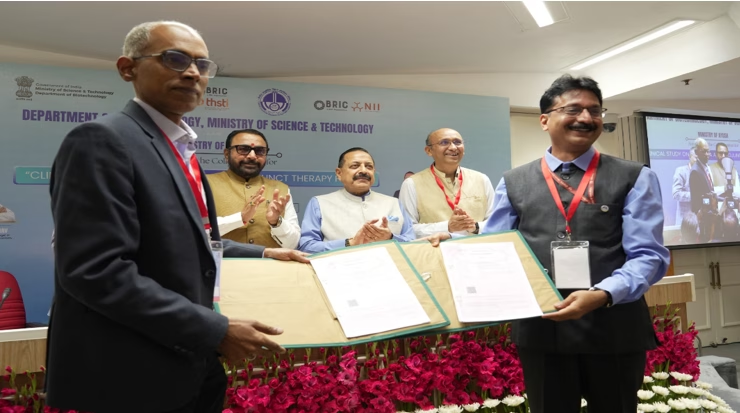
NEW DELHI — In a significant move toward integrative medicine, the Union Ministry of Ayush and the Department of Biotechnology (DBT) announced a large-scale collaborative clinical study on March 24, 2026, coinciding with World Tuberculosis Day. The study will investigate the efficacy of Ayurvedic interventions as an “adjunct therapy”—a supportive treatment used alongside standard medication—to improve recovery rates and quality of life for those battling tuberculosis (TB).
The announcement, made at Vigyan Bhawan by Dr. Jitendra Singh, Minister of State for Science and Technology, and Shri Prataprao Jadhav, Minister of State for Ayush, signals a shift in India’s public health strategy. The initiative aims to marry ancient traditional knowledge with rigorous modern clinical protocols to tackle one of the world’s most persistent infectious diseases.
The Science of Integration: What the Study Entails
Tuberculosis remains a formidable challenge in India, complicated by issues like drug resistance and patient malnutrition. While standard Anti-Tuberculosis Treatment (ATT) is highly effective at killing the Mycobacterium tuberculosis bacteria, the treatment process is often grueling. Patients frequently suffer from cachexia (severe muscle wasting and weight loss), fatigue, and reduced immunity.
The new study is designed as a multi-center clinical trial conducted at India’s premier medical institutions, including:
-
All India Institute of Medical Sciences (AIIMS)
-
Jawaharlal Institute of Postgraduate Medical Education and Research (JIPMER)
-
North Eastern Indira Gandhi Regional Institute of Health and Medical Sciences (NEIGRIHMS)
Over a 24-month period, researchers will evaluate how a specific Ayurveda regimen, combined with macronutrient supplementation, performs when administered alongside standard ATT. The primary goals are to assess safety, tolerability, and efficacy in accelerating physical recovery and strengthening the patient’s nutritional status.
Expert Perspectives: Beyond the Pathogen
Health officials emphasize that TB elimination requires more than just antibiotics; it requires a holistic restoration of the patient’s health.
“The treatment of tuberculosis is not only about eliminating the infection, but about making the patient completely healthy,” stated Shri Prataprao Jadhav during the launch. He noted that Ayurveda could play a pivotal role in improving “recovery, nutrition, and the quality of life.”
Dr. Rajesh S. Gokhale, Secretary of the DBT, underscored the importance of evidence-based validation. “By combining modern science with Ayurveda, we aim to improve patient outcomes… and accelerate India’s mission to eliminate TB,” Gokhale said.
Independent experts in the field of infectious disease, while not directly involved in the study, suggest that focusing on the “host” (the patient) rather than just the “pathogen” (the bacteria) is a modern necessity. “Standard TB drugs are heavy on the liver and the digestive system,” says Dr. Arvinder Singh, a consultant in pulmonary medicine. “If an adjunct therapy can mitigate side effects and boost the body’s natural resilience without interfering with the antibiotics, it could significantly improve treatment adherence.”
Addressing TB-Associated Cachexia
A primary focus of this research is TB-associated cachexia. In many patients, the metabolic stress of the infection leads to a “wasting” syndrome where the body consumes its own muscle and fat stores.
Why Nutrition Matters in TB:
-
Immune Function: Malnourished patients have weakened immune systems, making it harder for the body to assist the medication in clearing the infection.
-
Drug Metabolism: Proper protein and fat levels are necessary for the body to process and absorb standard TB medications effectively.
-
Recovery Speed: Patients who maintain or gain weight during treatment have a lower risk of relapse.
The study will utilize the Central Council for Research in Ayurvedic Sciences (CCRAS) protocols to provide standardized Ayurvedic formulations intended to stimulate appetite and improve metabolic assimilation.
Balancing Innovation with Rigor
While the integration of traditional medicine into public health is a cornerstone of the current administration’s “Viksit Bharat” vision, the scientific community maintains a cautious but optimistic watch.
One of the primary challenges in integrative studies is ensuring there are no herb-drug interactions. Certain botanical compounds can induce or inhibit enzymes in the liver (such as the Cytochrome P450 family), which might alter the concentration of standard TB drugs like Rifampicin or Isoniazid in the bloodstream.
To address this, the study has been designed with high-level scientific oversight from the BRIC-National Institute of Immunology (NII) and the Translational Health Science and Technology Institute (THSTI). This ensures that the Ayurvedic components are tested with the same level of scrutiny as any new pharmaceutical agent.
Implications for Public Health
For the average citizen, this study represents a step toward “patient-centric” care. If successful, the results could lead to a standardized, dual-pathway treatment protocol across India’s Revised National TB Control Program (RNTCP).
“India is moving in the right direction,” said Dr. Jitendra Singh. “The launch of this study reflects our commitment to science-led, evidence-based innovation.”
By 2028, when the results of this 24-month study are expected to be finalized, India may have a robust, homegrown blueprint for treating TB—one that treats the disease with modern chemistry and the patient with traditional wisdom.
Medical Disclaimer
This article is for informational purposes only and should not be considered medical advice. Always consult with qualified healthcare professionals before making any health-related decisions or changes to your treatment plan. The information presented here is based on current research and expert opinions, which may evolve as new evidence emerges.
References and Sources
Official Government Releases:
-
Press Information Bureau (PIB). “Ministry of Ayush and DBT Announce Collaborative Clinical Study on Ayurveda as Adjunct Therapy for Anti-Tuberculosis Treatment.” Posted 24 March 2026. [PIB Delhi].