 0
0
 0
0
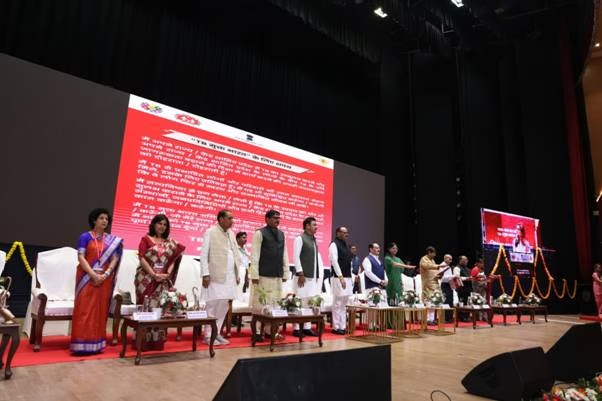
GREATER NOIDA, UP – In a landmark event marking World TB Day 2026, Union Minister for Health and Family Welfare, Shri Jagat Prakash Nadda, announced that India has significantly outperformed global trends in the fight against tuberculosis (TB). Speaking from Greater Noida, the Minister revealed a 21% decline in TB incidence and a 25% reduction in mortality over the last decade, reinforcing the government’s ambitious goal to eliminate the disease ahead of the United Nations’ Sustainable Development Goals (SDG) target of 2030.
The national launch served as a platform for the unveiling of the Intensified 100-Day TB Mukt Bharat Campaign, an aggressive micro-planned initiative targeting 1.58 lakh villages and urban wards. Accompanied by the launch of an AI-enabled chatbot named ‘Khushi,’ the event signaled a shift toward high-tech, community-led interventions designed to find and treat the “hidden” burden of the disease.
A Decadel Progress: By the Numbers
The latest data presented by the Ministry of Health paints a picture of a rapidly strengthening public health infrastructure. While TB remains a formidable global challenge, India’s domestic efforts have yielded substantial gains:
-
Incidence & Mortality: A 21% drop in new cases and a 25% drop in deaths since 2016.
-
Treatment Coverage: Now stands at 92%, a critical metric for breaking the chain of transmission.
-
Case Finding: Undetected TB cases have plummeted from over 10 lakh annually to fewer than one lakh.
-
Funding: Government investment has seen a ten-fold increase, rising from ₹640 crore in 2015-16 to ₹6,356 crore for the 2025-26 period.
“TB elimination has transitioned from a ‘whole-of-government’ approach to a ‘whole-of-society’ movement,” Shri Nadda stated during his keynote address. He emphasized Jan Bhagidari (people’s participation) as the engine behind these statistics, noting that over 7.16 lakh Ni-kshay Mitras—individual citizens and organizations—are currently providing nutritional and vocational support to patients.
The “Asymptomatic” Breakthrough
One of the most significant revelations from the 2026 report is the success of symptom-agnostic screening. Historically, TB programs focused on individuals with a persistent cough or fever. However, research suggests that a large portion of the infectious pool does not exhibit classic symptoms.
Under the TB Mukt Bharat Abhiyaan, health workers screened over 20 crore vulnerable individuals, detecting 32.65 lakh cases. Remarkably, 10.9 lakh of these patients were asymptomatic.
“Identifying the ‘invisible’ pool of infection is a game-changer,” says Dr. Arvinder Singh, a public health consultant not affiliated with the ministry. “By finding patients before they feel sick, we aren’t just saving the individual; we are preventing months of community transmission that occurs when someone doesn’t know they are a carrier.”
AI and Innovation: The New Frontier
To bridge the gap between rural populations and specialized care, the government launched the TB Mukt Bharat App featuring ‘Khushi,’ an AI-powered multilingual chatbot. Designed to run on entry-level smartphones, Khushi provides real-time guidance on symptoms, helps users locate the nearest of the 9,800+ NAAT (Nucleic Acid Amplification Test) laboratories, and explains government entitlements.
Technological leadership was also attributed to the Indian Council of Medical Research (ICMR). The Minister lauded the TrueNat molecular diagnostic platform—an Indian innovation—which allows for rapid TB testing in remote areas and has since been endorsed by the World Health Organization (WHO) for global use.
Shorter Treatments, Higher Compliance
The transition to the BPaLM regimen (Bedaquiline, Pretomanid, Linezolid, and Moxifloxacin) for drug-resistant TB has revolutionized patient experience. Traditionally, drug-resistant TB required up to 20 months of painful injections and heavy medication. The new regimen reduces this to just six months of oral tablets.
“The shorter duration is the single biggest factor in improving treatment adherence,” explains Smt. Anupriya Patel, Minister of State for Health and Family Welfare. “When a patient feels better in a few weeks, they are tempted to stop. A six-month window makes completion much more achievable.”
Public Health Implications and Challenges
Despite the optimism, experts warn that the final mile of elimination is often the hardest. Challenges include:
-
Urban Density: While 67,933 Gram Panchayats (village councils) have been declared TB-free, the new TB-Free Urban Ward Initiative must now tackle the complexities of overcrowded city slums and migrant populations.
-
Stigma: Fear of social isolation continues to prevent early testing in many communities.
-
Nutrition: TB is intrinsically linked to undernutrition. While the Nikshay Poshan Yojana has distributed over ₹4,590 crore in nutritional support since 2018, ensuring food security for the most vulnerable remains a massive logistical undertaking.
What This Means for You
For the general public, the message from World TB Day 2026 is clear: TB is preventable and curable.
-
Early Testing: If you are in a high-risk group or have been in contact with a TB patient, utilize the TB Mukt Bharat App to find a screening center, even if you feel healthy.
-
Support Systems: The Ni-kshay Mitra program allows any citizen to register and support a patient’s recovery, emphasizing that medical treatment is only half the battle.
-
Completion of Care: With newer, shorter drug regimens available at Ayushman Arogya Mandirs (Health and Wellness Centers), finishing the course of medicine is easier than ever.
As India enters the intensified 100-day blitz, the focus moves from national policy to local precision—ensuring that the goal of a TB-free India becomes a reality village by village, and ward by ward.
References
-
Ministry of Health and Family Welfare (MoHFW): Press Information Bureau (PIB) Release, March 24, 2026.
Medical Disclaimer: This article is for informational purposes only and should not be considered medical advice. Always consult with qualified healthcare professionals before making any health-related decisions or changes to your treatment plan. The information presented here is based on current research and expert opinions, which may evolve as new evidence emerges.