 0
0
 0
0
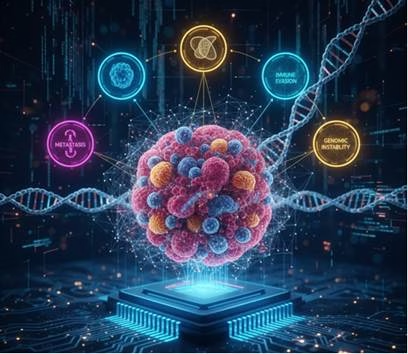
NEW DELHI — In a landmark push to modernize oncology and address the growing burden of non-communicable diseases, the Government of India has unveiled a multi-tiered technological framework designed to integrate Artificial Intelligence (AI) into the nation’s cancer screening and diagnostic infrastructure. Anchored by the newly launched Cancer AI & Technology Challenge (CATCH) grant program and supported by ethical AI guidelines, the initiative seeks to bridge the gap between high-tech innovation and rural healthcare delivery.
Announced on March 24, 2026, by the Ministry of Electronics and Information Technology (MeitY) and the Ministry of Health and Family Welfare, the strategy represents a pivot toward “precision public health.” By leveraging AI to assist in the early detection of oral, breast, and cervical cancers—the three most prevalent malignancies in India—health officials aim to improve survival rates that are often hindered by late-stage diagnoses.
The CATCH Program: Funding the Future of Diagnostics
At the heart of this technological surge is the CATCH Grant Program. Developed under the India AI Mission in partnership with the National Cancer Grid (NCG), the program is designed to move AI tools out of the laboratory and into the clinic.
The program offers milestone-based funding to collaborative teams of clinicians and tech developers. Selected projects can receive up to ₹50 lakh for initial pilot testing and validation, with a provision for an additional ₹1 crore to scale up solutions that demonstrate clinical readiness.
“AI is not a replacement for the oncologist, but it is becoming an indispensable ‘second pair of eyes,'” says Dr. Arvinder Singh, a health technology researcher not involved in the government program. “In a country where the patient-to-doctor ratio is skewed, AI-enabled screening can help frontline workers flag high-risk cases earlier than traditional methods might allow.”
SAHI and BODH: Creating an Ethical Safety Net
A significant hurdle in medical AI has always been data privacy and clinical accuracy. To address this, the Ministry of Health launched the Strategy for AI in Healthcare in India (SAHI) and the Benchmarking Open Data Platform for Health AI (BODH).
-
SAHI: This framework provides national guidance on the ethical and inclusive adoption of AI. It ensures that algorithms are trained on diverse datasets to prevent bias—a critical factor in a genetically and demographically diverse population like India’s.
-
BODH: Developed in collaboration with the Indian Institute of Technology (IIT) Kanpur, this platform acts as a “testing ground.” Before an AI tool is deployed to millions of citizens, it must be benchmarked against high-quality, standardized data to prove its reliability.
These initiatives are integrated into the Ayushman Bharat Digital Mission (ABDM), which provides a “sandbox” environment. This allows developers to test how their AI screening tools interact with existing digital health records without risking patient safety.
From Apps to Outcomes: The National NCD Portal
While high-level grants capture headlines, the practical application happens at the grassroots level through the National NCD Portal. This digital backbone supports the National Programme for Prevention and Control of Non-Communicable Diseases (NPNCD).
The portal enables Accredited Social Health Activists (ASHA) and Auxiliary Nurse Midwives (ANM) to use mobile applications for:
-
Population Enumeration: Identifying individuals in specific age brackets.
-
Risk Assessment: Tracking lifestyle factors that increase cancer risk.
-
Digital Referrals: Seamlessly moving a patient from a Primary Health Centre (PHC) to a District Hospital using their ABHA (Ayushman Bharat Health Account) ID.
By linking screening data to a standardized electronic health record, the system ensures that a patient who tests positive during a rural screening camp does not “fall through the cracks” of the referral system.
Statistical Context: A Growing Investment
The government’s commitment is reflected in the steady rise of financial approvals for the NP-NCD program. According to data provided by Shri Prataprao Jadhav, Union Minister of State for Health and Family Welfare, funding has seen a significant upward trend over the last five years:
| Fiscal Year | SPIP Approvals (₹ in Lakhs) |
| 2021–22 | 60,659.39 |
| 2022–23 | 1,18,470.27 |
| 2023–24 | 1,16,823.45 |
| 2024–25 | 1,51,052.88 |
| 2025–26 | 1,30,288.67 |
Despite a slight stabilization in the most recent fiscal year, the overall trajectory shows a nearly 115% increase in approved funding since 2021, signaling a long-term shift toward digitized NCD management.
Challenges and the “Human Factor”
Despite the optimism, experts urge caution regarding the “black box” nature of some AI algorithms. A primary concern is overdiagnosis—where AI might flag abnormalities that are not clinically significant, leading to unnecessary biopsies and patient anxiety.
Furthermore, the “care continuum” remains dependent on physical infrastructure. An AI tool can identify a potential tumor in seconds, but the patient still requires a human surgeon, oncologist, and chemotherapy facilities to complete treatment.
“Technology can solve the screening bottleneck,” notes Dr. Meera Deshpande, a public health consultant. “But we must ensure that our surgical and radiotherapy capacities grow at the same rate as our detection capabilities. A diagnosis without a clear path to treatment is a half-victory.”
What This Means for the Public
For the average citizen, these developments suggest that cancer screening will soon become more accessible and standardized.
-
Early Detection: AI tools used in cervical cancer screening (via visual inspection) or oral cancer (via smartphone images) can identify precancerous lesions that might be missed by the naked eye.
-
Data Portability: With the ABHA integration, your screening history travels with you, reducing the need for repeated tests at different hospitals.
-
Cost-Effectiveness: Over time, automated screening is expected to lower the cost of mass diagnostic programs, making regular check-ups more affordable for the uninsured.
As India moves toward an AI-integrated healthcare model, the focus remains on ensuring these tools are as equitable as they are innovative. The CATCH program and the SAHI guidelines serve as a blueprint for how a nation can embrace the future of medicine while guarding the ethical principles of patient care.
References
-
Ministry of Health and Family Welfare (MoHFW): Strategy for AI in Healthcare in India (SAHI), Published February 2026.
-
Press Information Bureau (PIB) Delhi: Cancer AI & Technology Challenge (CATCH) Grant Program Unveiled, Posted March 24, 2026. [Reference No: 2026/PIB/CATCH/01].
Medical Disclaimer: This article is for informational purposes only and should not be considered medical advice. Always consult with qualified healthcare professionals before making any health-related decisions or changes to your treatment plan. The information presented here is based on current research and expert opinions, which may evolve as new evidence emerges.